
Current Time in Argentina Time (ART)
Argentina Time (ART) is 3 hours behind Coordinated Universal Time (UTC-03:00). It serves as the unified standard time zone for the entire country of Argentina.
Current Argentina Time (ART) Time
Date: ... · Your Local Time: ...
Argentina Time Geographical Coverage
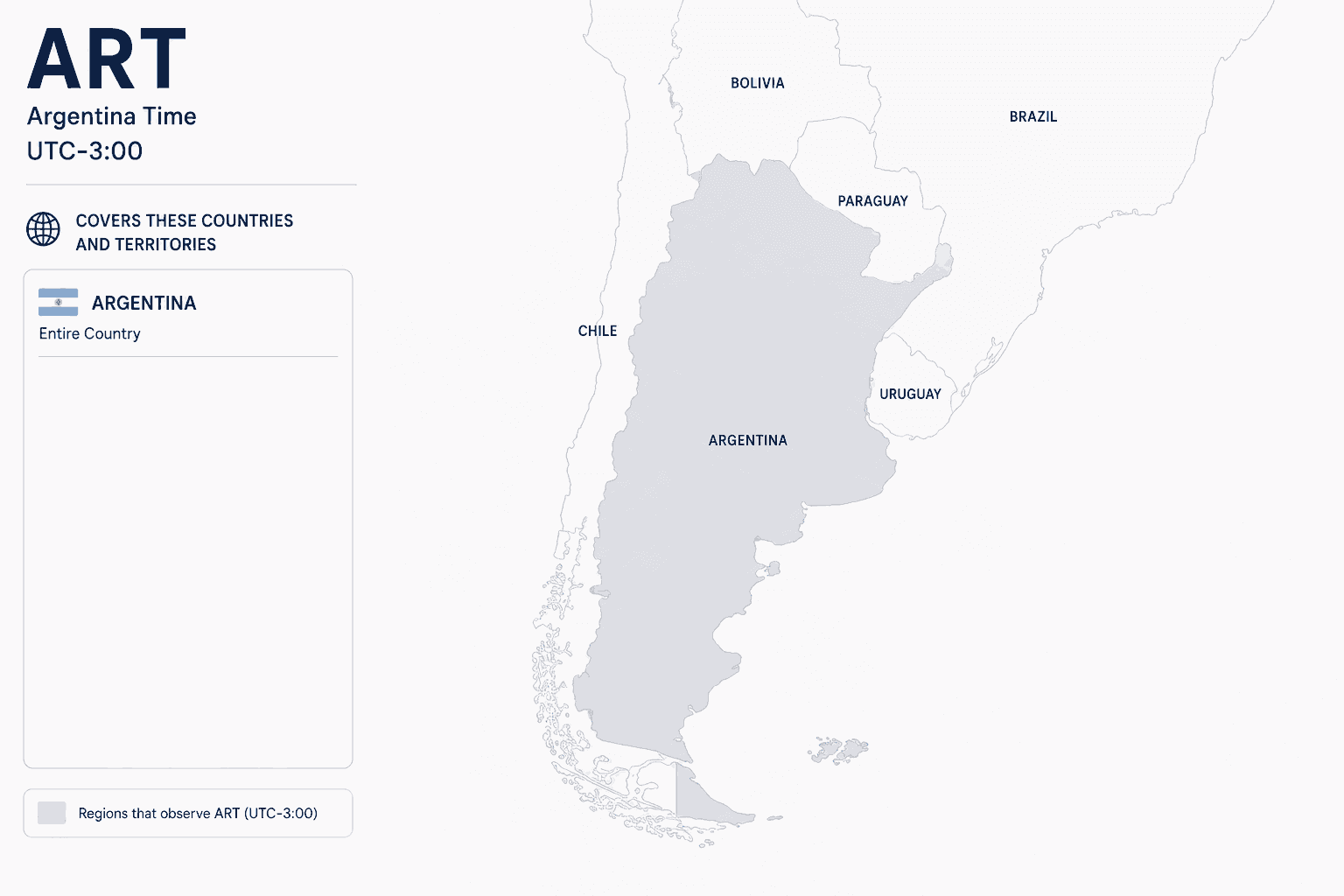
The map below highlights the specific regions, countries, and territories that observe the Argentina Time time zone.
Understanding Argentina Time (ART)
Argentina Time (ART) sits at UTC-03:00, placing Buenos Aires 3 hours behind Coordinated Universal Time and in a uniquely advantageous position relative to global business hubs. Argentina is South America's second-largest economy, built on the world's fourth-largest soybean export complex, significant wheat and beef trade, and the world's second-largest known lithium reserves — a resource whose strategic importance is accelerating alongside global battery demand. Alongside these commodity sectors, Buenos Aires has become a genuine technology hub: companies like MercadoLibre and Globant were founded here, and the city now anchors a thriving nearshore software and IT outsourcing industry serving North American clients across a time offset that, at its closest, is zero hours apart.
Countries and Territories Observing ART
Argentina is the sole country on ART. Unlike many large nations that split across multiple time zones, Argentina applies a single, nationwide standard with no provincial exceptions.
- ✦National Unification: Every Argentine province — from Patagonia in the south to Jujuy in the northwest — runs on the same UTC-03:00 clock. This uniformity eliminates domestic scheduling overhead for businesses operating across the country's 23 provinces, simplifies logistics coordination between agricultural inland regions and port cities, and ensures that Buenos Aires financial markets open and close on the same bell for every Argentine counterparty.
- ✦Regional Alignment (UTC-3): ART shares its UTC-03:00 offset with Brasilia Time (BRT), which governs Brazil's most populous and economically active states — São Paulo, Rio de Janeiro, and Brasília — as well as Uruguay Time (UYT). In practice, this creates a synchronized South American economic corridor where Argentina, Brazil, and Uruguay operate on an identical clock, streamlining cross-border commodity trading, financial settlements, and regional supply chain logistics across the continent's southern cone.
Daylight Saving Time (DST) Rules
Argentina abolished Daylight Saving Time in 2009, ending a long period of inconsistent observance during which the country repeatedly suspended and reinstated DST depending on energy policy. Since 2009, ART has been locked permanently at UTC-03:00. For the industries that anchor the Argentine economy, this stability is an operational asset: commodity exporters coordinating grain shipments on international markets, lithium mining operations feeding global battery supply chains, and software development firms delivering against North American sprint cycles all depend on a clock that does not shift twice a year.
| Major Regional Cities (UTC-3) | Country | DST Observed? |
|---|---|---|
| Buenos Aires | Argentina | No |
| Córdoba | Argentina | No |
| Mendoza | Argentina | No |
| São Paulo | Brazil | No |
Global Business Guide
ART's UTC-03:00 position is one of the most commercially favorable offsets in the Southern Hemisphere, particularly for businesses connecting South America with North America and Europe.
Americas — the nearshore advantage: ART's relationship with US time zones is the defining feature of Argentina's tech outsourcing economy. During US Eastern Standard Time (EST, UTC-5), ART runs just 2 hours ahead — close enough that Buenos Aires developers and New York clients share a full common workday with no early-morning or late-evening concessions required. During US Eastern Daylight Time (EDT, UTC-4), the gap narrows to just 1 hour, making ART and EDT effectively co-located for scheduling purposes. This near-alignment is why Argentina has become a default nearshoring destination for US technology companies seeking skilled engineers without the timezone friction of Asian outsourcing.
Europe: ART's morning directly overlaps with the European business afternoon. At 09:00–12:00 ART, London is at 12:00–15:00 GMT and Frankfurt is at 13:00–16:00 CET. This creates a productive mid-day window for commodity traders, financial partners, and European companies with Argentine operations — long enough for substantive calls without requiring either party to stretch outside core hours.
Asia-Pacific: The hardest scheduling corridor. Tokyo (JST, UTC+9) is 12 hours ahead of ART; Sydney (AEDT, UTC+11) reaches 14 hours during Australian summer. There is no natural business-hour overlap between ART and the major Asia-Pacific financial centers. Coordination with these markets requires one party to work early mornings or late evenings, or relies entirely on asynchronous communication and structured handoff workflows.
Frequently Asked Questions
Does Argentina observe Daylight Saving Time?
Argentina permanently abolished Daylight Saving Time in 2009 after years of inconsistent observance. Since then, ART has remained fixed at UTC-03:00 every day of the year, with no seasonal clock changes of any kind.
Are Argentina Time (ART) and Brasilia Time (BRT) the same?
ART and BRT are distinct, separately designated time zones, but they currently share the exact same UTC-03:00 offset. Because neither Argentina nor Brazil's southeastern states currently observe DST, the two zones remain perfectly aligned year-round — though that alignment could change if either country's DST policy shifts.
Need to schedule a meeting?
Use our dedicated converter pages to find the perfect overlap time across different time zones.