
Current Time in Atlantic Standard Time (AST)
Atlantic Standard Time (AST) is 4 hours behind Coordinated Universal Time (UTC-04:00). It covers Eastern Canada and the vast majority of the Caribbean.
Current Atlantic Standard Time (AST) Time
Date: ... · Your Local Time: ...
Important Note: Atlantic Standard Time has a fixed standard offset of -04:00. However, because this location observes Daylight Saving Time, the live clock above may currently reflect a different daylight offset.
Abbreviation Ambiguity: The abbreviation AST is used by multiple time zones around the world. On this page, it specifically refers to Atlantic Standard Time (-04:00).
Atlantic Standard Time Geographical Coverage
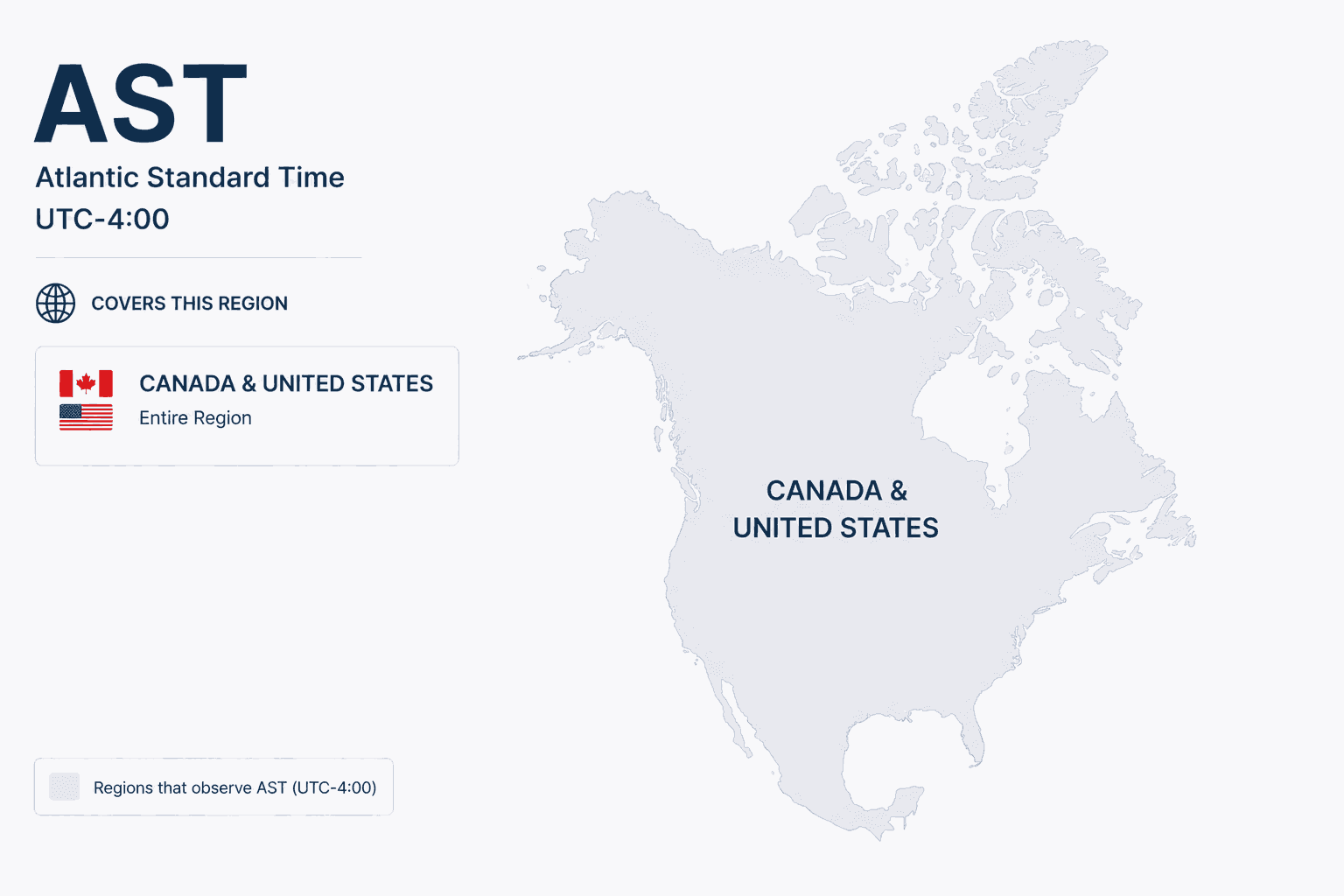
The map below highlights the specific regions, countries, and territories that observe the Atlantic Standard Time time zone.
Understanding Atlantic Standard Time (AST)
Atlantic Standard Time (AST) operates at UTC-4:00, bridging the eastern edge of the North American continent with the island economies of the Caribbean basin. Halifax anchors the zone's Canadian flank as the commercial and financial center of Atlantic Canada, processing significant Atlantic maritime shipping and serving as the gateway port for container traffic connecting North America's northeast seaboard to transatlantic routes. South of the Canadian border, San Juan in Puerto Rico functions as the Caribbean's primary financial hub — home to US federal banking oversight, a substantial pharmaceutical manufacturing sector, and a tourism economy that draws visitors across multiple continents. Santo Domingo, Port of Spain, and Hamilton (Bermuda) add offshore finance, energy logistics, and reinsurance weight to a time zone that is compact geographically but economically diverse. During Daylight Saving Time, Canadian and Bermudan regions advance to Atlantic Daylight Time (ADT) at UTC-3:00, while the Caribbean holds its position at UTC-4:00 year-round.
Countries and Territories Observing AST
AST spans three distinct geographic clusters across a north-to-south arc of roughly 5,000 kilometres, each with different DST behavior.
- ✦Canada: Nova Scotia (Halifax), New Brunswick (Fredericton, Moncton, Saint John), Prince Edward Island (Charlottetown), and the Labrador portion of Newfoundland and Labrador all observe AST as their standard offset and advance to ADT during summer. These Maritime provinces form the economic heartland of Atlantic Canada — fisheries, ocean shipping, and a growing ocean technology sector concentrated around Halifax's Dalhousie University research cluster.
- ✦Caribbean & Atlantic: Puerto Rico, the Dominican Republic, the US Virgin Islands, the British Virgin Islands, Antigua and Barbuda, Barbados, and Trinidad and Tobago all observe UTC-4 permanently without DST. Bermuda shares the AST offset in winter but, unlike its Caribbean neighbors, does observe DST and advances to ADT each summer alongside Nova Scotia. The net effect: Hamilton and Halifax share the same clock in winter and again in summer, but through different mechanisms — both on AST in winter, both on ADT in summer.
- ✦South America: Guyana operates at UTC-4 year-round with no DST, aligning it permanently with the Caribbean portion of AST. Parts of the Brazilian state of Amazonas also use UTC-4, though Brazil's DST policy has varied in recent years and the current standard for Amazonas is a fixed UTC-4 without seasonal adjustment.
Daylight Saving Time (DST) Rules
AST's most important scheduling characteristic is its north-to-south DST split. Canadian Maritime provinces and Bermuda advance to ADT (UTC-3:00) on the second Sunday in March and return to AST (UTC-4:00) on the first Sunday in November — following the same federal schedule as the rest of the US and Canada. In 2026, that means ADT begins on March 8 and ends on November 1.
The Caribbean and South American territories observing UTC-4 make no clock adjustment at any point in the year. The practical consequence is direct: during the ADT window from March through November, Halifax runs one hour ahead of San Juan. A 10:00 AST conference call that works for both cities in January becomes a 10:00 ADT Halifax call that reaches San Juan at 09:00 AST — a one-hour gap that persists for eight months of the year. Teams managing regular Halifax–Caribbean scheduling need standing calendar rules that account for this asymmetry each spring and autumn.
| Major Cities | Country/Territory | DST Observed? |
|---|---|---|
| Halifax | Canada | Yes |
| Hamilton | Bermuda | Yes |
| San Juan | Puerto Rico (US) | No |
| Santo Domingo | Dominican Republic | No |
| Port of Spain | Trinidad and Tobago | No |
| Georgetown | Guyana | No |
Global Business Guide
US East Coast: New York (EST, UTC-5) is 1 hour behind AST in winter — the tightest gap between AST and any US time zone. A 09:00 AST Halifax start corresponds to 08:00 EST, meaning Halifax business hours open one hour before New York. During ADT season, Halifax advances to UTC-3 while New York moves to EDT (UTC-4), maintaining the same 1-hour lead. For Caribbean AST cities like San Juan, the gap to New York is the same 1 hour in winter, but narrows to zero during summer when San Juan stays on AST (UTC-4) and New York advances to EDT (also UTC-4) — placing Puerto Rico and New York on identical clocks from March through November.
Europe: London (GMT, UTC+0) is 4 hours ahead of AST in winter and 3 hours ahead of ADT in summer. A 13:00–17:00 AST Halifax afternoon corresponds to 17:00–21:00 GMT — overlap exists only at the very end of the London workday. Frankfurt (CET, UTC+1) is 5 hours ahead of AST, making the window even narrower. The most productive Halifax–Europe overlap is a 12:00–13:00 AST window, reaching London at 16:00–17:00 GMT in the final hour before European close. For Caribbean AST cities, which never observe ADT, the gap to London remains fixed at 4 hours year-round.
Asia: Tokyo (JST, UTC+9) is 13 hours ahead of AST — no business-hours overlap exists in standard windows. Singapore (SGT, UTC+8) is 12 hours ahead. For AST-based teams with regular Asia-Pacific responsibilities, early-morning AST starts (07:00 AST = 19:00 SGT) or end-of-APAC-day calls are the only live options, with asynchronous workflows covering routine daily coordination.
Frequently Asked Questions
Does the Caribbean observe Daylight Saving Time?
The vast majority of Caribbean nations and territories — including Puerto Rico, the Dominican Republic, the US Virgin Islands, Trinidad and Tobago, and Barbados — do not observe Daylight Saving Time and remain on AST (UTC-4) year-round. This means these territories share the same clock as Halifax only during the Atlantic Standard Time window in winter, diverging by one hour once Canada and Bermuda advance to ADT each spring.
What is the difference between AST and ADT?
AST (Atlantic Standard Time) is the standard winter offset at UTC-4:00, observed from the first Sunday in November through the second Sunday in March across all AST regions. ADT (Atlantic Daylight Time) is the summer offset at UTC-3:00, applied by Eastern Canadian provinces and Bermuda when they advance their clocks by one hour during Daylight Saving Time.
Need to schedule a meeting?
Use our dedicated converter pages to find the perfect overlap time across different time zones.