
Current Time in Brasília Time (BRT)
Brasília Time (BRT) operates at UTC-03:00 year-round and serves as Brazil's official national time, covering the country's economic and political heartland. Since Brazil abolished Daylight Saving Time in 2019, BRT never shifts — making it one of the most scheduling-stable major time zones in the Western Hemisphere.
Current Brasília Time (BRT) Time
Date: ... · Your Local Time: ...
Brasília Time Geographical Coverage
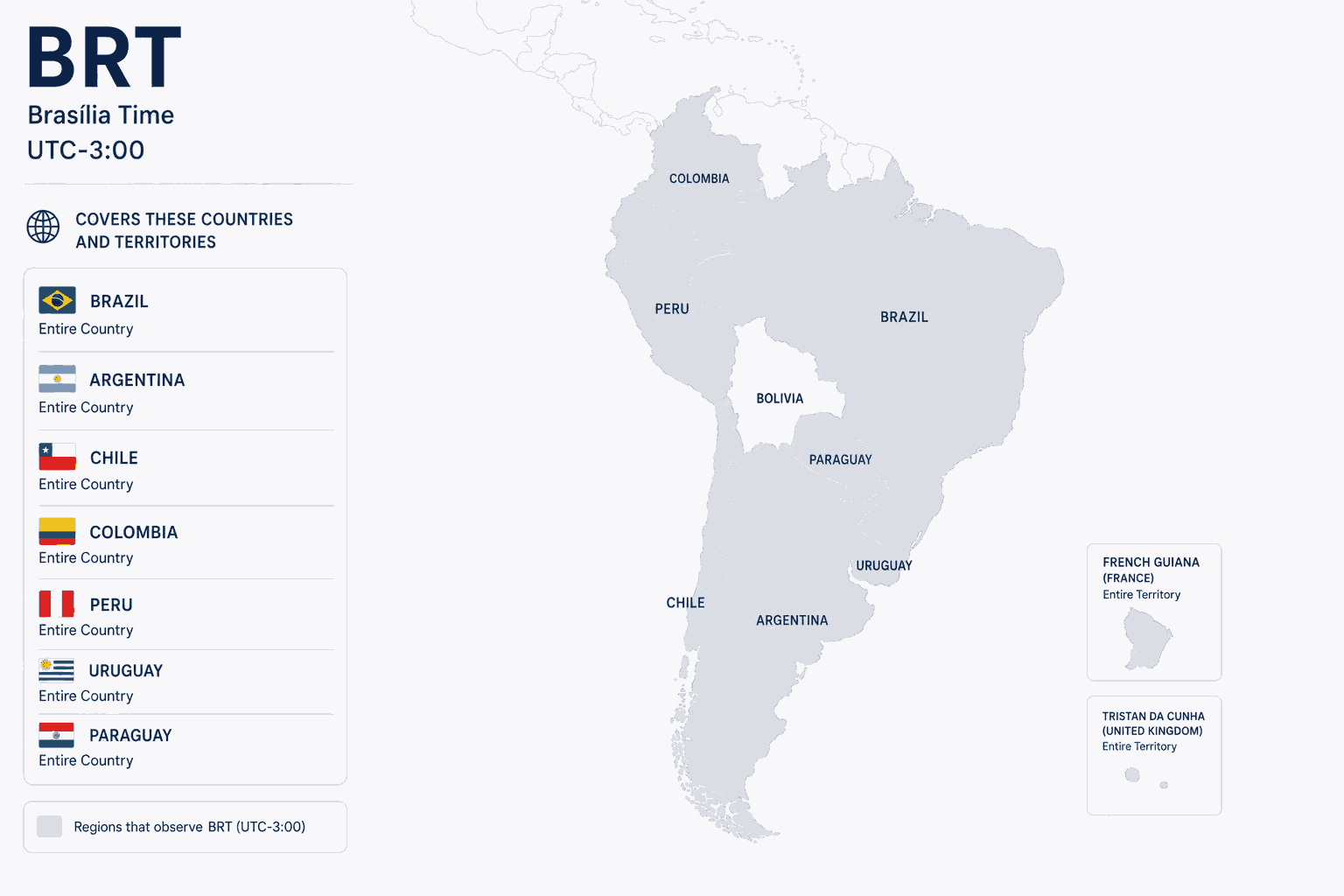
The map below highlights the specific regions, countries, and territories that observe the Brasília Time time zone.
Understanding Brasília Time (BRT)
Brasília Time (BRT) operates at UTC-3:00 on a permanent, year-round basis — no Daylight Saving Time, no seasonal adjustment, no clock changes. The B3 (Brasil Bolsa Balcão) in São Paulo is the largest stock exchange in Latin America by market capitalization, opening at 10:00 BRT each weekday and processing equity, derivatives, and fixed income volume that makes São Paulo the undisputed financial capital of the Southern Hemisphere. Vale, the world's largest iron ore producer, coordinates global shipping logistics from Rio de Janeiro on BRT. Embraer, the world's third-largest commercial aircraft manufacturer by deliveries, runs its production and delivery operations from São José dos Campos on the same clock. Petrobras manages one of the world's largest offshore oil portfolios from Rio de Janeiro against BRT schedules. For any enterprise with South American operations, BRT is not a peripheral reference — it is the primary scheduling anchor for the region's dominant economy.
Countries and Territories Observing BRT
BRT covers the majority of Brazil and functionally unifies a substantial portion of the South American continent on a single UTC-3 reference.
- ✦Brazil (The Core): Brazil operates across four time zones internally — BRT (UTC-3), AMT (UTC-4), ACT (UTC-5), and the Fernando de Noronha archipelago at UTC-2. However, BRT covers the Southeast (São Paulo, Rio de Janeiro, Minas Gerais, Espírito Santo), the South (Paraná, Santa Catarina, Rio Grande do Sul), the Northeast (Bahia, Ceará, Pernambuco, and others), and the Federal District (Brasília). This encompasses well over 90% of Brazil's population and the vast majority of its GDP, making BRT the functional national clock even though it is not applied universally across all territory.
- ✦South American Alignment (UTC-3): Argentina (ART) and Uruguay (UYT) both operate on a permanent UTC-3:00 offset without DST, placing Buenos Aires, Montevideo, and São Paulo on identical clocks year-round. Together, Brazil, Argentina, and Uruguay represent the Mercosur economic bloc's three largest founding members. Their temporal alignment means that cross-border B2B scheduling, securities settlement between B3 and BYMA (Buenos Aires), and agricultural commodity trade coordination across the Southern Cone all operate without any time zone conversion requirement.
Daylight Saving Time (DST) Rules
Brazil abolished Daylight Saving Time by presidential decree in April 2019, citing studies indicating the energy savings originally justifying DST had become negligible with modern LED lighting and changed consumption patterns. Prior to 2019, southeastern Brazilian states had observed DST since 1985, advancing clocks by one hour each October and reverting each February. Since abolition, BRT has remained fixed at UTC-3:00 without interruption.
The operational consequence is significant for global partners. Before 2019, a São Paulo-based team's offset relative to New York, London, or Frankfurt would shift by one hour twice annually — often on a Southern Hemisphere schedule that ran out of sync with Northern Hemisphere DST transitions, creating temporary three-way misalignments between the US, Europe, and Brazil simultaneously. That complexity is now permanently resolved. BRT is static, and any offset change between Brazil and a DST-observing partner country is entirely attributable to the partner's clock change, never Brazil's.
| Major Cities (UTC-3) | Country | DST Observed? |
|---|---|---|
| São Paulo | Brazil | No |
| Rio de Janeiro | Brazil | No |
| Brasília | Brazil | No |
| Belo Horizonte | Brazil | No |
| Buenos Aires | Argentina | No |
| Montevideo | Uruguay | No |
Global Business Guide
US East Coast — the closest major partner: New York (EDT, UTC-4) is just 1 hour behind BRT during the Northern Hemisphere summer, and 2 hours behind (EST, UTC-5) during winter. This makes the US East Coast–Brazil corridor the tightest major international scheduling gap in the Americas. A 09:00 BRT São Paulo start corresponds to 08:00 EDT in New York in summer — within the opening of the US business day. The B3 opens at 10:00 BRT (09:00 EDT / 08:00 EST), placing the São Paulo and New York trading sessions in near-complete daily overlap. For the eight months when New York is on EDT, BRT and EDT differ by only 1 hour — the most favorable scheduling alignment Brazil has with any major global financial center. When New York falls back to EST in November, the gap widens to 2 hours, but the overlap remains functionally complete across the full US East Coast business day.
Europe: London (GMT, UTC+0) is 3 hours ahead of BRT in winter and 4 hours ahead during BST. A 09:00 BRT São Paulo start corresponds to 12:00 GMT in winter — London's midday. Frankfurt (CET, UTC+1) is 4 hours ahead of BRT in winter: São Paulo's 09:00 reaches Frankfurt at 13:00 CET, mid-afternoon. This places the BRT morning squarely within the European working afternoon, creating a viable 3–4 hour live overlap window each day. During European summer (CEST, UTC+2), Frankfurt is 5 hours ahead of BRT, narrowing the overlap to BRT's 09:00–12:00 window reaching Europe at 14:00–17:00 CEST — still workable but tighter. The BRT–Europe overlap is one of the more functional transatlantic scheduling relationships among non-US time zones, and São Paulo's emergence as a hub for European multinational regional headquarters reflects this practical alignment.
Asia — the most constrained corridor: Tokyo (JST, UTC+9) is 12 hours ahead of BRT — the maximum possible offset between two time zones before crossing the International Date Line, placing São Paulo and Tokyo on near-perfectly opposite schedules. A 09:00 BRT start in São Paulo corresponds to 21:00 JST in Tokyo the same calendar day — after business hours. Tokyo's 09:00 JST opening reaches São Paulo at 21:00 BRT the previous evening. No standard business-hours overlap exists. Singapore (SGT, UTC+8) is 11 hours ahead: the same structural impossibility applies. For BRT–Asia live coordination, the only viable windows are a São Paulo very-early-morning call (07:00 BRT = 19:00 JST / 18:00 SGT, at the outer edge of extended Asian working hours) or a São Paulo late-evening call (20:00–21:00 BRT = 08:00–09:00 SGT the following morning). Asynchronous workflows with a single weekly video sync are the realistic model for sustained BRT–Asia team collaboration.
Frequently Asked Questions
Does Brazil observe Daylight Saving Time?
Brazil officially abolished Daylight Saving Time by presidential decree in April 2019, ending a practice that had been observed in the country's southeastern states since 1985. BRT has remained fixed at UTC-3:00 every day of the year since then, meaning the B3 stock exchange, federal government, and all Brazilian commercial operations run on a permanent, unchanging offset.
Is BRT the same as Argentina Time (ART)?
BRT (Brasília Time) and ART (Argentina Time) share the identical UTC-3:00 offset and neither country observes Daylight Saving Time, making São Paulo and Buenos Aires permanently synchronized on the same clock. Despite the different official designations, a meeting set for 10:00 BRT in São Paulo falls at exactly 10:00 ART in Buenos Aires — a fixed relationship that never shifts seasonally.
Need to schedule a meeting?
Use our dedicated converter pages to find the perfect overlap time across different time zones.