
Current Time in Eastern Daylight Time (EDT)
Eastern Daylight Time (EDT) is the daylight saving offset for the US and Canadian East Coast, running at UTC-04:00 from the second Sunday in March through the first Sunday in November. It is the active summer time for New York, Washington D.C., Toronto, and the world's most closely watched financial markets.
Current Eastern Daylight Time (EDT) Time
Date: ... · Your Local Time: ...
Important Note: Eastern Daylight Time has a fixed standard offset of -04:00. However, because this location observes Daylight Saving Time, the live clock above may currently reflect a different daylight offset.
Eastern Daylight Time Geographical Coverage
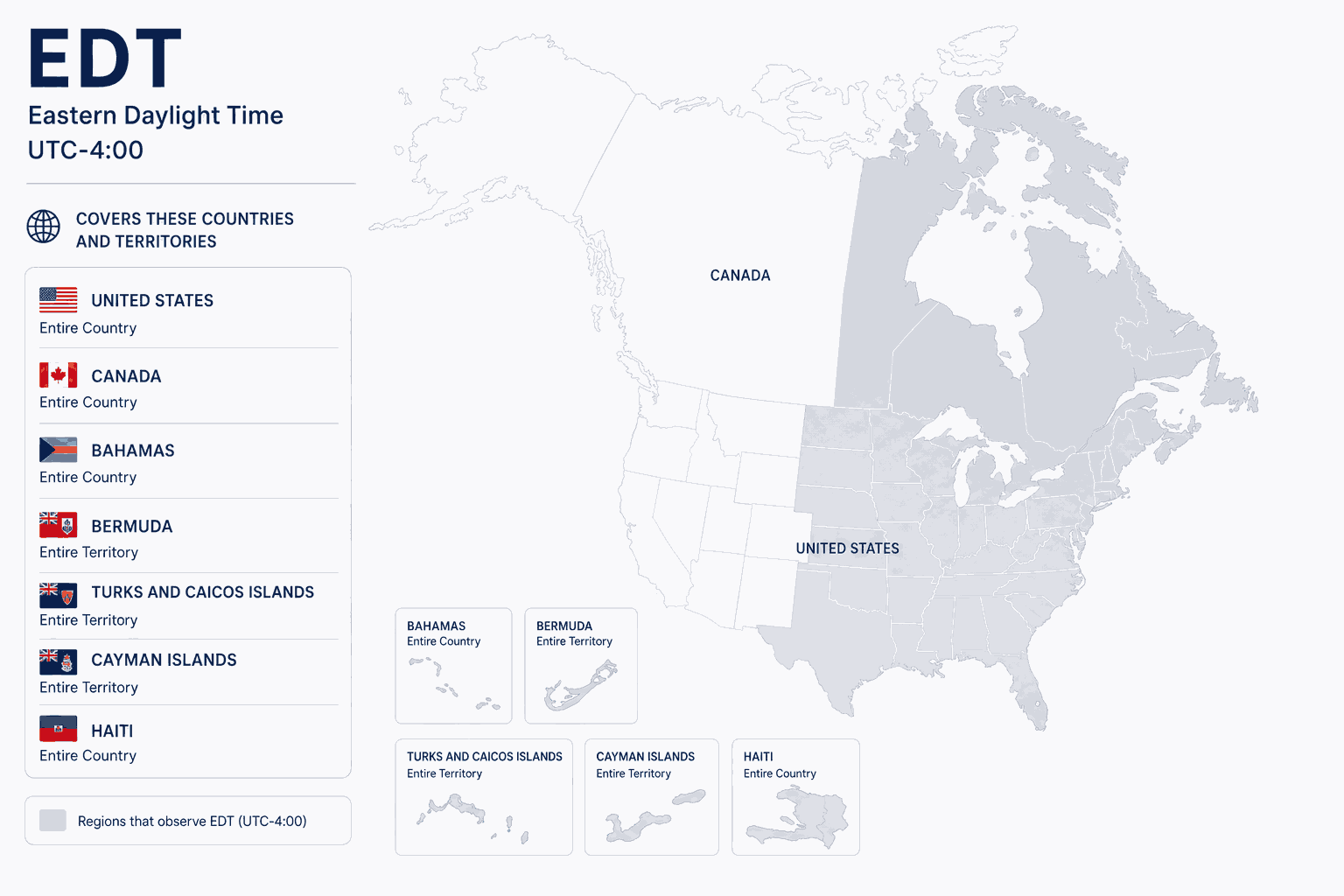
The map below highlights the specific regions, countries, and territories that observe the Eastern Daylight Time time zone.
Understanding Eastern Daylight Time (EDT)
Eastern Daylight Time (EDT) operates at UTC-4:00 and represents the active daylight saving phase for the most economically consequential time zone in the Western Hemisphere. From mid-March through early November, New York, Washington D.C., and Toronto run on EDT — the offset that governs NYSE and NASDAQ opening bells, Federal Reserve policy announcements, US congressional schedules, and the earnings call calendars of thousands of publicly traded corporations. The New York Stock Exchange opens at 09:30 EDT each weekday during this period, a moment that triggers price discovery across equity, bond, and derivatives markets worldwide. More global trading algorithms, institutional risk systems, and financial data feeds are calibrated to the EDT trading window than to any other single time zone's schedule. For the eight months EDT is active each year, it functions as the de facto operational clock of global capital markets.
Countries and Territories Observing EDT
EDT is observed across the US and Canadian East Coast and extends into select Caribbean territories that follow the same DST schedule.
- ✦United States: All states in the Eastern Time zone observe EDT during the daylight saving period: New York, New Jersey, Pennsylvania, Massachusetts, Virginia, North Carolina, Georgia, Florida, Ohio, Michigan, Indiana (most counties), and the District of Columbia, among others. The transition applies uniformly across these states under the federal Uniform Time Act.
- ✦Canada: Ontario (Toronto, Ottawa) and Quebec (Montreal, Quebec City) observe EDT on the same schedule as the US Eastern states, maintaining full clock alignment throughout the summer trading and business season. This synchronization is particularly significant for the Toronto–New York financial corridor, where the TSX and NYSE operate in parallel during EDT hours.
- ✦Caribbean: The Bahamas observes EDT during its summer period, advancing from EST to EDT on the same US federal schedule. Haiti also aligns with EDT during the daylight saving window. These territories represent an exception among Caribbean nations — the majority of the region stays on AST (UTC-4) year-round without DST, meaning they briefly share the same clock as New York during the EDT period before diverging again in November.
Daylight Saving Time (DST) Rules
EDT is not a separate time zone — it is the daylight saving phase of Eastern Time (ET), the umbrella designation covering both EST and EDT. The mechanics are straightforward: clocks advance from EST (UTC-5) to EDT (UTC-4) on the second Sunday in March at 02:00 local time, and revert from EDT back to EST on the first Sunday in November at 02:00 local time. In 2026, EDT runs from March 8 through November 1.
For global teams, the market-hours implication is the most critical scheduling fact: the NYSE opens at 09:30 EDT (13:30 UTC) during the EDT period, shifting to 09:30 EST (14:30 UTC) after the November reversion. Any automated trading system, earnings calendar, or international meeting template calibrated to a UTC-based NYSE open time must account for this 1-hour UTC shift twice annually. Teams in Europe, Asia, and Australia that follow US market hours often experience their most common scheduling errors at exactly these two transition points each year.
| Major Cities | Country | Standard Time | Daylight Saving Time |
|---|---|---|---|
| New York | United States | EST (UTC-5) | EDT (UTC-4) |
| Washington D.C. | United States | EST (UTC-5) | EDT (UTC-4) |
| Miami | United States | EST (UTC-5) | EDT (UTC-4) |
| Toronto | Canada | EST (UTC-5) | EDT (UTC-4) |
| Montreal | Canada | EST (UTC-5) | EDT (UTC-4) |
Global Business Guide
Europe: London (BST, UTC+1) is 5 hours ahead of EDT during the Northern Hemisphere summer — the period when both zones are simultaneously on their summer offsets. A 09:30 EDT NYSE open corresponds to 14:30 BST in London, placing the entire US morning trading session within London's afternoon. Frankfurt (CEST, UTC+2) is 6 hours ahead of EDT during this overlapping summer window: the NYSE open at 09:30 EDT reaches Frankfurt at 15:30 CEST, one hour before the Frankfurt Stock Exchange closes at 17:30 local time. This is the window where transatlantic equity arbitrage, dual-listed stock pricing, and US–EU institutional trades are most actively executed.
The transition risk: in late March, the US springs forward to EDT while Europe has already been on summer time for several days (EU DST starts the last Sunday in March; US DST starts the second Sunday). For approximately one week in March, the US–London gap is 5 hours rather than the usual 5, and then shifts again. In autumn, the EU reverts to winter time before the US does, briefly widening the gap to 6 hours for a week before the US follows. Calendar systems that hard-code "5 hours" for the London–New York gap will produce incorrect meeting times during these transition windows.
Asia: Tokyo (JST, UTC+9) is 13 hours ahead of EDT in summer. Seoul (KST, UTC+9) is identical. A 09:30 EDT NYSE open corresponds to 22:30 JST the same calendar day — after Japanese market close and outside any viable business window. Singapore (SGT, UTC+8) is 12 hours ahead: NYSE open at 09:30 EDT = 21:30 SGT. The only viable live window for EDT–Asia calls is an EDT early morning (07:00–08:00 EDT = 20:00–21:00 JST), placing the burden on Asian teams to remain available late evening. For EDT–India (IST, UTC+5:30) coordination, the gap is 9.5 hours: a 08:30 EDT start reaches Mumbai at 18:00 IST — the final hour of the Indian workday and the standard overlap slot for US East Coast–India technology calls.
Americas: EDT's 1-hour lead over CDT (Central Daylight Time, UTC-5) and 3-hour lead over PDT (Pacific Daylight Time, UTC-7) makes New York the opening city for US domestic business each morning. Chicago opens an hour after New York's markets; San Francisco opens three hours later. For intra-US scheduling, EDT is the default reference clock — major product launches, federal government announcements, and media broadcasts are consistently timed to Eastern, reflecting New York and Washington D.C.'s dominance as the zone's anchor cities.
Frequently Asked Questions
When does EDT start and end?
EDT begins on the second Sunday in March at 02:00 local time, when clocks spring forward one hour from EST (UTC-5) to EDT (UTC-4). It ends on the first Sunday in November at 02:00 local time, when clocks fall back to EST. In 2026, EDT runs from March 8 through November 1.
Is EDT the same as EST?
EDT and EST are two phases of the same Eastern Time zone, not two separate zones. EST (Eastern Standard Time) is the winter offset at UTC-5, observed from early November through mid-March. EDT (Eastern Daylight Time) is the summer offset at UTC-4, active during Daylight Saving Time — meaning New York and Toronto run one hour ahead of their winter clock for roughly eight months of every year.
Need to schedule a meeting?
Use our dedicated converter pages to find the perfect overlap time across different time zones.