
Current Time in Central Standard Time (CST)
Central Standard Time (CST) is 6 hours behind Coordinated Universal Time (UTC-06:00). It is extensively used across midcontinental North America and Central America.
Current Central Standard Time (CST) Time
Date: ... · Your Local Time: ...
Important Note: Central Standard Time has a fixed standard offset of -06:00. However, because this location observes Daylight Saving Time, the live clock above may currently reflect a different daylight offset.
Abbreviation Ambiguity: The abbreviation CST is used by multiple time zones around the world. On this page, it specifically refers to Central Standard Time (-06:00).
Central Standard Time Geographical Coverage
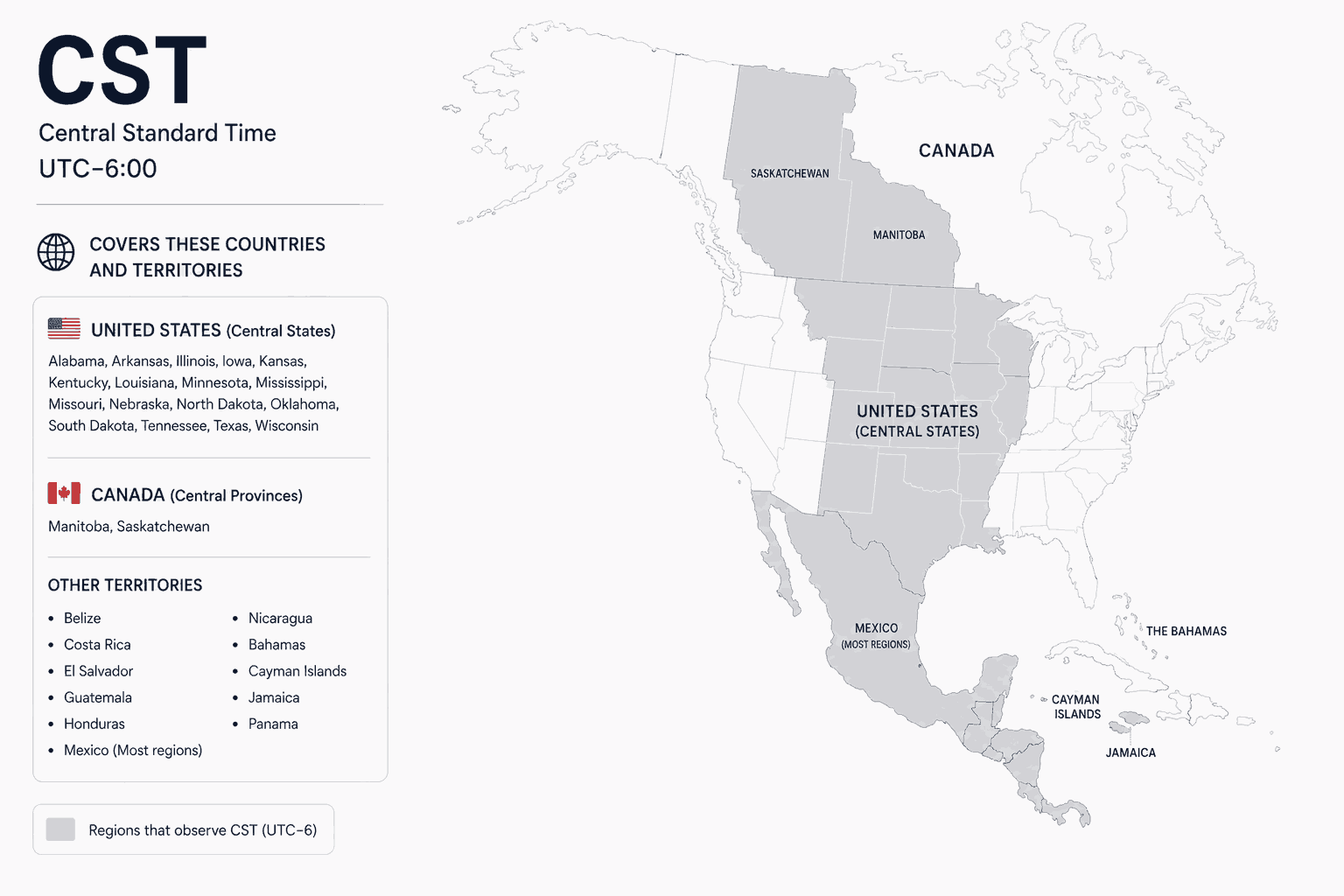
The map below highlights the specific regions, countries, and territories that observe the Central Standard Time time zone.
Understanding Central Standard Time (CST)
Central Standard Time (CST) runs at UTC-6:00, positioning it squarely in the midcontinent of North America. The zone stretches from the Great Lakes manufacturing belt through the agricultural heartland and down to the Gulf Coast energy corridor — covering more Fortune 500 headquarters, logistics infrastructure, and commodity trading volume than any other single US time zone. Chicago's O'Hare remains the busiest cargo hub on the continent, and the Texas Triangle of Houston, Dallas, and Austin anchors the zone's southern economic weight. During Daylight Saving Time, the region advances to Central Daylight Time (CDT) at UTC-5:00.
Countries and Territories Observing CST
CST covers a broad band of North America and extends through much of Central America, though DST behavior varies significantly by country.
- ✦United States: Illinois, Texas, Missouri, Minnesota, Wisconsin, Iowa, and the Florida panhandle all fall under Central Time. The zone also covers Kansas, Nebraska, South Dakota, North Dakota, Oklahoma, Arkansas, Louisiana, Mississippi, and Alabama — forming the contiguous economic spine of the American interior.
- ✦Canada: Manitoba observes CST/CDT on the same schedule as the US. Parts of Ontario west of the Eastern Time boundary and the majority of Saskatchewan also use UTC-6, though Saskatchewan does not observe DST and stays on CST year-round.
- ✦Central America & Mexico: Guatemala, Honduras, Costa Rica, El Salvador, Nicaragua, and Belize all operate at UTC-6 permanently — no DST. Mexico City and most of Mexico used CST historically but abandoned DST in 2022, now holding at UTC-6 year-round under standard time indefinitely.
Daylight Saving Time (DST) Rules
In the United States and Canada, Central Time shifts forward to CDT (UTC-5:00) on the second Sunday in March and returns to CST (UTC-6:00) on the first Sunday in November. In 2026, that means clocks advance on March 8 and fall back on November 1. Regions like Saskatchewan, Mexico City, and Central American nations remain at UTC-6 throughout the year, creating a recurring seasonal offset between them and their CDT-observing neighbors from March to November.
| Major Cities | Country | DST Observed? |
|---|---|---|
| Chicago | United States | Yes |
| Houston | United States | Yes |
| Dallas | United States | Yes |
| Minneapolis | United States | Yes |
| Winnipeg | Canada | Yes |
| Mexico City | Mexico | No |
Global Business Guide
Scheduling from Europe: London (GMT/UTC+0) is 6 hours ahead of CST in winter and 5–6 hours ahead during seasonal DST transitions. A 15:00–17:00 window in London lands squarely in Chicago's 09:00–11:00 morning — the cleanest overlap for transatlantic calls with the US Central corridor. Paris and Berlin (CET, UTC+1) add one more hour, making 16:00–18:00 Central European Time optimal for CST morning meetings.
Scheduling from Asia and India: India Standard Time (IST, UTC+5:30) sits 11.5 hours ahead of CST. An 08:00 start in Mumbai or Bangalore translates to 20:30 the previous evening in Chicago — outside business hours entirely. The most practical window is an India late-afternoon call at 19:00–20:00 IST, which reaches CST at 07:30–08:30, just at the opening of the workday. Teams coordinating with Tokyo (JST, UTC+9) face a 15-hour gap, making asynchronous handoffs the default and making the 07:00 CST / 22:00 JST window the only viable live-sync slot.
Frequently Asked Questions
Is CST the same as Central Time (CT)?
Central Time (CT) is the umbrella term for the zone, while CST and CDT refer to its two seasonal offsets. CST (UTC-6) applies during standard time from November through March, and CDT (UTC-5) applies during Daylight Saving Time from March through November.
Does Mexico City use CST?
Mexico City operates on UTC-6, the same offset as CST, but it does not observe Daylight Saving Time following Mexico's elimination of the practice under a 2022 law. This means Mexico City stays at UTC-6 year-round while US and Canadian Central Time cities shift to UTC-5 each summer.
Need to schedule a meeting?
Use our dedicated converter pages to find the perfect overlap time across different time zones.