
Current Time in Beijing Time (BJT)
Beijing Time (BJT) is 8 hours ahead of Coordinated Universal Time (UTC+08:00). It serves as the single, unified time zone for all of mainland China.
Current Beijing Time (BJT) Time
Date: ... · Your Local Time: ...
Beijing Time Geographical Coverage
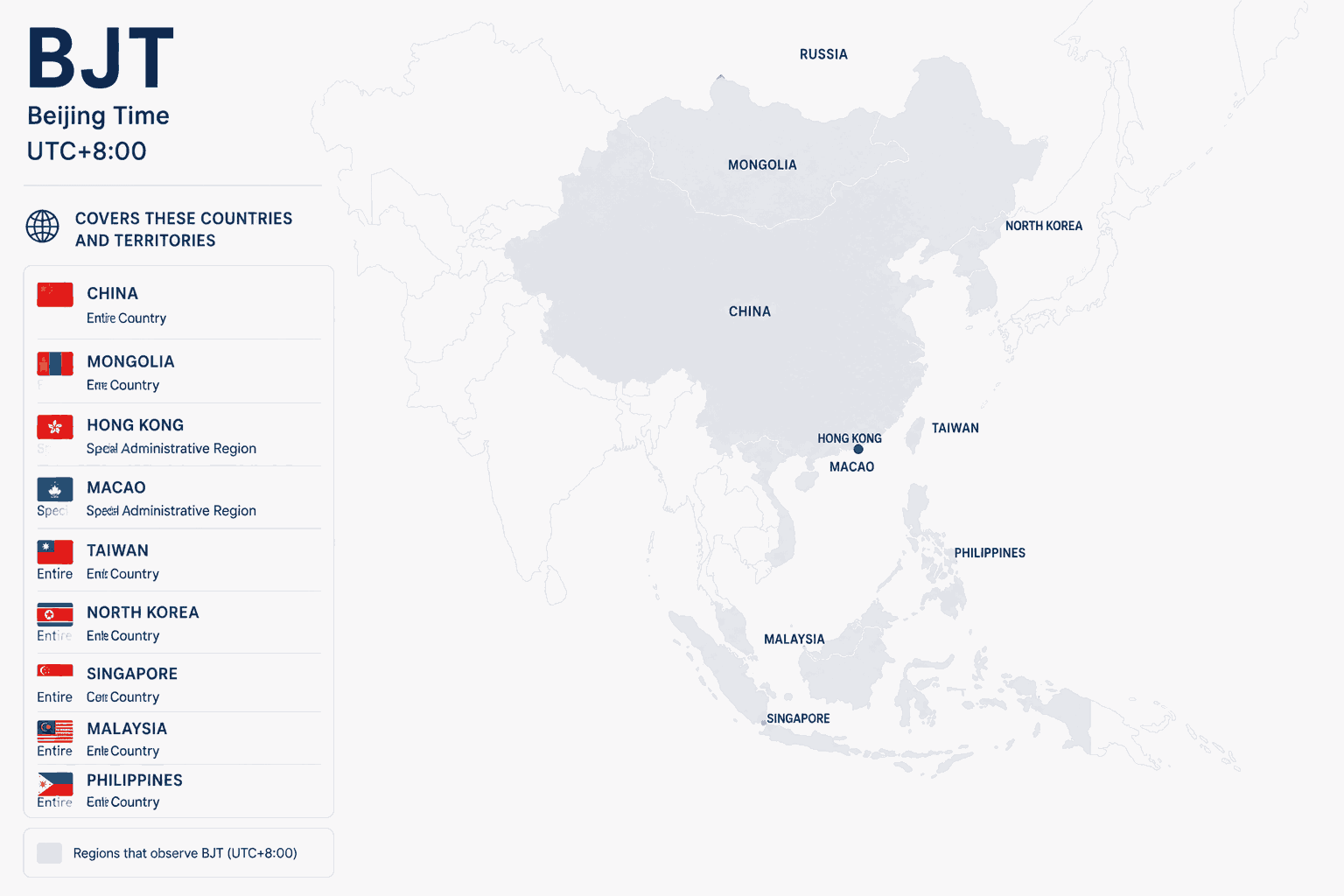
The map below highlights the specific regions, countries, and territories that observe the Beijing Time time zone.
Understanding Beijing Time (BJT)
Beijing Time (BJT), also internationally designated as China Standard Time (CST), operates at UTC+8:00 on a permanent, year-round basis — the single unified clock for the world's second-largest economy and its 1.4 billion people. The Shanghai Stock Exchange (SSE) opens its morning session at 09:30 BJT, trading alongside the Shenzhen Stock Exchange (SZSE) to form the world's second-largest equity market by combined capitalization. Shenzhen's technology manufacturing corridor — home to Huawei, Tencent, DJI, and hundreds of hardware supply chain companies serving global electronics brands — operates on BJT schedules that drive production release windows, quality inspection deadlines, and export container booking cutoffs worldwide. Beijing, as the political and regulatory capital, issues the government procurement calendars, customs schedule updates, and export licensing windows against which multinational supply chain teams set their own operational clocks. For any business with manufacturing, sourcing, or market access operations in China, BJT is not a secondary reference — it is the primary constraint around which the global supply chain is built.
Countries and Territories Observing BJT
BJT covers mainland China exclusively as a national designation, though its UTC+8:00 offset aligns it with a group of neighboring economies forming one of the world's most economically significant time blocs.
- ✦Mainland China: China's territory spans approximately 5,200 kilometres from its eastern coastline at roughly 135° East longitude to its western border regions near 73° East — a geographic span that would, under standard 15°-per-zone conventions, encompass five separate time zones from roughly UTC+5 to UTC+9. Since 1949, the People's Republic of China has mandated a single unified time zone at UTC+8:00 across all 34 provincial-level administrative divisions. The consequences are most visible in Xinjiang, China's westernmost autonomous region: at the height of summer, solar noon in Ürümqi falls at approximately 15:00 BJT rather than the geographically natural 13:00 local solar time. Many Uyghur residents and local businesses in Xinjiang informally use an unofficial "Xinjiang Time" at UTC+6:00, creating a parallel two-clock system within Chinese territory that complicates scheduling for anyone operating there.
- ✦Regional Alignment (UTC+8): Hong Kong (HKT), Taiwan, Singapore (SGT), Malaysia (MYT), and Western Australia (AWST) all share the UTC+8:00 permanent offset. None of these jurisdictions observes DST. The combined economic weight of this UTC+8 bloc — encompassing mainland China, Hong Kong, Singapore, Taiwan, and Malaysia — makes it the largest permanent time zone by GDP anywhere in the world. A Shanghai manufacturer shipping to Singapore, a Shenzhen hardware firm coordinating with a Taipei component supplier, or a Beijing financial institution settling a transaction with Hong Kong's HKEX all operate on identical clocks with zero time conversion required.
Daylight Saving Time (DST) Rules
Mainland China abolished Daylight Saving Time in 1991, ending an eight-year experiment with seasonal clock changes that had been observed since 1986. Since 1991, BJT has remained fixed at UTC+8:00 without interruption. The decision was driven by the administrative complexity of managing DST transitions across a country of China's size and the minimal energy savings observed at the national level.
The operational consequence for global supply chains is significant. China's factory production schedules, customs clearance windows, shipping container booking cutoffs, and quality control inspection deadlines are all set against a clock that never changes. When US, European, or Australian partners shift their clocks in spring and autumn, the offset between their local time and China changes by one hour — but the Chinese factory floor makes no adjustment. Procurement teams managing Chinese manufacturing relationships must account for this asymmetric shift twice annually, updating meeting templates and deadline calculations on their own side each March and November.
| Major Cities | Country | DST Observed? |
|---|---|---|
| Beijing | China | No |
| Shanghai | China | No |
| Shenzhen | China | No |
| Guangzhou | China | No |
| Chengdu | China | No |
Global Business Guide
Europe: London (GMT, UTC+0) is 8 hours behind BJT in winter and 7 hours behind during BST. Shanghai's 09:30 SSE open corresponds to 01:30 GMT — long before any European market opens. The viable BJT–Europe live window is China's late afternoon: 16:00–18:00 BJT maps to 08:00–10:00 GMT and 09:00–11:00 CET, catching London and Frankfurt at the start of their trading day. This narrow two-hour window is where the majority of European institutional orders for China-listed securities, cross-border M&A calls, and China-sourcing procurement reviews are concentrated. During CEST (UTC+2), Frankfurt is 6 hours behind BJT, and China's 16:00 close reaches Frankfurt at 10:00 CEST — a slightly more workable window that extends to 12:00 CEST by Shanghai's 18:00 close.
Americas: New York (EDT, UTC-4) is 12 hours behind BJT during US summer. Shanghai's 09:30 SSE open corresponds to 21:30 EDT the previous evening — after US markets have closed entirely. The only viable BJT–US East Coast live window is a very early China morning: a 07:00–08:00 BJT start reaches New York at 19:00–20:00 EDT, at the outer edge of extended US working hours. This structural gap is why the majority of US–China manufacturing coordination runs asynchronously: Chinese factories submit production reports, defect logs, and shipment confirmations at end-of-day BJT, which US teams review at the start of their following morning. When the US falls back to EST (UTC-5) in November, the gap widens to 13 hours, further reducing any practical live overlap. US West Coast teams (PDT, UTC-7) face a 15-hour summer gap — asynchronous workflows are not merely convenient but operationally necessary for sustained PDT–BJT coordination.
Asia — the seamless corridor: Tokyo (JST, UTC+9) is 1 hour ahead of BJT: Shanghai's full business day runs in near-complete parallel with Tokyo, with the SSE's 09:30 open corresponding to 10:30 JST. Seoul (KST, UTC+9) is identical. Singapore (SGT, UTC+8) and Hong Kong (HKT, UTC+8) are on the same clock as Beijing — zero offset, zero conversion, complete business day alignment. India (IST, UTC+5:30) is 2.5 hours behind BJT: a 12:00–18:00 BJT afternoon maps to 09:30–15:30 IST, a productive midday overlap for China–India technology sourcing and logistics coordination. Dubai (GST, UTC+4) is 4 hours behind: BJT's 13:00–18:00 afternoon corresponds to Dubai's 09:00–14:00 GST, a functional morning-to-afternoon overlap for Gulf–China commodity trade and infrastructure project calls.
Frequently Asked Questions
Does China observe Daylight Saving Time?
Mainland China abolished Daylight Saving Time in 1991 and has remained permanently fixed at UTC+8:00 ever since, with no seasonal clock adjustment at any point in the year. This means the offset between Beijing or Shanghai and any DST-observing country shifts by one hour twice annually when those countries change their clocks — but BJT itself never moves.
How many time zones are there in China?
Despite spanning a geographical width that would naturally encompass five separate time zones — from the eastern coast at roughly UTC+8 to the western reaches of Xinjiang near UTC+6 or even UTC+5 — China officially mandates a single unified time zone, Beijing Time (BJT) at UTC+8:00, across the entire country. This policy has been in place since 1949 and applies to all 34 provincial-level administrative regions without exception.
Need to schedule a meeting?
Use our dedicated converter pages to find the perfect overlap time across different time zones.