
Current Time in Singapore Time (SGT)
Singapore Time (SGT) is 8 hours ahead of Coordinated Universal Time (UTC+08:00). It serves as a major temporal anchor for the Asia-Pacific business region.
Current Singapore Time (SGT) Time
Date: ... · Your Local Time: ...
Singapore Time Geographical Coverage
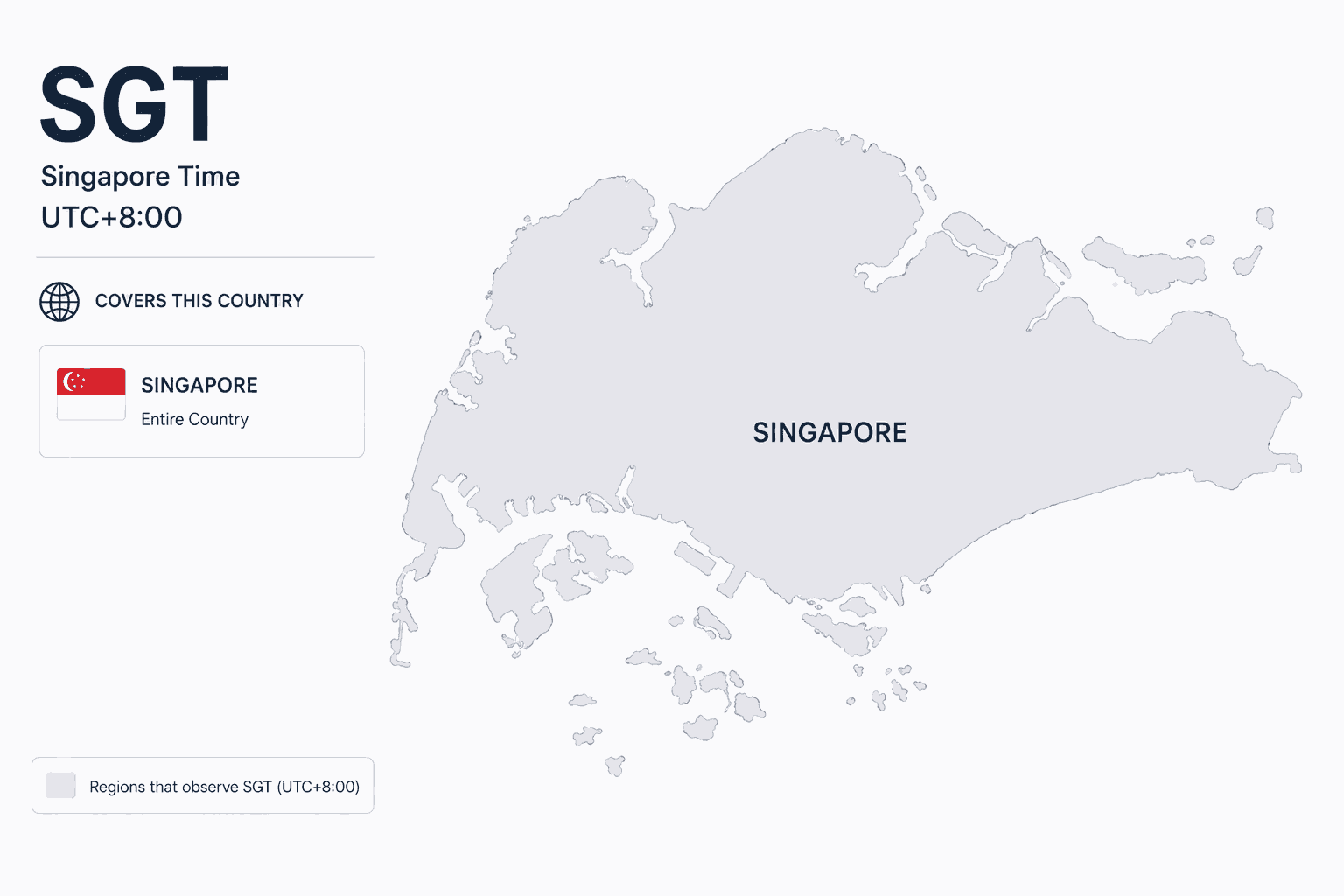
The map below highlights the specific regions, countries, and territories that observe the Singapore Time time zone.
Understanding Singapore Time (SGT)
Singapore Time (SGT) operates at UTC+8:00 — eight hours ahead of Greenwich — from a city-state that punches far above its 734 square kilometres in global economic weight. The Singapore Exchange (SGX) opens at 09:00 SGT each weekday, anchoring equity and derivatives markets that connect institutional capital across the Asia-Pacific region. Singapore's port, consistently ranked among the world's two busiest by container throughput, operates continuously within this time frame. For multinational corporations managing APAC regional headquarters, SGT is the operational clock: legal entity management, treasury functions, and technology delivery teams across Southeast Asia synchronize to it daily. The absence of Daylight Saving Time means SGT never shifts, giving it the scheduling predictability that financial and logistics operations demand.
Countries and Territories Observing SGT
SGT officially covers Singapore alone, but its offset connects it to a much larger economic cluster.
- ✦Singapore: The entire island nation operates on a single fixed clock at UTC+8:00. There are no regional subdivisions or variations within the country. Singapore adopted its current offset in 1982 when it advanced from UTC+7:30 to align with Malaysia and the broader regional commercial bloc — a deliberate economic decision as much as a geographic one.
- ✦Regional Alignment (UTC+8): China (CST), Hong Kong (HKT), Taiwan (CST), Malaysia (MYT), and Western Australia (AWST) all share the UTC+8:00 offset, though none of them observes DST either. This creates a contiguous trading window stretching from Perth to Beijing to Kuala Lumpur where all major participants are reading the same clock simultaneously. Combined, the UTC+8 economic zone encompasses a GDP exceeding $25 trillion and includes two of the world's four largest stock exchanges by market capitalization.
Daylight Saving Time (DST) Rules
SGT does not observe Daylight Saving Time. Singapore sits at approximately 1.35° North latitude — less than 150 kilometres from the equator — where the difference between the longest and shortest day of the year is under 30 minutes. The original purpose of DST (extending usable evening daylight in high-latitude countries) has no practical application this close to the equator, and Singapore has not observed any form of seasonal clock change since 1941.
The operational consequence is straightforward: SGT never moves. Unlike counterparts in London, New York, or Frankfurt, a standing meeting time set in Singapore does not drift by an hour in March or October. The offset to DST-observing countries changes — but always on their side, never on Singapore's.
| Major Regional Cities (UTC+8) | Country | DST Observed? |
|---|---|---|
| Singapore | Singapore | No |
| Beijing | China | No |
| Hong Kong | Hong Kong | No |
| Kuala Lumpur | Malaysia | No |
| Taipei | Taiwan | No |
| Perth | Australia | No |
Global Business Guide
European overlap: London (GMT, UTC+0) is 8 hours behind SGT in winter and 7 hours behind during BST. Singapore's 09:00–11:00 morning corresponds to 01:00–03:00 GMT — outside any workable European window. The viable corridor is SGT's late afternoon: 16:00–18:00 SGT maps to 08:00–10:00 GMT and 09:00–11:00 CET, catching European teams at the start of their day. This makes the SGT late-afternoon slot the primary window for Singapore–Europe financial and business calls, and why Frankfurt and London trading desks with APAC mandates typically start early.
Middle East and India: Dubai (GST, UTC+4) is 4 hours behind SGT. Singapore's 09:00–13:00 morning aligns with Dubai's 05:00–09:00, making early Dubai morning the only live overlap before the Gulf workday begins in earnest. Singapore's 13:00–18:00 afternoon maps comfortably to Dubai's 09:00–14:00 — the most productive corridor for SGT–GST calls. India (IST, UTC+5:30) is 2.5 hours behind SGT: a 14:00–18:00 SGT window reaches Mumbai and Bengaluru at 11:30–15:30 IST, a solid midday overlap for distributed technology teams.
Americas — the hardest corridor: New York (EST, UTC-5) is 13 hours behind SGT in winter, narrowing to 12 hours during EDT. Singapore's 09:00 start corresponds to 20:00 EST the previous evening — no functional business overlap exists during standard hours for either side. The only viable live window is a Singapore very-early-morning call (07:00–08:00 SGT = 18:00–19:00 EST) or a US late-evening call, with one party absorbing the inconvenience entirely. For sustained US–Singapore team collaboration, asynchronous workflows with a single weekly live sync are the practical standard. West Coast US teams (PST, UTC-8) face a 16-hour gap in winter, making any live synchronization during normal business hours structurally impossible.
Frequently Asked Questions
Does Singapore use Daylight Saving Time?
Singapore does not observe Daylight Saving Time and has no policy to introduce it, remaining fixed at UTC+8:00 every day of the year. Singapore's location approximately one degree north of the equator means daylight hours remain nearly constant across the seasons, removing the original rationale for DST entirely.
Which other major countries share Singapore's time zone?
China, Hong Kong, Taiwan, Malaysia, and Western Australia all operate on the same UTC+8:00 offset as Singapore, though each uses its own regional designation — CST, HKT, CST, MYT, and AWST respectively. Collectively, the UTC+8 bloc represents one of the world's most economically significant time bands.
Need to schedule a meeting?
Use our dedicated converter pages to find the perfect overlap time across different time zones.