
Current Time in Korea Standard Time (KST)
Korea Standard Time (KST) is 9 hours ahead of Coordinated Universal Time (UTC+09:00). It serves as the unified time zone for the entire Korean Peninsula.
Current Korea Standard Time (KST) Time
Date: ... · Your Local Time: ...
Korea Standard Time Geographical Coverage
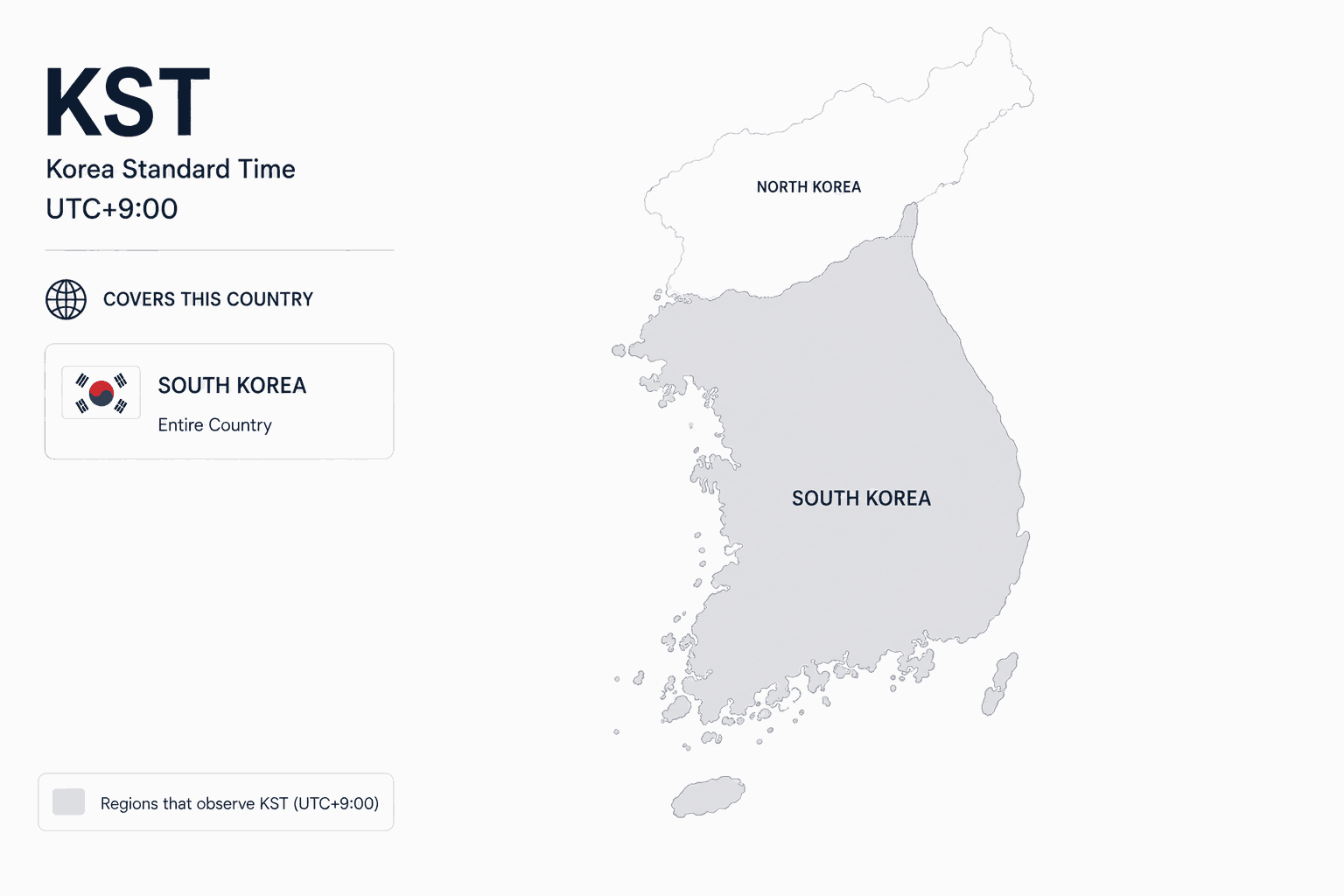
The map below highlights the specific regions, countries, and territories that observe the Korea Standard Time time zone.
Understanding Korea Standard Time (KST)
Korea Standard Time (KST) operates at UTC+9:00, anchoring the business day for one of the world's most export-intensive economies. Samsung Electronics alone accounts for a significant share of global DRAM and NAND flash memory production, with its fabrication schedules synchronized to KST. SK Hynix, the world's second-largest memory chip manufacturer, operates from Icheon, South Korea, on the same clock. Hyundai and Kia run combined global vehicle production that ranks them consistently among the world's top five automotive groups by volume. Beyond hardware and manufacturing, South Korea's cultural export industry — K-pop, K-drama, and streaming content — generates billions in annual revenue and has built a global audience that follows Korean release schedules in real time. The Korea Exchange (KRX) opens at 09:00 KST, placing Seoul's equity markets in sequence with Tokyo and ahead of Singapore, forming the opening act of the daily Asia-Pacific trading session.
Countries and Territories Observing KST
KST covers the Korean Peninsula across two politically separate but temporally unified states.
- ✦South Korea: The entire country operates on a single, fixed UTC+9:00 offset with no regional variation. From the Seoul metropolitan area — home to roughly half the national population — to the southern port city of Busan and the manufacturing corridors of Ulsan and Changwon, every business, institution, and transport network runs on the same clock. South Korea abolished DST after 1988 and has maintained a permanent fixed offset since.
- ✦North Korea: Pyongyang Time, North Korea's official designation, also operates at UTC+9:00. North Korea briefly shifted to UTC+8:30 in August 2015 as a political statement, creating a 30-minute offset from South Korea and Japan. That experiment ended in April 2018, when North Korea reverted to UTC+9:00 ahead of inter-Korean summit meetings, restoring full temporal alignment across the peninsula.
- ✦Regional Alignment (UTC+9): Japan (JST) shares the identical UTC+9:00 offset without DST, creating a seamlessly synchronized trading and manufacturing corridor between Tokyo, Osaka, Seoul, and Busan. Palau and the eastern Indonesian provinces of Maluku and West Papua round out the UTC+9 bloc, though the Korea–Japan bilateral dominates the economic weight of the alignment.
Daylight Saving Time (DST) Rules
KST does not observe Daylight Saving Time. South Korea last observed DST in 1988, during the Seoul Summer Olympics, and has not reinstated it since. The operational consequence for global supply chains is significant: Samsung, SK Hynix, and the major Korean automotive and shipbuilding groups publish production schedules, earnings calls, and logistics windows against a clock that never moves. Every component delivery window, fabrication cycle milestone, and equity settlement date set against KST has held its offset without interruption since 1988.
When DST-observing partners — the US, UK, EU — shift their clocks in spring and autumn, the offset between those countries and Seoul changes by one hour. The adjustment is entirely on the partner's side. KST teams working with New York or London need to update their meeting templates twice a year; their Korean counterparts do not.
| Major Regional Cities (UTC+9) | Country | DST Observed? |
|---|---|---|
| Seoul | South Korea | No |
| Busan | South Korea | No |
| Incheon | South Korea | No |
| Pyongyang | North Korea | No |
| Tokyo | Japan | No |
| Osaka | Japan | No |
Global Business Guide
European overlap: Frankfurt and Paris (CET, UTC+1) are 8 hours behind KST in winter and 7 hours behind during CEST. Seoul's 17:00–18:00 workday close corresponds to 09:00–10:00 CET — a single-hour window at the boundary of each city's working day. London (GMT) is 9 hours behind, making Seoul's 18:00 close reach London at 09:00 GMT. European teams with Seoul mandates typically start their day with KST handoff reviews, and Korean teams close with deliverables timed for European morning consumption. During CEST (European summer), the gap narrows by one hour, giving a slightly wider overlap window between Seoul's afternoon and Frankfurt's morning.
Americas — the most constrained corridor: New York (EST, UTC-5) is 14 hours behind KST in winter, narrowing to 13 hours during EDT. Seoul's 09:00 KRX open corresponds to 19:00 EST the previous evening. The only viable live window for US East Coast teams is an early KST morning call (07:00–08:00 KST = 17:00–18:00 EST), placing the burden on the Korean side to start before standard business hours. US West Coast teams (PST, UTC-8) face a 17-hour winter gap — live synchronization during normal business hours is not structurally possible, and async handoffs with a single weekly video sync are the standard operating model for Korea–US West Coast engineering teams.
APAC neighbours — the efficient corridor: Singapore (SGT, UTC+8) is 1 hour behind KST, making it the tightest major international scheduling gap in Korea's commercial network. A 10:00–18:00 KST window reaches Singapore at 09:00–17:00 SGT — near-complete business hours alignment. India (IST, UTC+5:30) is 3.5 hours behind KST: a 13:00–18:00 KST afternoon maps to 09:30–14:30 IST, a productive midday overlap for Korea–India technology sourcing and IT services coordination. Dubai (GST, UTC+4) is 5 hours behind KST, with Seoul's 14:00–18:00 window reaching the Gulf at 09:00–13:00 GST — a clean overlap for Korea–Middle East trade and logistics calls.
Frequently Asked Questions
Does South Korea observe Daylight Saving Time?
South Korea does not observe Daylight Saving Time and has not done so since 1988, when DST was discontinued following the Seoul Summer Olympics. KST remains fixed at UTC+9:00 every day of the year, meaning the offset between Seoul and any DST-observing country shifts by one hour twice annually when those countries change their clocks.
Are KST and JST the same?
Yes, Korea Standard Time (KST) and Japan Standard Time (JST) share the identical UTC+9:00 offset, and neither country observes Daylight Saving Time. Seoul and Tokyo run on exactly the same clock year-round, which directly supports the deep semiconductor, automotive, and consumer electronics supply chain integration between the two economies.
Need to schedule a meeting?
Use our dedicated converter pages to find the perfect overlap time across different time zones.