
Current Time in Philippine Time (PHT)
Philippine Time (PHT) operates at UTC+08:00 year-round across the entire Philippine archipelago, with no Daylight Saving Time adjustment at any point in the year. Manila anchors one of the world's most globally time-sensitive workforces — a BPO and IT services sector that operates around the clock to serve clients in North America, Europe, and across the Asia-Pacific.
Current Philippine Time (PHT) Time
Date: ... · Your Local Time: ...
Philippine Time Geographical Coverage
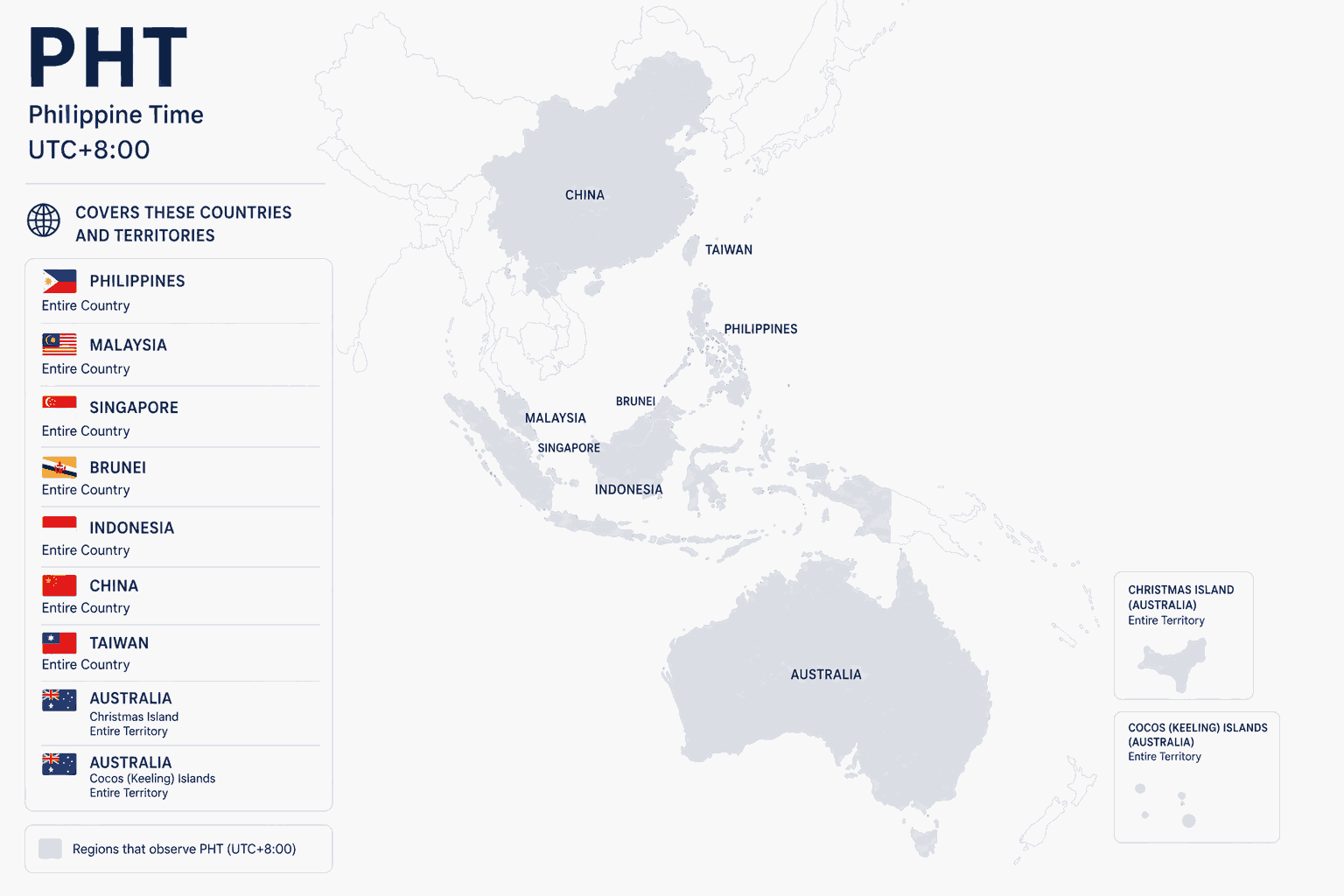
The map below highlights the specific regions, countries, and territories that observe the Philippine Time time zone.
Understanding Philippine Time (PHT)
Philippine Time (PHT) operates at UTC+8:00 on a permanent, year-round basis — a fixed clock governing an archipelago of over 7,600 islands and a workforce that is, by deliberate design, one of the most globally time-flexible in the world. The Philippines hosts the largest Business Process Outsourcing (BPO) industry on the planet by headcount, with the IT-BPO sector employing over 1.3 million workers directly and generating more than $29 billion in annual revenue as of recent industry reports. Makati's financial district and the Bonifacio Global City (BGC) corridor in Manila house regional headquarters for dozens of Fortune 500 companies specifically because of the Philippines' English proficiency, infrastructure quality, and — critically — a workforce culture built around operating on North American and European clock schedules regardless of what PHT reads locally. The Philippine Stock Exchange (PSE) opens at 09:30 PHT in Makati, but the country's most economically significant scheduling activity happens not at the PSE open, but at 21:00 PHT, when graveyard-shift BPO floors across Metro Manila power up for the New York business day.
Countries and Territories Observing PHT
PHT covers the Philippines exclusively as a national designation, but its UTC+8:00 offset connects it to the largest and most economically significant time bloc in Asia.
- ✦The Philippines: All geographic regions of the Philippines — Metro Manila (National Capital Region), Luzon, the Visayas, and Mindanao — operate on a single, unified UTC+8:00 offset. Despite spanning approximately 1,850 kilometres from the northernmost point of Batanes to the southernmost tip of Tawi-Tawi, the country applies no regional time zone subdivisions. This single-zone policy simplifies domestic logistics, broadcast scheduling, and government operations across the archipelago. The Philippines last observed DST in 1990, and no legislative proposal to reintroduce it has advanced since.
- ✦The UTC+8 Asian Bloc: PHT shares its exact UTC+8:00 offset with Singapore (SGT), Malaysia (MYT), China (CST), Hong Kong (HKT), Taiwan (CST), and Western Australia (AWST). No DST is observed in any of these zones. This alignment gives Philippine-based businesses direct, zero-conversion scheduling access to some of the world's most significant financial and commercial centers: Singapore's APAC banking hub, Hong Kong's equity markets, Kuala Lumpur's commodity exchanges, and Perth's mining and resources sector. A Manila procurement team calling a Singapore supplier, a Cebu IT firm coordinating with a Kuala Lumpur client, or a BGC-based regional hub scheduling with Shanghai all operate on identical clocks.
Daylight Saving Time (DST) Rules
PHT does not observe Daylight Saving Time. The Philippines last adjusted its clocks for DST in 1990 under a government energy conservation directive. That experiment was short-lived, and PHT has remained fixed at UTC+8:00 without interruption since. There is no current legislative framework for reintroducing DST, and the country's BPO sector — which would be most disrupted by a clock change given its shift-based scheduling model — has consistently opposed any such proposal.
The practical consequence for global partners is straightforward: PHT never moves. When the US advances to EDT in March or reverts to EST in November, the PHT–US offset shifts by one hour on the American side. When the UK advances to BST in March, the PHT–London gap narrows by one hour on the British side. BPO shift managers in Manila update their team schedules twice a year to account for these Northern Hemisphere DST transitions — but their own clock requires no adjustment.
| Major Regional Cities (UTC+8) | Country | DST Observed? |
|---|---|---|
| Manila | Philippines | No |
| Cebu City | Philippines | No |
| Quezon City | Philippines | No |
| Singapore | Singapore | No |
| Kuala Lumpur | Malaysia | No |
| Beijing | China | No |
| Perth | Australia | No |
Global Business Guide
Standard PHT business hours — Asian and Australian overlap: The PHT daytime window (09:00–18:00 PHT) aligns naturally with the full working day in Singapore (09:00–18:00 SGT, same clock), Malaysia (same), Hong Kong (same), and Beijing (same). Tokyo (JST, UTC+9) is 1 hour ahead: Manila's 09:00 reaches Tokyo at 10:00 JST, providing near-complete bilateral overlap. Sydney (AEST, UTC+10) is 2 hours ahead during Australian winter: Manila's 09:00 corresponds to Sydney's 11:00 AEST, a comfortable mid-morning overlap. These APAC daylight hours are the operational window for the Philippines' domestic financial sector, import/export logistics, and regional corporate coordination.
The graveyard shift — North American synchronization: New York (EDT, UTC-4) is 12 hours behind PHT during US summer. Manila's 21:00 PHT corresponds to New York's 09:00 EDT — the NYSE open. Manila's 22:00 reaches Chicago at 09:00 CDT; Manila's midnight corresponds to Los Angeles at 09:00 PDT. The Philippine BPO industry has built its entire operational model around this 12–15 hour gap. A graveyard shift typically runs from approximately 22:00 to 07:00 PHT, covering the full US East Coast business day from open to close. Workers in this shift — estimated at several hundred thousand across the sector — handle US customer service calls, IT help desk tickets, financial data processing, medical transcription, and software QA in real time during American daylight hours. When the US falls back to EST in November, the PHT–New York gap widens to 13 hours, shifting the graveyard window one hour earlier (21:00 PHT start = 08:00 EST). BPO operations managers in Manila track this annual transition as a significant scheduling event.
European shift — the dawn window: London (GMT, UTC+0) is 8 hours behind PHT in winter and 7 hours behind during BST. Manila's 16:00–18:00 PHT afternoon corresponds to 08:00–10:00 GMT — London's opening two hours. For European client coverage, Philippine BPO teams typically work a mid-shift starting at approximately 15:00–16:00 PHT, catching the European morning as it opens and running through to UK close at approximately 00:00–01:00 PHT. Frankfurt (CET, UTC+1) is 7 hours behind PHT in winter: Manila's 16:00 reaches Frankfurt at 09:00 CET. During CEST (UTC+2), Frankfurt is 6 hours behind, pulling the European sync window to Manila's 15:00 start for a 09:00 CEST Frankfurt alignment. This creates a three-shift structure across much of Manila's BPO industry: a standard Asian daytime shift, a European mid-shift starting mid-afternoon PHT, and a North American graveyard shift starting late evening PHT — a 24-hour operational cycle anchored entirely to a single, fixed UTC+8:00 clock.
Frequently Asked Questions
Does the Philippines observe Daylight Saving Time?
The Philippines does not observe Daylight Saving Time and has not done so since 1990, when the practice was last used as an energy conservation measure. PHT remains permanently fixed at UTC+8:00 every day of the year, meaning the offset between Manila and any DST-observing partner country shifts by one hour twice annually when those countries change their clocks — but PHT itself never moves.
Are PHT and SGT the same time?
Yes, Philippine Time (PHT) and Singapore Time (SGT) share the identical UTC+8:00 offset, and neither country observes Daylight Saving Time, making Manila and Singapore permanently synchronized on the same clock year-round. The same alignment holds with Malaysia (MYT), Greater China (CST), Hong Kong (HKT), and Western Australia (AWST) — all permanent UTC+8 zones.
Need to schedule a meeting?
Use our dedicated converter pages to find the perfect overlap time across different time zones.