
Current Time in Japan Standard Time (JST)
Japan Standard Time (JST) is 9 hours ahead of Coordinated Universal Time (UTC+09:00). It serves as the unified time zone for the entire Japanese archipelago.
Current Japan Standard Time (JST) Time
Date: ... · Your Local Time: ...
Japan Standard Time Geographical Coverage
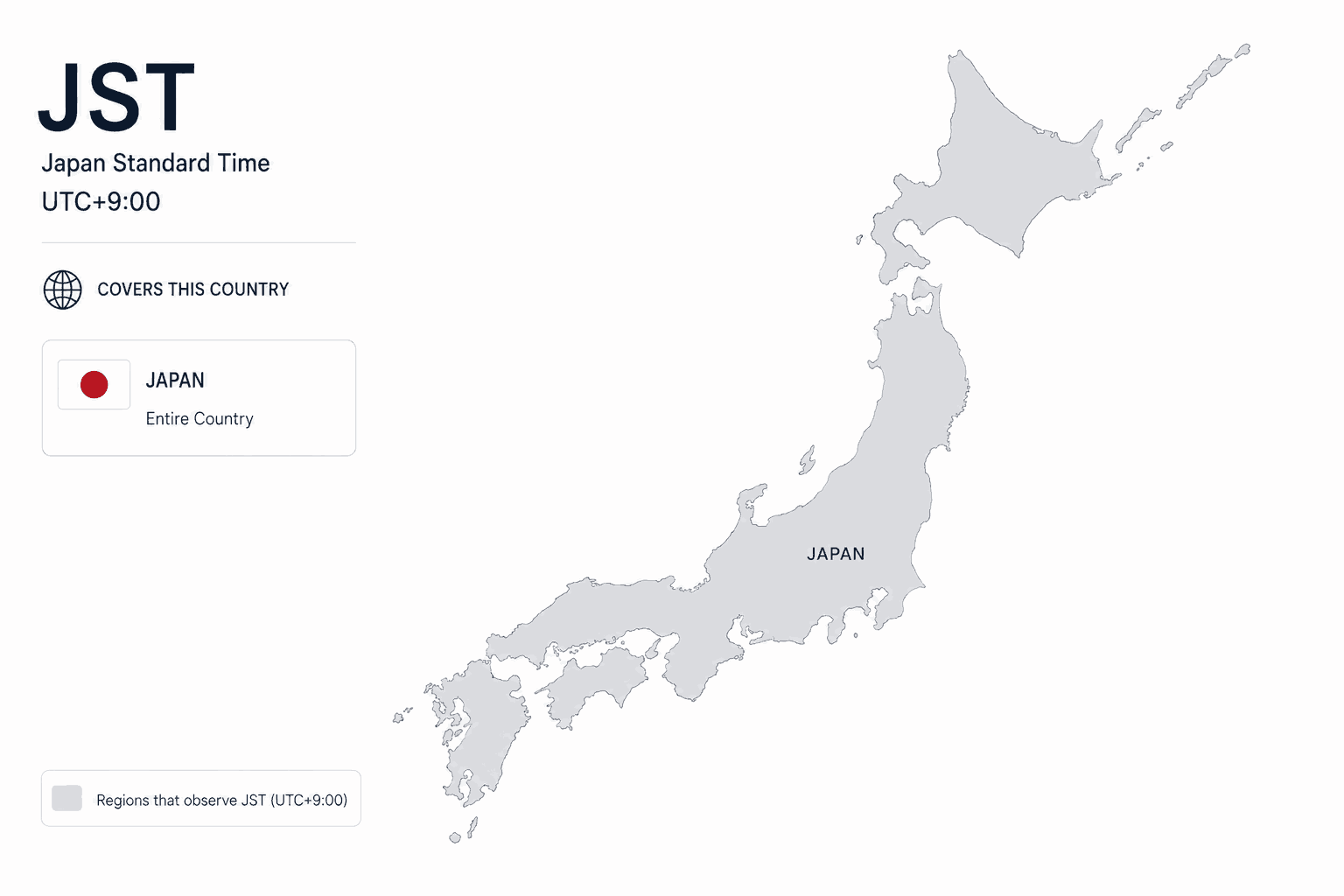
The map below highlights the specific regions, countries, and territories that observe the Japan Standard Time time zone.
Understanding Japan Standard Time (JST)
Japan Standard Time (JST) operates at UTC+9:00, making Tokyo one of the first major financial centers to open each global trading day. The Tokyo Stock Exchange (TSE) begins its morning session at 09:00 JST, processing equity volume from the world's third or fourth largest national economy — one built on export industries whose supply chains run on precise, predictable scheduling. Toyota's just-in-time manufacturing philosophy, which reshaped global logistics, was developed and refined entirely within JST's fixed, DST-free clock. Sony, Panasonic, Honda, and Nintendo all anchor their global product and release calendars to this same time reference. JST's permanence — unchanged since 1951 — means that every factory delivery window, every earnings call, and every firmware launch schedule set against Tokyo time has held its offset without interruption for over seven decades.
Countries and Territories Observing JST
JST officially covers Japan alone, but its UTC+9:00 offset connects it to a cluster of regional neighbors operating on the same clock.
- ✦Japan: All four main islands — Honshu, Hokkaido, Kyushu, and Shikoku — along with the Ryukyu chain including Okinawa, operate on a single unified time zone. Japan covers a latitudinal span of roughly 3,000 kilometres north to south, yet applies no regional subdivision. The Aichi Prefecture factory floor runs on the same clock as the Hokkaido research campus and the Okinawa resort hotel.
- ✦Regional Alignment (UTC+9): South Korea (KST), Palau, and the eastern Indonesian provinces of Maluku and West Papua all share the UTC+9:00 offset. South Korea's alignment with JST is particularly significant: the Seoul–Tokyo economic corridor, covering semiconductor supply chains, automotive components, and consumer electronics, operates without any time conversion between its two anchor cities. North Korea technically uses Pyongyang Time at UTC+9:00 as well, having reverted from a brief UTC+8:30 experiment it maintained from 2015 to 2018.
Daylight Saving Time (DST) Rules
Japan does not observe Daylight Saving Time. JST has been fixed at UTC+9:00 continuously since the Allied occupation-era DST policy was abolished in 1951 following public opposition. No DST legislation has been enacted since, and JST's permanent offset is now embedded in the scheduling logic of automotive, electronics, and gaming supply chains worldwide.
The operational advantage is compounding: every partner in Japan's global manufacturing network — from Taiwanese chip fabs to German automotive suppliers — knows that a 14:00 JST delivery confirmation does not shift by an hour in spring. When European counterparts advance to summer time in late March, the JST–CET gap narrows by one hour, but Tokyo makes no adjustment of its own.
| Major Regional Cities (UTC+9) | Country | DST Observed? |
|---|---|---|
| Tokyo | Japan | No |
| Yokohama | Japan | No |
| Osaka | Japan | No |
| Seoul | South Korea | No |
| Pyongyang | North Korea | No |
Global Business Guide
European overlap: Frankfurt and Paris (CET, UTC+1) are 8 hours behind JST in winter and 7 hours behind during CEST. Tokyo's 17:00–18:00 closing hour corresponds to 09:00–10:00 CET — a razor-thin window at the boundary of each city's working day. London (GMT) is 9 hours behind, making the same Tokyo close correspond to 08:00–09:00 GMT. In practice, the JST–Europe overlap requires one side to flex: Tokyo teams taking early calls before 09:00 JST, or European teams scheduling before 10:00 local. Automatic summary handoffs — end-of-day JST to start-of-day CET — are the standard workflow for Japan–Europe distributed teams.
Americas — the most constrained corridor: New York (EST, UTC-5) is 14 hours behind JST in winter and 13 hours behind during EDT. Tokyo's 09:00 opening corresponds to 19:00 EST the previous evening — no workable overlap exists during standard business hours for either side. A 07:00 JST early start reaches New York at 17:00 EST on the prior day, providing a narrow end-of-US-day window. For US West Coast teams (PST, UTC-8), the gap is 17 hours in winter: live synchronization during business hours is structurally impossible, and asynchronous handoff models with a single weekly video sync are the realistic operating standard.
APAC neighbours — the comfortable corridor: Singapore (SGT, UTC+8) is just 1 hour behind JST, making it the most scheduling-friendly major financial partner for Tokyo. A 10:00–17:00 JST window reaches Singapore at 09:00–16:00 SGT — near-perfect business hours overlap. India (IST, UTC+5:30) is 3.5 hours behind JST: a 13:00–18:00 JST afternoon maps to 09:30–14:30 IST, a solid overlap for Japan–India technology and services coordination. Dubai (GST, UTC+4) is 5 hours behind, making JST's 14:00–18:00 window align with Dubai's 09:00–13:00 — workable for Gulf–Japan trade and logistics calls.
Frequently Asked Questions
Does Japan observe Daylight Saving Time?
Japan has not observed Daylight Saving Time since 1951, when the practice introduced during the Allied occupation was abolished by the Japanese government. JST has remained fixed at UTC+9:00 ever since, and there is no current legislation to reintroduce DST in Japan.
Is JST the same as Korean Standard Time (KST)?
Yes, South Korea's Korean Standard Time (KST) operates at the same UTC+9:00 offset as JST, and South Korea also does not observe Daylight Saving Time. The two countries share an identical clock year-round, which simplifies scheduling for the significant trade, technology, and cultural exchange between Tokyo and Seoul.
Need to schedule a meeting?
Use our dedicated converter pages to find the perfect overlap time across different time zones.