
Current Time in Central European Summer Time (CEST)
Central European Summer Time (CEST) is the daylight saving offset for continental Europe, running at UTC+02:00 from the last Sunday in March through the last Sunday in October. It synchronizes the business day for the majority of the European Union, from Frankfurt's financial markets to Paris, Rome, and Madrid.
Current Central European Summer Time (CEST) Time
Date: ... · Your Local Time: ...
Important Note: Central European Summer Time has a fixed standard offset of +02:00. However, because this location observes Daylight Saving Time, the live clock above may currently reflect a different daylight offset.
Central European Summer Time Geographical Coverage
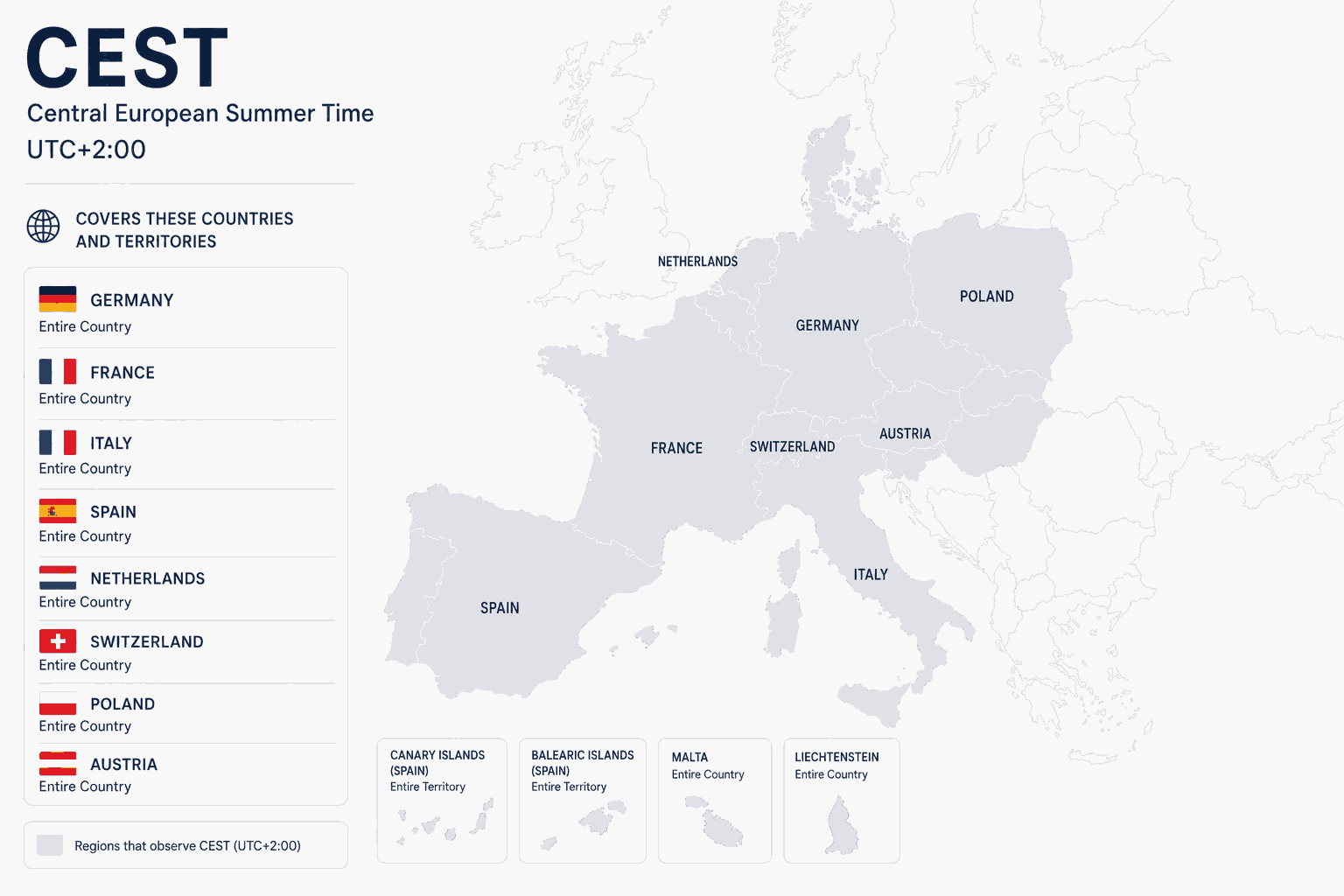
The map below highlights the specific regions, countries, and territories that observe the Central European Summer Time time zone.
Understanding Central European Summer Time (CEST)
Central European Summer Time (CEST) operates at UTC+2:00 and represents the active daylight saving phase for the European Union's economic core — the seven-month window from late March to late October when continental Europe runs one hour ahead of its winter standard. During CEST hours, the Frankfurt Stock Exchange (Xetra) and Euronext Paris both open at 09:00 local time (07:00 UTC), placing European equity markets ahead of London's LSE open and well ahead of any US market. The European Central Bank, headquartered in Frankfurt, publishes monetary policy decisions and interest rate announcements against the CEST calendar. Airbus's production and delivery schedules run on CEST from Toulouse. BMW, Mercedes-Benz, and Volkswagen coordinate their global supply chains from Munich, Stuttgart, and Wolfsburg on this offset. For the majority of the year, CEST is the operating clock of the European single market — 27 member states with a combined GDP exceeding €17 trillion synchronized to the same summer time.
Countries and Territories Observing CEST
CEST covers a contiguous block of continental Europe under a unified EU DST directive, with all member states advancing and reverting their clocks on the same weekend.
- ✦Western & Central Europe: Germany, France, Italy, Spain, and Poland form the economic core of the CEST zone and collectively account for the majority of EU GDP. The Netherlands, Belgium, Luxembourg, Austria, Czech Republic, Slovakia, Hungary, Croatia, Slovenia, and Serbia all observe CEST on the same EU schedule. Switzerland and Liechtenstein, despite not being EU members, observe an identical DST timetable, maintaining full synchronization with Frankfurt and Zurich's financial markets throughout the summer.
- ✦Scandinavia & Others: Sweden, Norway, and Denmark observe CEST, keeping their technology, shipping, and energy sectors aligned with the continental European business day. Monaco, Andorra, and San Marino follow suit. The uniform adoption across such a geographically diverse block — from Tromsø in northern Norway to Valletta in Malta — is the result of EU Directive 2000/84/EC, which standardized DST transition dates across all member states.
- ✦The "Bridge" Timezone: CEST's UTC+2 position creates a narrow but functional overlap with both Asian and American markets within a single business day. Tokyo (JST, UTC+9) is 7 hours ahead at CEST's open, meaning Asian equity markets are in their final trading hours when Frankfurt and Paris begin. New York (EDT, UTC-4) is 6 hours behind CEST, meaning the NYSE opens at 09:30 EDT which is 15:30 CEST — placing US market open within CEST's afternoon. No other major time zone achieves same-day live overlap with both Asian morning markets and US afternoon markets as consistently as CEST.
Daylight Saving Time (DST) Rules
CEST is the daylight saving phase of Central European Time (CET), which covers the same geographic zone at UTC+1:00 during winter. Under the EU DST directive, clocks advance from CET to CEST on the last Sunday in March at 02:00 local time and revert from CEST to CET on the last Sunday in October at 03:00 local time (which becomes 02:00 after the clock falls back). In 2026, CEST begins on March 29 and ends on October 25.
The coordinated EU-wide transition is the defining operational feature of this zone. Unlike the US, where individual states can theoretically opt out of DST (and a handful partially do), EU member states advance and revert their clocks simultaneously — no gaps, no misalignments within the bloc. This means a Frankfurt bank, a Madrid law firm, a Warsaw logistics company, and a Stockholm tech startup all operate on the identical CEST offset throughout the summer, with no intra-EU scheduling complexity from timezone fragmentation.
The one edge case to track: the EU and US do not change their clocks on the same weekend. The US springs forward in mid-March; the EU follows on the last Sunday of March, approximately two weeks later. During this two-week window each spring, the CEST–EDT gap is one hour wider than usual. The same asymmetry applies in autumn: the EU falls back in late October while the US waits until early November, again creating a temporary one-hour shift in the transatlantic gap.
| Major Cities | Country | Standard Time | Daylight Saving Time |
|---|---|---|---|
| Berlin | Germany | CET (UTC+1) | CEST (UTC+2) |
| Paris | France | CET (UTC+1) | CEST (UTC+2) |
| Rome | Italy | CET (UTC+1) | CEST (UTC+2) |
| Madrid | Spain | CET (UTC+1) | CEST (UTC+2) |
| Amsterdam | Netherlands | CET (UTC+1) | CEST (UTC+2) |
| Warsaw | Poland | CET (UTC+1) | CEST (UTC+2) |
Global Business Guide
London and the intra-European corridor: London (BST, UTC+1) is exactly 1 hour behind CEST throughout the entire summer — a fixed, invariant gap that holds from late March through late October because both the UK and EU advance their clocks on the same last-Sunday-in-March date and revert on the same last-Sunday-in-October date. A 10:00 CEST Berlin call reaches London at 09:00 BST, every single day of the CEST period without exception. This stability makes the London–Frankfurt and London–Paris corridors the most scheduling-reliable major international business pairs in the world. Frankfurt Xetra opens at 09:00 CEST; the LSE opens at 08:00 BST — a precisely synchronized one-hour sequence that governs transatlantic equity price discovery each morning.
Asia — the morning handoff window: Tokyo (JST, UTC+9) is 7 hours ahead of CEST. Singapore (SGT, UTC+8) is 6 hours ahead. At CEST's 09:00 open, Tokyo is at 16:00 JST and Singapore is at 15:00 SGT — both cities in their mid-to-late afternoon. The CEST 09:00–11:00 morning window is the primary overlap slot for European–Asia calls, catching Tokyo and Seoul before their 17:00–18:00 close and Singapore before its 17:00 end of business. India (IST, UTC+5:30) is 3.5 hours ahead of CEST: a 10:00–14:00 CEST window maps to 13:30–17:30 IST, a productive midday-to-afternoon overlap for EU–India technology and business services coordination.
Americas — the afternoon window: New York (EDT, UTC-4) is 6 hours behind CEST during the Northern Hemisphere summer, when both zones are simultaneously on their summer offsets. The NYSE opens at 09:30 EDT, which is 15:30 CEST — giving Frankfurt and Paris a two-hour window (15:30–17:30 CEST / 09:30–11:30 EDT) of simultaneous market activity before Xetra and Euronext close at 17:30 CEST. This two-hour transatlantic overlap is where the majority of US–EU equity arbitrage, dual-listed stock pricing, and institutional cross-border trades are executed daily. US West Coast teams (PDT, UTC-7) are 9 hours behind CEST: a 17:00 CEST close corresponds to 08:00 PDT — San Francisco is just opening as continental Europe shuts down for the day, leaving the full US afternoon available only for asynchronous European follow-up.
The transition gap risk: The two-week window in mid-to-late March when the US has already advanced to EDT but Europe has not yet moved to CEST is the most common source of US–Europe scheduling errors each year. During this window, the New York–Berlin gap is 5 hours (EDT UTC-4 vs CET UTC+1) rather than the summer standard of 6 hours (EDT UTC-4 vs CEST UTC+2). Calendar invites set with hard UTC offsets or with the assumption of a fixed 6-hour gap will produce incorrect meeting times during this transition period. The same issue recurs in reverse in late October when the EU falls back to CET before the US reverts to EST.
Frequently Asked Questions
When does CEST start and end?
CEST begins on the last Sunday in March at 02:00 local CET time, when clocks spring forward one hour from CET (UTC+1) to CEST (UTC+2). It ends on the last Sunday in October at 03:00 local CEST time, when clocks fall back to CET. In 2026, CEST runs from March 29 through October 25, covering approximately seven months of the year across all EU member states that observe this schedule.
Is CEST the same as CET?
CEST and CET are two phases of the same Central European Time zone. CET (Central European Time) is the winter offset at UTC+1, observed from late October through late March. CEST (Central European Summer Time) is the summer offset at UTC+2, active during the EU Daylight Saving Time period — meaning Berlin, Paris, and Rome run one hour ahead of their winter clock for roughly seven months each year.
Need to schedule a meeting?
Use our dedicated converter pages to find the perfect overlap time across different time zones.