
Current Time in Greenwich Mean Time (GMT)
Greenwich Mean Time (GMT) is the global baseline for timekeeping, operating at Coordinated Universal Time (UTC+00:00). It spans Western Europe and major parts of Africa.
Current Greenwich Mean Time (GMT) Time
Date: ... · Your Local Time: ...
Important Note: Greenwich Mean Time has a fixed standard offset of +00:00. However, because this location observes Daylight Saving Time, the live clock above may currently reflect a different daylight offset.
Greenwich Mean Time Geographical Coverage
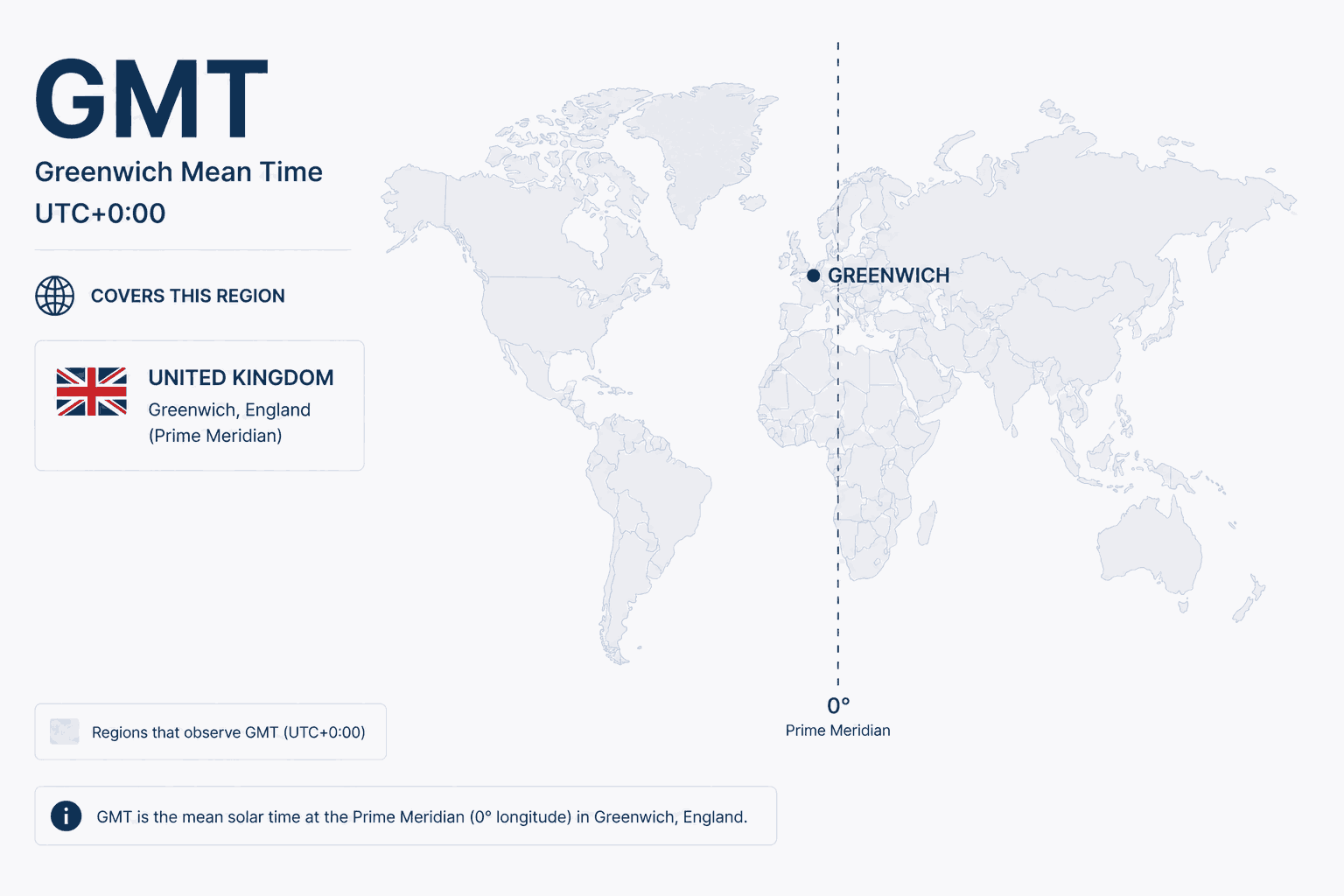
The map below highlights the specific regions, countries, and territories that observe the Greenwich Mean Time time zone.
Understanding Greenwich Mean Time (GMT)
Greenwich Mean Time (GMT) sits at UTC+00:00 — the zero-point from which every other time zone on Earth is measured. Its origin traces to the Royal Observatory in Greenwich, London, where the Prime Meridian was established in 1884 as the international reference for global navigation and timekeeping. That historical function has never been replaced: GMT remains the anchor for international financial settlement, aviation coordination, and broadcast scheduling worldwide. The London Stock Exchange opens at 08:00 GMT, and its trading window directly overlaps with both the closing hours of Asian markets and the opening of European bourses — a concentration of capital flow that no other time zone replicates.
Countries and Territories Observing GMT
GMT covers a geographically distinct set of territories in Western Europe and West Africa, with meaningful variation in whether they observe Daylight Saving Time.
- ✦Europe: The United Kingdom and Ireland observe GMT during standard time (winter), shifting to BST and Irish Standard Time respectively in summer. Portugal also uses GMT as its standard offset, advancing to Western European Summer Time (WEST, UTC+1) during DST. Iceland is the notable exception — it remains at UTC+0 permanently, observing neither DST nor any seasonal offset change.
- ✦Africa: A broad band of West African nations uses UTC+0 year-round with no DST: Ghana, Senegal, Ivory Coast, Mali, Mauritania, Guinea, Burkina Faso, and others. These countries maintain a fixed GMT offset regardless of the season, meaning they fall in line with GMT in winter but diverge by one hour from BST-observing UK and Ireland between March and October.
Daylight Saving Time (DST) Rules
The United Kingdom and Ireland advance their clocks to UTC+1 — British Summer Time (BST) and Irish Standard Time (IST) respectively — beginning on the last Sunday in March and reverting to GMT on the last Sunday in October. In 2026, clocks spring forward on March 29 and fall back on October 25. Portugal follows the same schedule under Western European Summer Time (WEST).
Iceland, Ghana, Senegal, and all other West African GMT nations do not observe DST. From late March through late October each year, a practical one-hour gap opens between London and Accra — a detail that matters for anyone scheduling calls across those corridors during summer months.
| Major Cities | Country | DST Observed? |
|---|---|---|
| London | United Kingdom | Yes |
| Dublin | Ireland | Yes |
| Lisbon | Portugal | Yes |
| Accra | Ghana | No |
| Dakar | Senegal | No |
| Reykjavik | Iceland | No |
Global Business Guide
Scheduling from the Americas: New York (EST, UTC-5) is 5 hours behind GMT in winter, narrowing to 4 hours during the DST transition period in spring. A 14:00–17:00 GMT window corresponds to 09:00–12:00 EST — the most productive overlap for US East Coast and London collaboration. For US Central (CST, UTC-6) and West Coast (PST, UTC-8) teams, morning GMT hours are inaccessible during standard business hours, making 16:00–17:00 GMT the only viable real-time window before London closes.
Scheduling from Asia: Tokyo (JST, UTC+9) is 9 hours ahead of GMT. London's 08:00–09:00 opening corresponds to 17:00–18:00 in Tokyo — a narrow but functional overlap at the boundary of each city's workday. Singapore and Hong Kong (UTC+8) offer a slightly wider window: GMT's 09:00–10:00 aligns with their 17:00–18:00. For India (IST, UTC+5:30), a 09:30–11:00 GMT morning maps cleanly to 15:00–16:30 IST, making that window the standard choice for GMT–India business calls.
Frequently Asked Questions
What is the difference between GMT and BST?
GMT (Greenwich Mean Time) is the UK's standard winter offset at UTC+0, observed from the last Sunday in October through the last Sunday in March. BST (British Summer Time) is the daylight saving offset at UTC+1, applied each summer when clocks advance one hour.
Is GMT the same as UTC?
GMT and UTC share exactly the same numerical offset — both represent UTC+00:00 — but they are fundamentally different in nature. UTC is an atomic-clock-based international time standard used as the global reference, while GMT is a geographic time zone legally observed by specific countries including the United Kingdom and Ireland during winter months.
Need to schedule a meeting?
Use our dedicated converter pages to find the perfect overlap time across different time zones.