
Current Time in Central European Time (CET)
Central European Time (CET) is 1 hour ahead of Coordinated Universal Time (UTC+01:00). It covers the majority of the European Union and parts of North Africa.
Current Central European Time (CET) Time
Date: ... · Your Local Time: ...
Important Note: Central European Time has a fixed standard offset of +01:00. However, because this location observes Daylight Saving Time, the live clock above may currently reflect a different daylight offset.
Central European Time Geographical Coverage
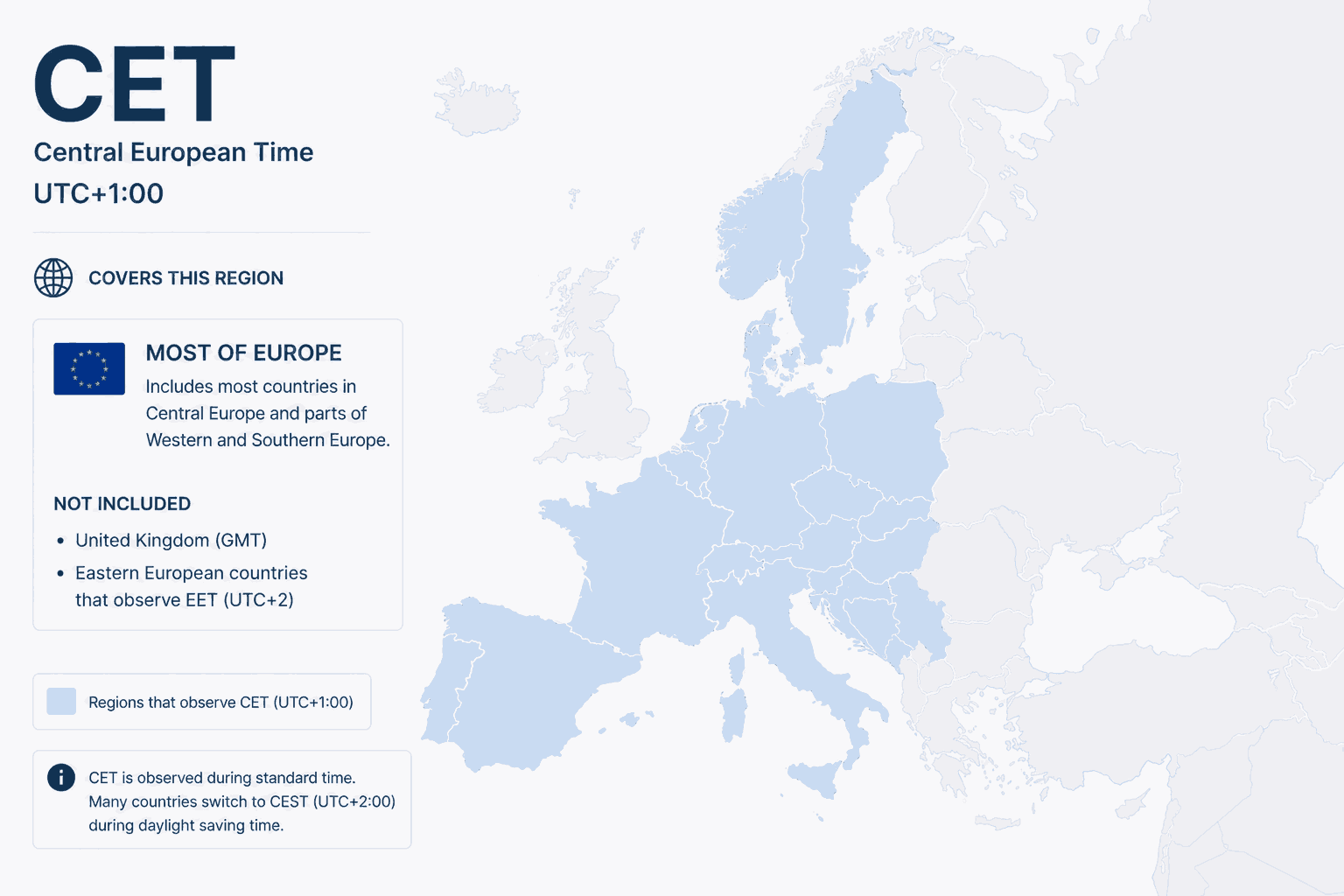
The map below highlights the specific regions, countries, and territories that observe the Central European Time time zone.
Understanding Central European Time (CET)
Central European Time (CET) operates at UTC+1:00 and functions as the unified working clock for the majority of the European Union — a single economic bloc with a combined GDP exceeding $17 trillion. From the manufacturing corridors of the Rhine-Ruhr to the financial architecture of Frankfurt's banking district, from the fashion and luxury industries in Paris and Milan to the logistics networks spanning Warsaw and Rotterdam, CET anchors the business day for more EU member states than any other offset. During Daylight Saving Time, the zone advances to Central European Summer Time (CEST) at UTC+2:00, maintaining synchronized market hours across the continent.
Countries and Territories Observing CET
CET covers a contiguous block across central and western Europe and extends into North and Central Africa, with an important DST distinction between the two regions.
- ✦Europe: France, Germany, Italy, Spain, and Poland form the economic core of the CET zone. The Netherlands, Belgium, Luxembourg, Austria, Switzerland, Czech Republic, Slovakia, Hungary, Croatia, and Serbia all observe CET. Scandinavia is also fully included — Sweden, Norway, and Denmark operate on CET/CEST, keeping northern European markets synchronized with the continental core. Monaco, Andorra, San Marino, and Vatican City follow suit.
- ✦Africa: Algeria and Tunisia observe UTC+1 year-round without DST, making them fixed CET equivalents. The western regions of the Democratic Republic of the Congo and Angola also use UTC+1 permanently. From late March through late October, a one-hour gap opens between these African capitals and their European CET counterparts who have shifted to CEST — a scheduling detail that is routinely missed in cross-Mediterranean business calls.
Daylight Saving Time (DST) Rules
All EU member states observing CET advance their clocks to CEST (UTC+2:00) on the last Sunday in March and revert to CET (UTC+1:00) on the last Sunday in October, under a coordinated EU-wide directive. In 2026, clocks spring forward on March 29 at 02:00 local time and fall back on October 25 at 03:00 local time.
Algeria, Tunisia, DR Congo, and Angola do not observe DST. They remain at UTC+1 throughout the year, which means they are aligned with CET in winter but a full hour behind CEST-observing European cities during summer.
| Major Cities | Country | DST Observed? |
|---|---|---|
| Paris | France | Yes |
| Berlin | Germany | Yes |
| Rome | Italy | Yes |
| Madrid | Spain | Yes |
| Warsaw | Poland | Yes |
| Algiers | Algeria | No |
| Tunis | Tunisia | No |
Global Business Guide
Scheduling from the Americas: New York (EST, UTC-5) is 6 hours behind CET in winter, narrowing to 5 hours during CEST. A 14:00–17:00 CET window maps to 08:00–11:00 EST — the ideal corridor for transatlantic calls between the US East Coast and Frankfurt, Paris, or Berlin. Chicago (CST, UTC-6) and the US Central corridor face a tighter window: 16:00–17:00 CET aligns with 10:00–11:00 CST, leaving only the final hour of the European workday as live overlap. For West Coast US teams (PST, UTC-8), real-time synchronization with CET business hours is not practical — asynchronous handoffs are the default.
Scheduling from Asia: Tokyo (JST, UTC+9) is 8 hours ahead of CET. Frankfurt's 09:00 opening corresponds to 17:00 in Tokyo, making the start of the European workday the only viable cross-continental live window for Japan–EU calls. Singapore and Hong Kong (UTC+8) share a similar dynamic — CET's 09:00–10:00 maps to 16:00–17:00 in those cities. India (IST, UTC+5:30) offers the most workable Asia–Europe overlap: a CET window of 13:00–16:00 corresponds to 17:30–20:30 IST, enabling end-of-day India calls to connect with early-afternoon Europe — the standard scheduling pattern for EU–India technology and services teams.
Frequently Asked Questions
What is the difference between CET and CEST?
CET (Central European Time) is the standard winter offset at UTC+1, observed from the last Sunday in October through the last Sunday in March. CEST (Central European Summer Time) is the daylight saving offset at UTC+2, applied each summer when European clocks advance one hour.
Does Spain use Central European Time?
Yes, mainland Spain observes CET (UTC+1) in winter and CEST (UTC+2) in summer, placing it on the same clock as Germany and France. This makes Spain one hour ahead of the United Kingdom despite sharing a much closer geographic longitude to Portugal, which uses GMT.
Need to schedule a meeting?
Use our dedicated converter pages to find the perfect overlap time across different time zones.