
Current Time in Eastern European Time (EET)
Eastern European Time (EET) is 2 hours ahead of Coordinated Universal Time (UTC+02:00). It covers a vast corridor from Finland down to Greece, serving as Europe's major tech and IT hub.
Current Eastern European Time (EET) Time
Date: ... · Your Local Time: ...
Important Note: Eastern European Time has a fixed standard offset of +02:00. However, because this location observes Daylight Saving Time, the live clock above may currently reflect a different daylight offset.
Eastern European Time Geographical Coverage
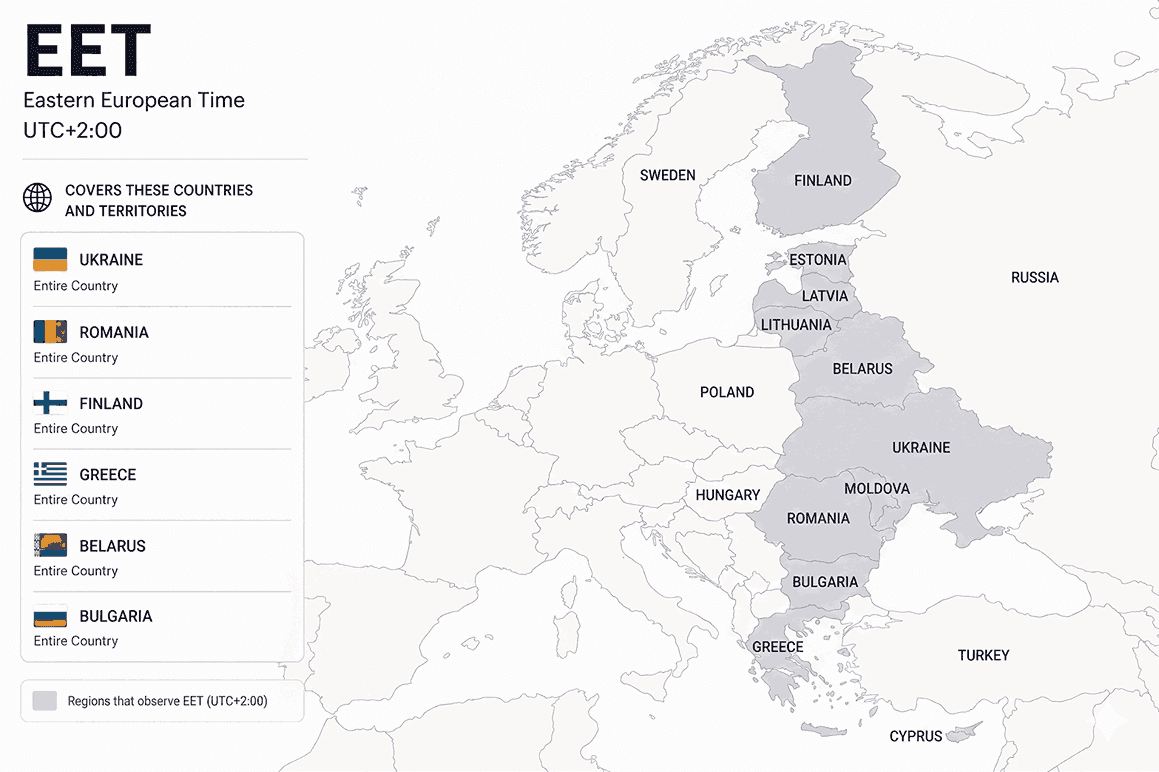
The map below highlights the specific regions, countries, and territories that observe the Eastern European Time time zone.
Understanding Eastern European Time (EET)
Eastern European Time (EET) operates at UTC+02:00, placing it two hours ahead of Coordinated Universal Time and one hour ahead of Central Europe. Far from a minor regional designation, EET anchors an economically significant corridor stretching from the Baltic Sea to the Mediterranean. The countries under its clock are home to some of Europe's fastest-growing technology sectors — Estonia pioneered e-governance and digital infrastructure that other nations now study as a model, while Romania and Ukraine have become primary destinations for software engineering and IT outsourcing. Beyond tech, EET covers Greece's sprawling maritime and shipping industry, one of the world's largest merchant fleets by tonnage, and the agricultural and manufacturing heartlands of Romania and Bulgaria. When Western European businesses need senior engineering capacity, a same-continent time zone to collaborate with, or affordable logistics expertise, they typically reach into EET territory first.
Countries and Territories Observing EET
The UTC+02:00 offset is shared by two distinct groups with very different DST behaviours.
- ✦Eastern Europe and the Baltics: The contiguous EET bloc covers Finland, Estonia, Latvia, Lithuania, Ukraine, Romania, Bulgaria, Greece, and Cyprus. Every one of these countries observes the unified EU Daylight Saving Time schedule, switching to EEST (UTC+03:00) in summer. Despite spanning thousands of kilometres — from Helsinki's Arctic latitude to Cyprus's Mediterranean coastline — this entire region moves its clocks on the same date.
- ✦Regional Alignment (UTC+2): South Africa runs on South African Standard Time (SAST) at UTC+02:00 year-round with no DST adjustment. This means SAST and EET are in perfect sync only during Eastern Europe's winter period (late October to late March). Egypt also operates on UTC+02:00 and, after a decade-long pause, reintroduced Daylight Saving Time — shifting to UTC+03:00 in summer — meaning Egypt now moves in and out of alignment with EET across the year.
Daylight Saving Time (DST) Rules
Eastern Europe observes a unified DST schedule set by EU regulation. On the last Sunday in March, clocks spring forward one hour at 03:00 local time, entering Eastern European Summer Time (EEST) at UTC+03:00. On the last Sunday in October, clocks fall back one hour at 04:00 local time, returning to standard EET (UTC+02:00).
This contrasts sharply with South Africa, which holds a fixed UTC+02:00 position throughout the entire year — no spring-forward, no fall-back. For global schedulers, this means a meeting time confirmed with a Cape Town contact in January will shift by one hour relative to Bucharest or Athens when summer arrives.
| Major Cities | Country | DST Observed? |
|---|---|---|
| Bucharest | Romania | Yes |
| Athens | Greece | Yes |
| Helsinki | Finland | Yes |
| Kyiv | Ukraine | Yes |
| Cape Town | South Africa | No |
| Cairo | Egypt | Yes |
Global Business Guide
EET is one of the most collaboration-friendly time zones for international teams because of its position on the UTC scale.
From Western Europe (CET/CEST): EET sits exactly one hour ahead of Central European Time. A 10:00 AM meeting in Berlin is 11:00 AM in Bucharest or Athens — full business-hour overlap throughout the entire workday. This is the tightest cross-timezone alignment anywhere in Europe.
From the Americas (EST): EET is 7 hours ahead of Eastern Standard Time (EST). The practical sweet spot is EET's early afternoon. A call scheduled at 14:00–17:00 EET corresponds to 07:00–10:00 EST in New York — catching the East Coast at the start of its morning before the day fragments.
From India (IST) and Southeast Asia (SGT): IST (UTC+05:30) runs 3.5 hours ahead of EET. The optimal window is EET's morning — a 09:00–12:00 EET call maps to 12:30–15:30 IST, squarely within Indian business hours. Singapore (SGT, UTC+08:00) is 6 hours ahead of EET, making an 09:00–11:00 EET start the cleanest overlap before the Singapore afternoon closes out.
Frequently Asked Questions
What is the difference between EET and EEST?
EET (Eastern European Time) is the standard winter offset at UTC+02:00, observed from late October to late March. EEST (Eastern European Summer Time) is the daylight saving offset at UTC+03:00, active from the last Sunday in March to the last Sunday in October across Eastern European countries.
Is South African Time (SAST) the same as EET?
South Africa operates on SAST (UTC+02:00), which shares the same numerical offset as EET during winter. However, South Africa does not observe Daylight Saving Time, so it only aligns with EET from late October to late March — when Eastern Europe returns to its standard UTC+02:00 offset.
Need to schedule a meeting?
Use our dedicated converter pages to find the perfect overlap time across different time zones.