
Current Time in South African Standard Time (SAST)
South African Standard Time (SAST) operates at UTC+02:00 year-round, anchoring the business day for the African continent's largest economy and its most significant financial markets. SAST never observes Daylight Saving Time, making Johannesburg and Cape Town two of the most scheduling-stable major business hubs for European and UK enterprise partners.
Current South African Standard Time (SAST) Time
Date: ... · Your Local Time: ...
South African Standard Time Geographical Coverage
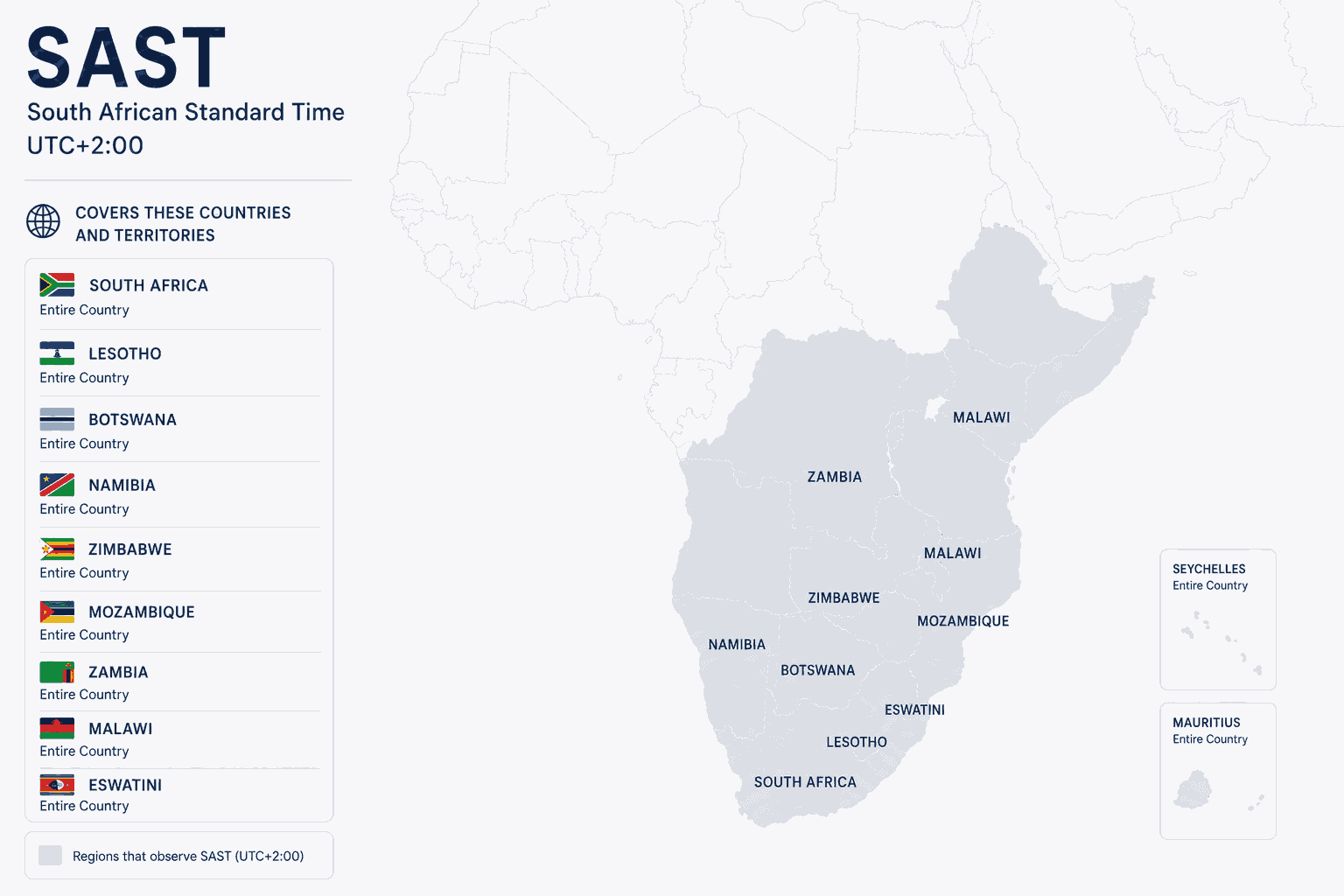
The map below highlights the specific regions, countries, and territories that observe the South African Standard Time time zone.
Understanding South African Standard Time (SAST)
South African Standard Time (SAST) operates at UTC+2:00 on a permanent, year-round basis — a fixed clock that has not observed Daylight Saving Time since 1944. The Johannesburg Stock Exchange (JSE) is the largest stock exchange on the African continent by market capitalization, opening at 09:00 SAST each weekday and listing major global mining, financial services, and consumer goods corporations. Naspers — one of the world's largest technology investment companies by portfolio value, with major stakes in Tencent and numerous emerging market platforms — operates from Cape Town on this offset. Cape Town itself has developed into a recognized African technology and startup hub, attracting venture capital and remote-first technology companies drawn to its infrastructure quality, English-language environment, and proximity to European working hours. For enterprises operating across the African continent, SAST is the primary scheduling reference — the anchor time against which regional operations from Lagos to Nairobi are calibrated.
Countries and Territories Observing SAST
SAST covers the southernmost cluster of the African continent uniformly, and its UTC+2:00 offset connects it to a much broader band of African nations sharing the same permanent clock.
- ✦South Africa, Eswatini, and Lesotho: All three countries operate on SAST at UTC+2:00 with no regional subdivisions or DST adjustments. South Africa's nine provinces — from the Western Cape to Limpopo — run on an identical offset, simplifying national broadcast, financial settlement, and government operations. Eswatini (formerly Swaziland) and Lesotho, both landlocked and surrounded by South African territory, align with SAST as a direct operational necessity for cross-border trade and logistics.
- ✦Alignment with Central Africa Time (CAT): Zimbabwe, Botswana, Zambia, Malawi, the Democratic Republic of Congo (eastern zones), Rwanda, Burundi, and Uganda all observe Central Africa Time (CAT) at the same UTC+2:00 permanent offset. None of these countries observe DST. The practical result is a contiguous UTC+2 bloc stretching from Cape Town to Kampala — a massive African scheduling zone that shares zero time conversion requirement across its internal business relationships. A Johannesburg mining company coordinating with a Lusaka logistics partner, or a Cape Town fintech firm calling a Harare correspondent bank, faces no time zone calculation at all.
Daylight Saving Time (DST) Rules
SAST does not observe Daylight Saving Time. South Africa last adjusted its clocks in 1944 and has maintained a fixed UTC+2:00 offset without interruption since. No DST legislation has been introduced or seriously proposed since, and South Africa's financial regulators, JSE settlement systems, and corporate treasury operations are all built around a permanent, unchanging offset.
The strategic consequence of this DST-free status is most visible in the European BPO and offshore IT sector. When European countries advance to CEST (UTC+2) in late March, SAST and CEST reach numerical parity — Johannesburg and Frankfurt share the same clock for the seven months of European summer. When Europe reverts to CET (UTC+1) in late October, SAST moves 1 hour ahead of Frankfurt but remains only 2 hours ahead of London. The offset between South Africa and any European country shifts entirely due to Europe's clock changes — never South Africa's. For European enterprises managing South African delivery centers, this means the scheduling relationship is simple to track: one hour shifts in October when Europe falls back, and again in March when Europe springs forward. The South African team itself adjusts nothing.
| Major Cities (UTC+2) | Country | DST Observed? |
|---|---|---|
| Johannesburg | South Africa | No |
| Cape Town | South Africa | No |
| Durban | South Africa | No |
| Pretoria | South Africa | No |
| Harare | Zimbabwe | No |
| Lusaka | Zambia | No |
Global Business Guide
Europe — the strategic alignment window: During European summer (CEST, UTC+2), SAST and Central European Time are numerically identical. Berlin at 10:00 CEST equals Johannesburg at 10:00 SAST — zero offset, zero conversion. Paris, Rome, Madrid, Amsterdam, and Warsaw are all on the same clock as Cape Town from late March through late October. London (BST, UTC+1) is just 1 hour behind SAST during this period: a 09:00 SAST Johannesburg start corresponds to 08:00 BST in London, within the first hour of the UK business day. This alignment is the primary driver behind South Africa's growing role as a European BPO and offshore IT destination — not only are wages and operational costs competitive, but the scheduling friction of working with a South African team is close to zero for seven months of the year.
During European winter (CET, UTC+1), SAST moves 1 hour ahead of Frankfurt and Paris, and 2 hours ahead of London (GMT, UTC+0). A 09:00 SAST Johannesburg start now reaches London at 07:00 GMT — before standard UK business hours open. The practical overlap window shifts to 10:00–17:00 SAST corresponding to 09:00–16:00 CET and 08:00–15:00 GMT. Still a full working-day overlap — just without the zero-offset simplicity of the summer months.
United States: New York (EDT, UTC-4) is 6 hours behind SAST during US summer. A 09:00 SAST start in Johannesburg corresponds to 03:00 EDT in New York — well before any US business activity. The viable SAST–US East Coast overlap window is SAST's late afternoon: 15:00–17:00 SAST maps to 09:00–11:00 EDT, catching New York's morning before JSE close. During US winter (EST, UTC-5), the gap widens to 7 hours, tightening the live overlap to 16:00–17:00 SAST = 09:00–10:00 EST — a single hour at the end of the South African workday. US West Coast teams (PDT, UTC-7) face a 9-hour summer gap: no standard business-hours overlap exists with SAST, and asynchronous handoffs are the default model for South Africa–California coordination.
Asia: Singapore (SGT, UTC+8) is 6 hours ahead of SAST. Johannesburg's 09:00 corresponds to Singapore's 15:00 SGT — mid-afternoon, with three hours remaining before Singapore's standard 18:00 close. The SAST morning is the most productive window for South Africa–Asia live calls: 09:00–12:00 SAST maps to 15:00–18:00 SGT and 16:00–19:00 JST, capturing the final working hours of Asia's business day before it closes. India (IST, UTC+5:30) is 3.5 hours ahead: SAST's 09:00–13:00 morning maps to 12:30–16:30 IST, a comfortable midday overlap for South Africa–India technology and services coordination.
Frequently Asked Questions
Does South Africa observe Daylight Saving Time?
South Africa does not observe Daylight Saving Time and has not done so since 1944, remaining permanently fixed at UTC+2:00 every day of the year. This means that when European countries advance to CEST (UTC+2) each spring, SAST and Central European Summer Time reach an identical offset — a zero-difference alignment that makes South Africa one of Europe's most time-convenient offshore business partners during summer months.
Is SAST the same as European time?
SAST (UTC+2) matches Central European Summer Time (CEST, UTC+2) exactly during the European summer from late March to late October — meaning Johannesburg and Berlin, Paris, and Rome run on the same clock for roughly seven months of the year. During European winter, when the continent reverts to CET (UTC+1), SAST moves 1 hour ahead of Frankfurt and Paris, and 2 hours ahead of London (GMT, UTC+0).
Need to schedule a meeting?
Use our dedicated converter pages to find the perfect overlap time across different time zones.