
Current Time in Peru Time (PET)
Peru Time (PET) is 5 hours behind Coordinated Universal Time (UTC-05:00). It serves as the unified standard time zone for the entire country of Peru.
Current Peru Time (PET) Time
Date: ... · Your Local Time: ...
Peru Time Geographical Coverage
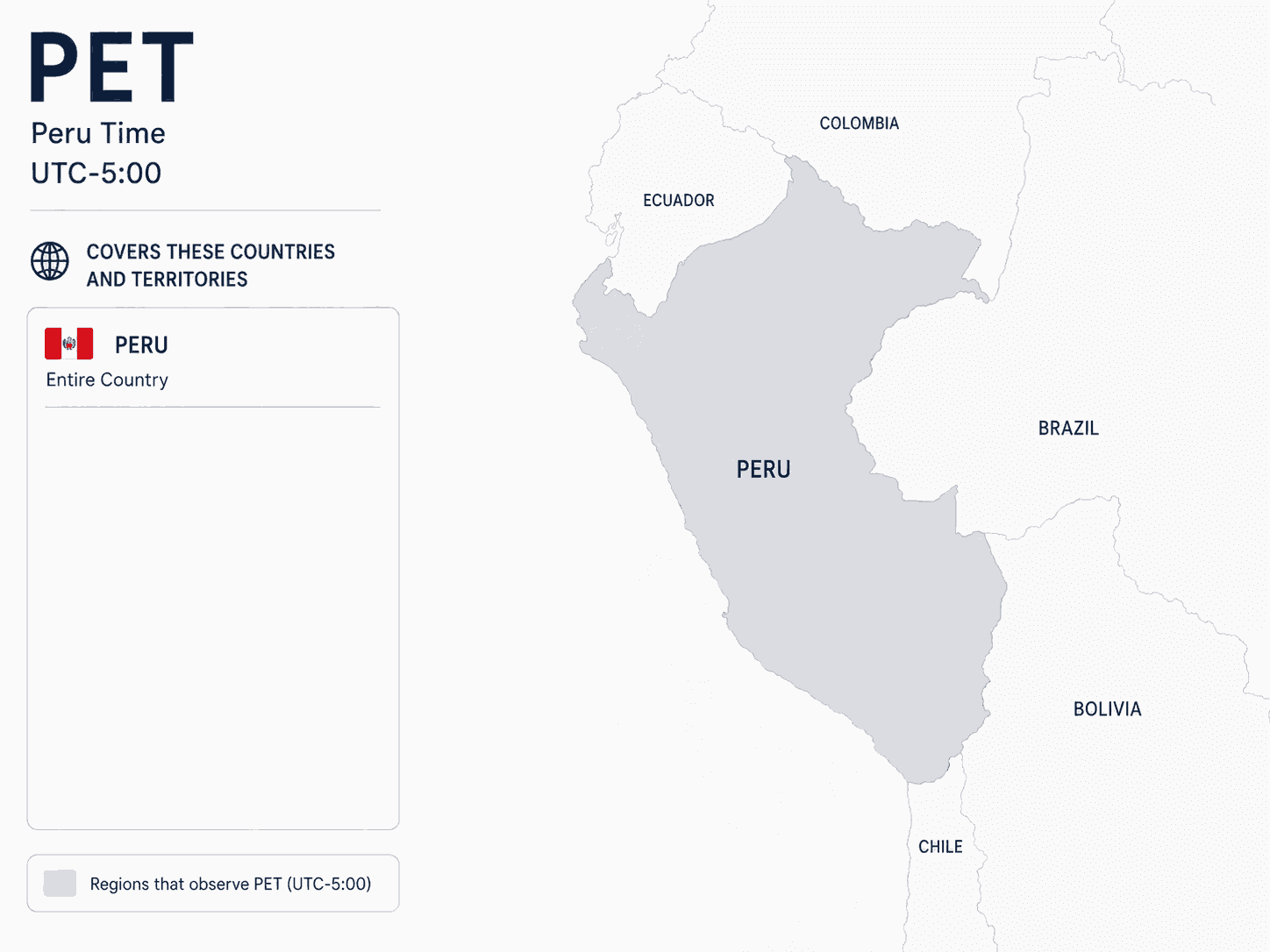
The map below highlights the specific regions, countries, and territories that observe the Peru Time time zone.
Understanding Peru Time (PET)
Peru Time (PET) operates at UTC-05:00, placing Lima 5 hours behind Coordinated Universal Time and at the center of one of South America's most resource-intensive economies. Peru ranks among the world's top three producers of copper, silver, and zinc — commodities whose pricing and delivery schedules are negotiated against international markets that require precise, reliable time coordination. Alongside mining, Peru has built a fast-growing agricultural export sector, with blueberries, grapes, and avocados now ranking among its top export earners by value. Lima anchors all of this as the country's financial capital, its primary Pacific port hub, and a city with a global culinary reputation that has made it one of South America's most prominent destinations for international business travel and investment.
Countries and Territories Observing PET
Peru applies a single, unified time zone across its entire national territory. From the Pacific coastal desert to the high Andean plateau and down into the Amazon rainforest, every region of Peru operates on the same UTC-05:00 clock.
- ✦National Unification: PET covers all 25 regions of Peru without exception. This single-zone structure matters operationally: mining operations in the Andes, agricultural logistics on the coast, and financial services in Lima all coordinate against the same clock, removing any domestic offset complexity from supply chain scheduling, export documentation, and interregional business communications.
- ✦Regional Alignment (UTC-5): PET shares its exact UTC-05:00 offset with Colombia Time (COT) and Ecuador Time (ECT), placing Lima, Bogotá, and Quito on identical schedules. This Andean UTC-5 corridor connects three major South American commodity exporters — copper and silver from Peru, oil from Colombia, and petroleum and bananas from Ecuador — without any offset friction for cross-border trade settlements, shared logistics, or joint venture coordination.
Daylight Saving Time (DST) Rules
Peru has not observed Daylight Saving Time since 1994 and maintains a permanent UTC-05:00 offset year-round. For Peru's commodity-driven economy, this consistency is operationally significant: copper futures traders managing positions on the London Metal Exchange (LME) and Chicago Mercantile Exchange (CME) need predictable Lima business hours that do not shift against fixed market open and close times. Agricultural exporters coordinating refrigerated container shipments with North American and European importers face the same requirement. The absence of DST removes one recurring variable from scheduling calculations that are already complex.
| Major Regional Cities (UTC-5) | Country | DST Observed? |
|---|---|---|
| Lima | Peru | No |
| Bogotá | Colombia | No |
| Quito | Ecuador | No |
| New York (Winter) | USA | Yes |
Global Business Guide
PET's UTC-05:00 position delivers some of the tightest North American alignment available from South America, alongside a productive European overlap and a structurally difficult Asia-Pacific corridor.
Americas — EST parity and commodity market alignment: During the Northern Hemisphere winter, PET and US Eastern Standard Time (EST, UTC-05:00) are perfectly synchronized — no offset between Lima and New York. This alignment is commercially critical: the Lima Stock Exchange (BVL) closes at 15:00 PET, which corresponds exactly to 15:00 EST in winter, meaning Peruvian equities and commodity settlement prices are available to New York traders at the same local time. When the US moves to EDT (UTC-04:00) in summer, PET falls one hour behind, but the practical overlap remains wide. For US Central Time clients, the relationship mirrors the COT pattern: PET runs one hour ahead in winter and matches CST exactly in summer.
Europe: PET mornings align with the European business afternoon. At 09:00–13:00 PET, London is at 14:00–18:00 GMT and Frankfurt is at 15:00–19:00 CET. This window is particularly relevant for LME copper and precious metals trading, where European market participants and Lima-based miners or trading desks frequently need to align on prices and contract terms before end-of-business in Europe.
Asia-Pacific: Despite Peru's significant trans-Pacific trade flows — China is Peru's largest single trading partner for copper exports — live scheduling between PET and Asia-Pacific time zones is structurally difficult. Tokyo (JST, UTC+9) sits 14 hours ahead; Beijing (CST, UTC+8) is 13 hours ahead; Sydney (AEDT, UTC+11) reaches 16 hours ahead in Australian summer. The copper trade between Lima and Shanghai runs on structured settlement mechanisms rather than live calls, and companies managing this corridor rely on async communication, overnight reporting cycles, and designated liaison windows at the edges of each side's business day.
Frequently Asked Questions
Does Peru observe Daylight Saving Time?
Peru does not observe Daylight Saving Time and has not done so since 1994. PET remains fixed at UTC-05:00 throughout the entire year, with no seasonal clock changes affecting business hours, market schedules, or international coordination.
How does Peru Time (PET) align with the US?
PET (UTC-05:00) is identical to US Eastern Standard Time (EST) during the Northern Hemisphere winter — Lima and New York run on the exact same clock. When the US shifts to Eastern Daylight Time (EDT, UTC-04:00) in summer, PET falls one hour behind, but a full shared workday between Peru and the US East Coast remains entirely achievable without scheduling concessions on either side.
Need to schedule a meeting?
Use our dedicated converter pages to find the perfect overlap time across different time zones.