
Current Time in Mountain Daylight Time (MDT)
Mountain Daylight Time (MDT) is 6 hours behind Coordinated Universal Time (UTC-06:00). It is observed during the summer months across the Rocky Mountain region of North America.
Current Mountain Daylight Time (MDT) Time
Date: ... · Your Local Time: ...
Important Note: Mountain Daylight Time has a fixed standard offset of -06:00. However, because this location observes Daylight Saving Time, the live clock above may currently reflect a different daylight offset.
Mountain Daylight Time Geographical Coverage
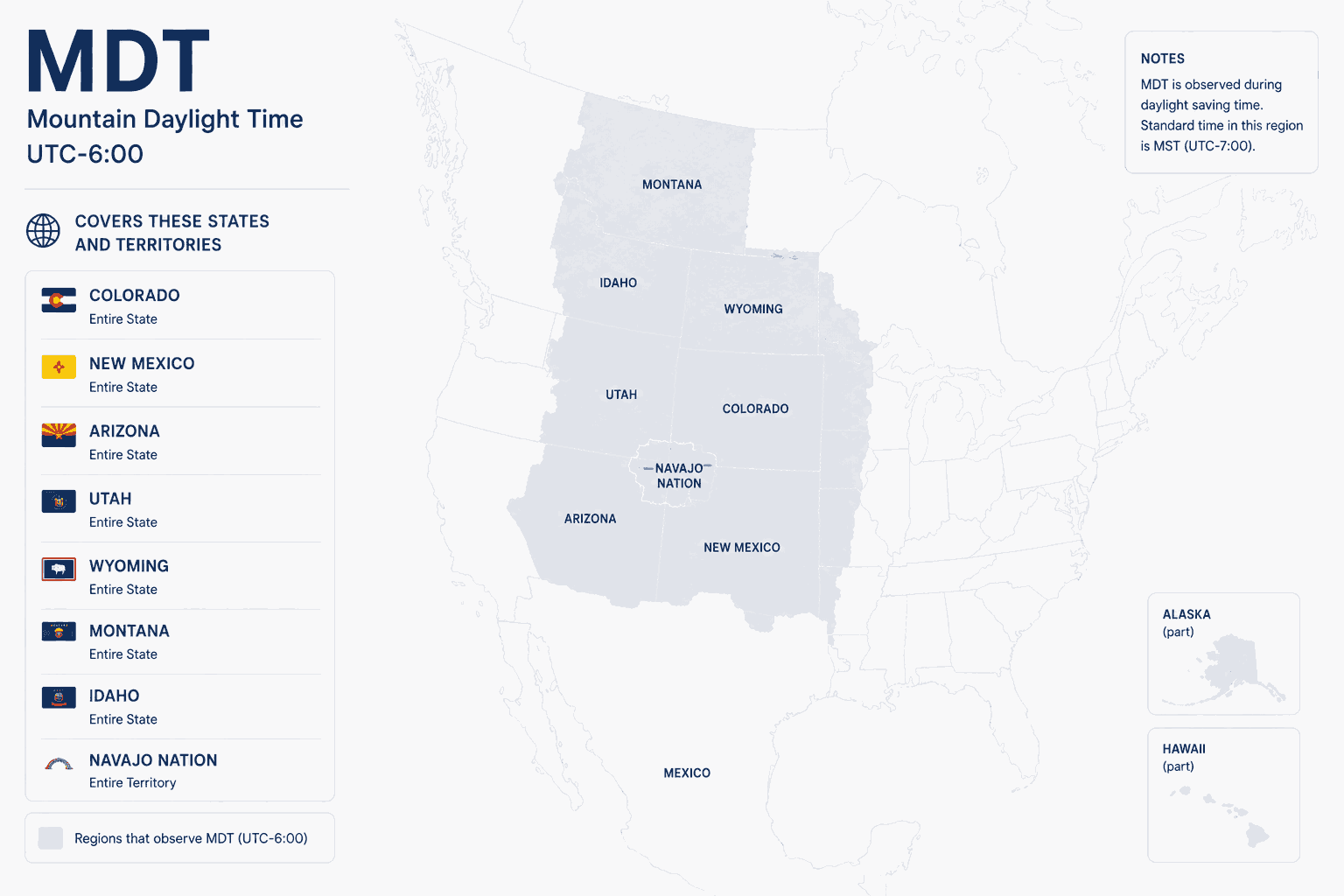
The map below highlights the specific regions, countries, and territories that observe the Mountain Daylight Time time zone.
Understanding Mountain Daylight Time (MDT)
Mountain Daylight Time (MDT) operates at UTC-6:00 and represents the active daylight saving phase for the Rocky Mountain corridor of North America — the approximately eight-month window from mid-March through early November when Denver, Salt Lake City, Calgary, and Edmonton run one hour ahead of their winter standard. Alberta's oil sands around Calgary and Edmonton represent one of the world's largest proven petroleum reserves, and the energy companies coordinating production, pipeline logistics, and commodity trading from this corridor operate on MDT schedules for the majority of the year. Denver's Front Range technology and aerospace cluster — anchored by Lockheed Martin, Raytheon, and a growing concentration of SaaS and cloud infrastructure companies — has expanded significantly in the 2020s. Utah's Wasatch Front, branded as "Silicon Slopes," hosts major operations for Adobe, Qualtrics, and Domo, making MDT increasingly central to global technology product and release calendars during its active period.
Regions Observing MDT
MDT is observed across a north-to-south corridor of western North America spanning the US Rockies and Canadian Prairie provinces, with one well-documented internal exception.
- ✦Observing Regions: Colorado, Utah, Wyoming, Montana, and Idaho advance from MST (UTC-7) to MDT (UTC-6) on the standard federal schedule each March. In Canada, Alberta — including Calgary and Edmonton — observes MDT on the same schedule as the US states, maintaining full synchronization with Denver throughout the summer. Parts of British Columbia's eastern interior and the Northwest Territories also fall within the Mountain Time zone and observe MDT accordingly. New Mexico, parts of Kansas, Nebraska, North Dakota, and South Dakota that lie within the Mountain Time boundary also advance to MDT.
- ✦The Arizona Exception: Most of Arizona — including Phoenix, Tucson, and the state government — does not observe Daylight Saving Time and remains on MST (UTC-7) year-round, a policy in place since 1968. During the MDT period from March through November, Phoenix at MST (UTC-7) aligns with Los Angeles and San Francisco at PDT (also UTC-7) rather than with Denver at MDT (UTC-6). A Denver company calling a Phoenix office during summer must account for a one-hour gap that does not exist in winter. The Navajo Nation — a sovereign territory spanning parts of northeastern Arizona, southeastern Utah, and northwestern New Mexico — observes DST on the standard federal schedule, creating one of the most complex intrastate time zone situations in the United States: a traveler crossing certain roads through the Four Corners region can pass through MST, MDT, MST, and MDT within a single journey.
Daylight Saving Time (DST) Rules
MDT is the daylight saving phase of Mountain Time (MT), the umbrella designation covering both MST and MDT. Clocks advance from MST (UTC-7) to MDT (UTC-6) on the second Sunday in March at 02:00 local time and revert from MDT back to MST on the first Sunday in November at 02:00 local time. In 2026, MDT runs from March 8 through November 1 — covering approximately 238 days, or about 65% of the calendar year. The schedule is identical to the US federal DST timetable observed by EDT, CDT, and PDT, keeping all US time zone gaps internally consistent throughout the summer.
| Major Cities | State/Province | DST Observed? | Summer Offset |
|---|---|---|---|
| Denver | Colorado | Yes | UTC-6 (MDT) |
| Salt Lake City | Utah | Yes | UTC-6 (MDT) |
| Calgary | Alberta | Yes | UTC-6 (MDT) |
| Edmonton | Alberta | Yes | UTC-6 (MDT) |
| Phoenix | Arizona | No | UTC-7 (MST) |
Global Business Guide
US East Coast: New York (EDT, UTC-4) is 2 hours ahead of MDT during the Northern Hemisphere summer, when both zones are simultaneously on their daylight saving offsets. A 09:00 MDT Denver start corresponds to 11:00 EDT in New York — placing the entire Mountain Time morning within New York's late-morning and afternoon. The NYSE opens at 09:30 EDT, which is 07:30 MDT, meaning Denver-based traders and financial professionals are active well before their local 09:00 standard business open to track East Coast market hours. The 2-hour EDT lead is consistent and predictable throughout the MDT period — no transition asymmetry applies since both zones move on the same federal schedule.
US West Coast: Los Angeles and San Francisco (PDT, UTC-7) are 1 hour behind MDT during summer. A 09:00 MDT Denver start corresponds to 08:00 PDT in Los Angeles — Denver opens one hour before the West Coast each morning. The Phoenix anomaly applies here: during MDT season, Phoenix at MST (UTC-7) matches Los Angeles at PDT (UTC-7) at zero offset — a counterintuitive same-clock alignment between an Arizona city and a California city that diverges only when comparing Phoenix to Denver.
Europe: London (BST, UTC+1) is 7 hours ahead of MDT during the Northern Hemisphere summer when both are on their respective summer offsets. A 09:00 MDT Denver start corresponds to 16:00 BST in London — one hour before the LSE closes. Frankfurt (CEST, UTC+2) is 8 hours ahead: MDT's 09:00 reaches Frankfurt at 17:00 CEST, exactly at Xetra close. The practical MDT–Europe overlap window is the final 60–90 minutes of the European trading day: a 15:30–17:00 CEST Frankfurt window corresponds to 07:30–09:00 MDT in Denver, requiring European teams to end their day while Mountain Time teams are starting theirs. For sustained MDT–Europe business coordination, the early MDT morning is the daily live window, with European afternoons consumed by asynchronous follow-up from the previous day's MDT close.
Asia — the widest gap: Tokyo (JST, UTC+9) is 15 hours ahead of MDT. Singapore (SGT, UTC+8) is 14 hours ahead. Beijing (BJT, UTC+8) is also 14 hours ahead. No standard business-hours overlap exists between MDT and any major Asian market. A 17:00 MDT Denver close corresponds to 08:00 JST the following morning in Tokyo — a clean calendar-forward async handoff, but no live synchronization window during mutual working hours. India (IST, UTC+5:30) is 11.5 hours ahead of MDT: a 07:00 MDT early start reaches Mumbai at 18:30 IST, at the outer edge of extended Indian working hours — the only technically viable live MDT–India window, requiring an early start on the Mountain Time side. Asynchronous workflows with a single weekly early-morning MDT video sync are the standard operating model for any sustained MDT–Asia team coordination.
Frequently Asked Questions
When does MDT start and end?
MDT begins on the second Sunday in March at 02:00 local MST time, when clocks spring forward one hour from MST (UTC-7) to MDT (UTC-6). It ends on the first Sunday in November at 02:00 local MDT time, when clocks fall back to MST. In 2026, MDT runs from March 8 through November 1, covering the majority of the calendar year.
Is Arizona on MDT?
Most of Arizona — including Phoenix and Tucson — does not observe Daylight Saving Time and remains on MST (UTC-7) year-round under a state law in effect since 1968, meaning Arizona does not advance to MDT each March. The significant exception is the Navajo Nation, a sovereign territory spanning parts of northeastern Arizona, southeastern Utah, and northwestern New Mexico, which does observe DST and shifts to MDT on the standard federal schedule.
Need to schedule a meeting?
Use our dedicated converter pages to find the perfect overlap time across different time zones.