
Current Time in Mountain Standard Time (MST)
Mountain Standard Time (MST) is 7 hours behind Coordinated Universal Time (UTC-07:00). It covers the Rocky Mountain region of North America, from Canada down to Mexico.
Current Mountain Standard Time (MST) Time
Date: ... · Your Local Time: ...
Important Note: Mountain Standard Time has a fixed standard offset of -07:00. However, because this location observes Daylight Saving Time, the live clock above may currently reflect a different daylight offset.
Mountain Standard Time Geographical Coverage
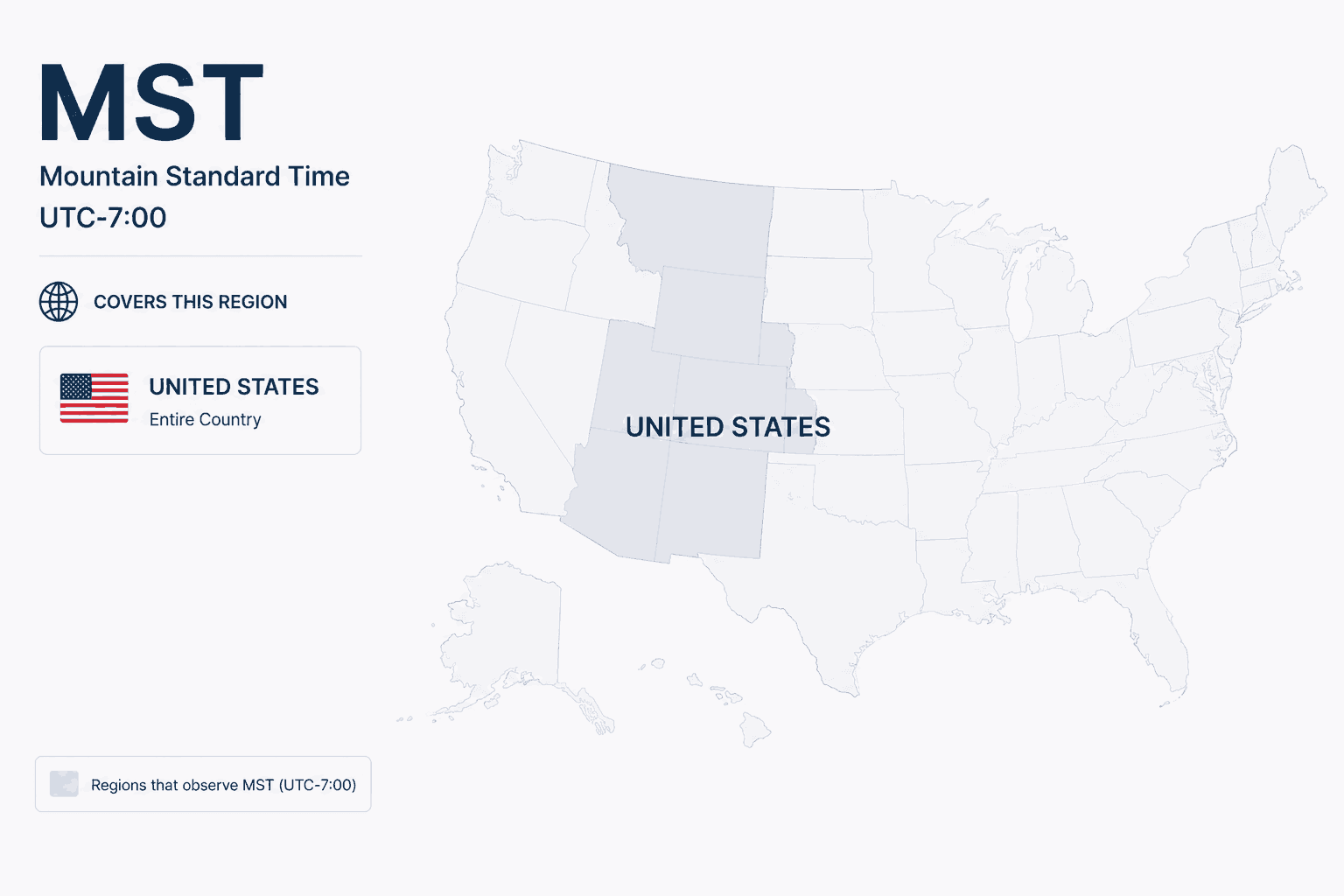
The map below highlights the specific regions, countries, and territories that observe the Mountain Standard Time time zone.
Understanding Mountain Standard Time (MST)
Mountain Standard Time (MST) operates at UTC-7:00, covering the Rocky Mountain spine of North America from Alberta's oil sands in the north through Colorado's Front Range technology and financial corridor to the Mexican border states in the south. Denver has emerged as one of North America's faster-growing technology and aerospace hubs, while Calgary anchors a Canadian energy sector that processes billions in daily commodity trade. Utah's Wasatch Front — marketed as "Silicon Slopes" — now houses major operations for Adobe, Qualtrics, Domo, and dozens of high-growth SaaS companies, making MST increasingly relevant to global technology scheduling. During Daylight Saving Time, most of the zone advances to Mountain Daylight Time (MDT) at UTC-6:00, though a significant and well-documented exception applies in Arizona.
Countries and Territories Observing MST
MST covers a north-to-south corridor of western North America across three countries, with meaningful DST variation between and within jurisdictions.
- ✦United States: Colorado, Utah, Wyoming, Montana, and Idaho form the contiguous Mountain Time core. Arizona falls within the zone's geographic boundaries but manages its own DST policy independently (detailed below). Parts of North Dakota, South Dakota, Nebraska, Kansas, and Oregon that lie west of their state's primary time zone boundary also observe Mountain Time.
- ✦Canada: Alberta — including Calgary and Edmonton — observes MST/MDT on the same schedule as the US. The Northwest Territories also operates on MST. Parts of British Columbia's eastern interior and some Saskatchewan border communities use Mountain Time, though Saskatchewan as a whole stays on CST year-round without DST.
- ✦Mexico: Sonora, Chihuahua, Sinaloa, Nayarit, and Baja California Sur all observe UTC-7 as their standard offset. Crucially, Sonora follows Arizona's lead and does not observe DST, remaining at UTC-7 year-round. Chihuahua and the remaining Mexican Mountain Time states do observe DST on a schedule aligned with the US.
Daylight Saving Time (DST) Rules
For most of the Mountain Time zone, clocks advance to MDT (UTC-6:00) on the second Sunday in March and fall back to MST (UTC-7:00) on the first Sunday in November. In 2026, MDT begins on March 8 and ends on November 1.
The Arizona Exception is the most consequential DST anomaly in the continental United States. Arizona enacted a state law in 1968 permanently exempting it from federal DST requirements, and Phoenix — the zone's fifth-largest city — has operated on fixed MST (UTC-7) ever since. The scheduling implications are counterintuitive and frequently missed: during MDT season (March through November), Phoenix at UTC-7 aligns with Los Angeles and San Francisco at PDT (also UTC-7), not with Denver at MDT (UTC-6). A Phoenix-based business calling a Denver office during summer must account for a one-hour gap that does not exist in winter.
Compounding the complexity, the Navajo Nation — a sovereign territory spanning northeastern Arizona, southeastern Utah, and northwestern New Mexico — does observe DST. During summer, a driver crossing certain roads through the Four Corners region can pass through MST, MDT, MST, and MDT within a single journey.
| Major Cities | State/Province | DST Observed? |
|---|---|---|
| Denver | Colorado | Yes |
| Salt Lake City | Utah | Yes |
| Calgary | Alberta | Yes |
| Edmonton | Alberta | Yes |
| Phoenix | Arizona | No |
| Tucson | Arizona | No |
Global Business Guide
US East Coast: New York is 2 hours ahead of Mountain Time year-round (EST is UTC-5 vs MST UTC-7; EDT is UTC-4 vs MDT UTC-6). A 09:00 Denver start maps to 11:00 in New York, offering a comfortable mid-morning overlap. However, because Phoenix never shifts to MDT, it falls 3 hours behind New York during the summer (UTC-7 vs UTC-4) rather than 2, a discrepancy that frequently catches remote teams off-guard on meeting invites.
US West Coast: Los Angeles (PST, UTC-8) is 1 hour behind MST in winter. During summer, Denver shifts to MDT (UTC-6) while Los Angeles moves to PDT (UTC-7), maintaining the same 1-hour gap. The exception is Phoenix: at fixed MST (UTC-7), it temporarily aligns perfectly with Los Angeles (PDT) at zero offset difference during the summer months.
Europe: London (GMT, UTC+0) is 7 hours ahead of MST in winter. A 16:00–17:00 GMT window corresponds to 09:00–10:00 MST — the cleanest transatlantic overlap for Mountain Time business calls. Frankfurt and Paris (CET, UTC+1) are 8 hours ahead in winter, meaning a 09:00 MST start corresponds to 17:00 CET, leaving only the very end of the European workday for live overlap.
Asia and Australia: Tokyo (JST, UTC+9) is 16 hours ahead of MST, and Singapore (SGT, UTC+8) is 15 hours ahead. No standard business-hours overlap exists on either side. For Mountain Time teams with regular APAC responsibilities, early-morning MST calls (06:00–07:00 MST = 21:00–22:00 SGT) or late-evening MST calls are the only live options, with asynchronous workflows handling the majority of daily coordination.
Frequently Asked Questions
Does Arizona observe Daylight Saving Time?
Most of Arizona — including Phoenix, Tucson, and the state government — does not observe Daylight Saving Time, remaining on MST (UTC-7) year-round under a state law in effect since 1968. The significant exception is the Navajo Nation, which spans parts of northeastern Arizona, Utah, and New Mexico and does observe DST, creating one of the most complex intrastate time zone situations in the United States.
What is the difference between MST and MDT?
MST (Mountain Standard Time) is the winter offset at UTC-7:00, observed from the first Sunday in November through the second Sunday in March. MDT (Mountain Daylight Time) is the summer offset at UTC-6:00, applied when most Mountain Time regions advance their clocks by one hour during Daylight Saving Time.
Need to schedule a meeting?
Use our dedicated converter pages to find the perfect overlap time across different time zones.