
Current Time in Indian Standard Time (IST)
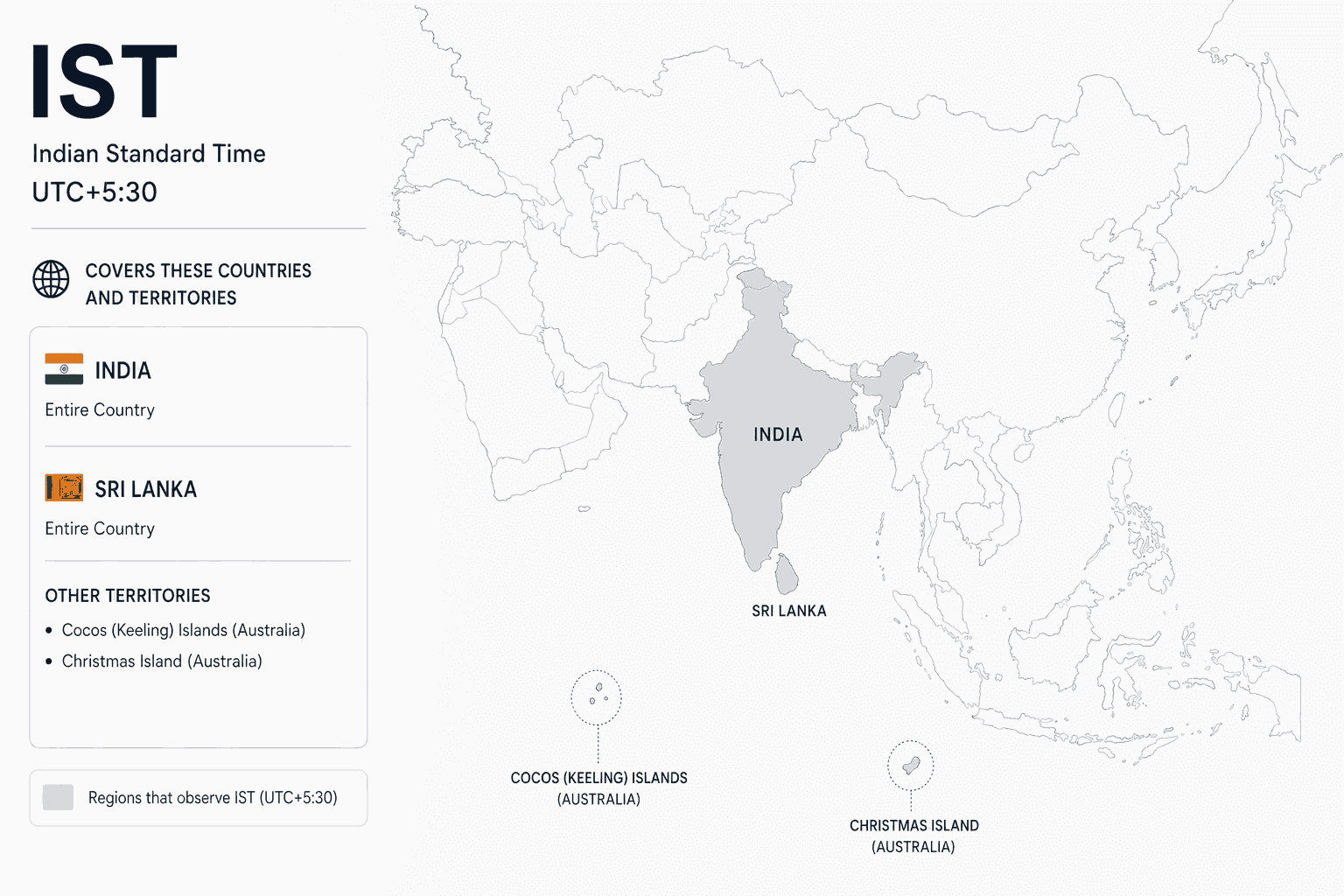
Indian Standard Time (IST) is 5 hours and 30 minutes ahead of Coordinated Universal Time (UTC+05:30). It is observed throughout India and Sri Lanka year-round.
Current Indian Standard Time (IST) Time
Date: ... · Your Local Time: ...
Abbreviation Ambiguity: The abbreviation IST is used by multiple time zones around the world. On this page, it specifically refers to Indian Standard Time (+05:30).
Indian Standard Time Geographical Coverage
The map below highlights the specific regions, countries, and territories that observe the Indian Standard Time time zone.
Understanding Indian Standard Time (IST)
Indian Standard Time (IST) sits at UTC+5:30 — a half-hour offset that reflects India's deliberate choice to split the difference between its eastern and western geographic extremes under a single national clock. That single clock governs the daily schedules of 1.4 billion people and, critically, the working hours of the world's largest technology services workforce. Bengaluru, Hyderabad, and Chennai collectively house the engineering and delivery centers for the majority of global Fortune 500 IT contracts. The Bombay Stock Exchange (BSE) and National Stock Exchange (NSE) open at 09:15 IST, processing equity trades that feed into global portfolios. For any distributed team operating across time zones, IST is not a peripheral consideration — it is a primary scheduling constraint.
Countries and Territories Observing IST
Two countries share the UTC+5:30 offset, though only India uses the IST designation officially.
- ✦India: The entire country — from the westernmost tip of Gujarat to the far eastern reaches of Arunachal Pradesh, a span of roughly 3,000 kilometres — operates on a single time zone. No regional subdivisions, no state-level variations. This uniformity simplifies national rail scheduling and broadcast coordination, though it means sunrise and sunset times vary by nearly two hours between the country's extremes.
- ✦Sri Lanka: Sri Lanka Standard Time (SLST) operates at UTC+5:30, making it numerically identical to IST. Colombo and Mumbai share the same clock, which simplifies coordination for the significant trade and technology relationships between the two countries. Sri Lanka previously used UTC+5:45 and UTC+6:00 at various points in its history before settling on its current offset.
Daylight Saving Time (DST) Rules
India does not observe Daylight Saving Time. IST has been fixed at UTC+5:30 since its standardization in 1906, and the country has had no DST policy since 1945. The clock does not change in March, October, or at any other point in the year.
This stability is an operational advantage for scheduling — IST never moves — but it creates a recurring complication for remote teams. When the United States, United Kingdom, or European countries shift their clocks twice annually, the offset between those countries and India changes by one hour. For example, a standing 10:00 AM US Eastern call maps to 20:30 IST in winter. However, when the US springs forward to EDT in March, the time gap narrows, moving that same 10:00 AM US call an hour earlier to 19:30 IST. Teams must account for this asymmetric shift proactively each spring and autumn.
| Major Cities | Country | DST Observed? |
|---|---|---|
| Mumbai | India | No |
| New Delhi | India | No |
| Bengaluru | India | No |
| Chennai | India | No |
| Hyderabad | India | No |
| Kolkata | India | No |
| Colombo | Sri Lanka | No |
Global Business Guide
Scheduling from Europe: London (GMT, UTC+0) is 5.5 hours behind IST in winter. A 09:30–10:00 GMT morning call corresponds to 15:00–15:30 IST — comfortably within Indian business hours. When the UK shifts to BST (UTC+1) in late March, that gap narrows to 4.5 hours, moving the same GMT morning call to 14:00–14:30 IST. Frankfurt and Paris (CET, UTC+1) are 4.5 hours behind IST in winter and 3.5 hours behind during CEST, making a 10:00–11:00 CET window map to 14:30–15:30 IST — the most productive overlap corridor for EU–India engineering and business calls.
Scheduling from the Americas: New York (EST, UTC-5) is 10.5 hours behind IST in winter and 9.5 hours behind during EDT. A 08:00 EST start corresponds to 18:30 IST — the final 30 minutes of the standard Indian workday and the most common overlap slot for US East Coast–India calls. For West Coast US teams (PST, UTC-8), the gap is 13.5 hours in winter: a 07:00 PST start reaches 20:30 IST, firmly outside business hours for Indian colleagues. Asynchronous workflows or a rotational meeting burden are the practical solutions for sustained PST–IST collaboration.
Frequently Asked Questions
Does India observe Daylight Saving Time (DST)?
India does not observe Daylight Saving Time and has not done so since 1945. IST remains fixed at UTC+5:30 every day of the year, meaning the offset between India and any DST-observing country shifts by one hour twice annually when those countries change their clocks.
Why does IST have a 30-minute offset?
India chose the 82.5° East meridian — which passes through Mirzapur in Uttar Pradesh — as its central reference longitude, as it bisects the subcontinent geographically. That meridian sits exactly 5 hours and 30 minutes ahead of the Prime Meridian in Greenwich, producing the UTC+5:30 offset that has defined IST since 1906.
Need to schedule a meeting?
Use our dedicated converter pages to find the perfect overlap time across different time zones.