
Current Time in Gulf Standard Time (GST)
Gulf Standard Time (GST) is 4 hours ahead of Coordinated Universal Time (UTC+04:00). It is the standard time zone for the United Arab Emirates and Oman.
Current Gulf Standard Time (GST) Time
Date: ... · Your Local Time: ...
Gulf Standard Time Geographical Coverage
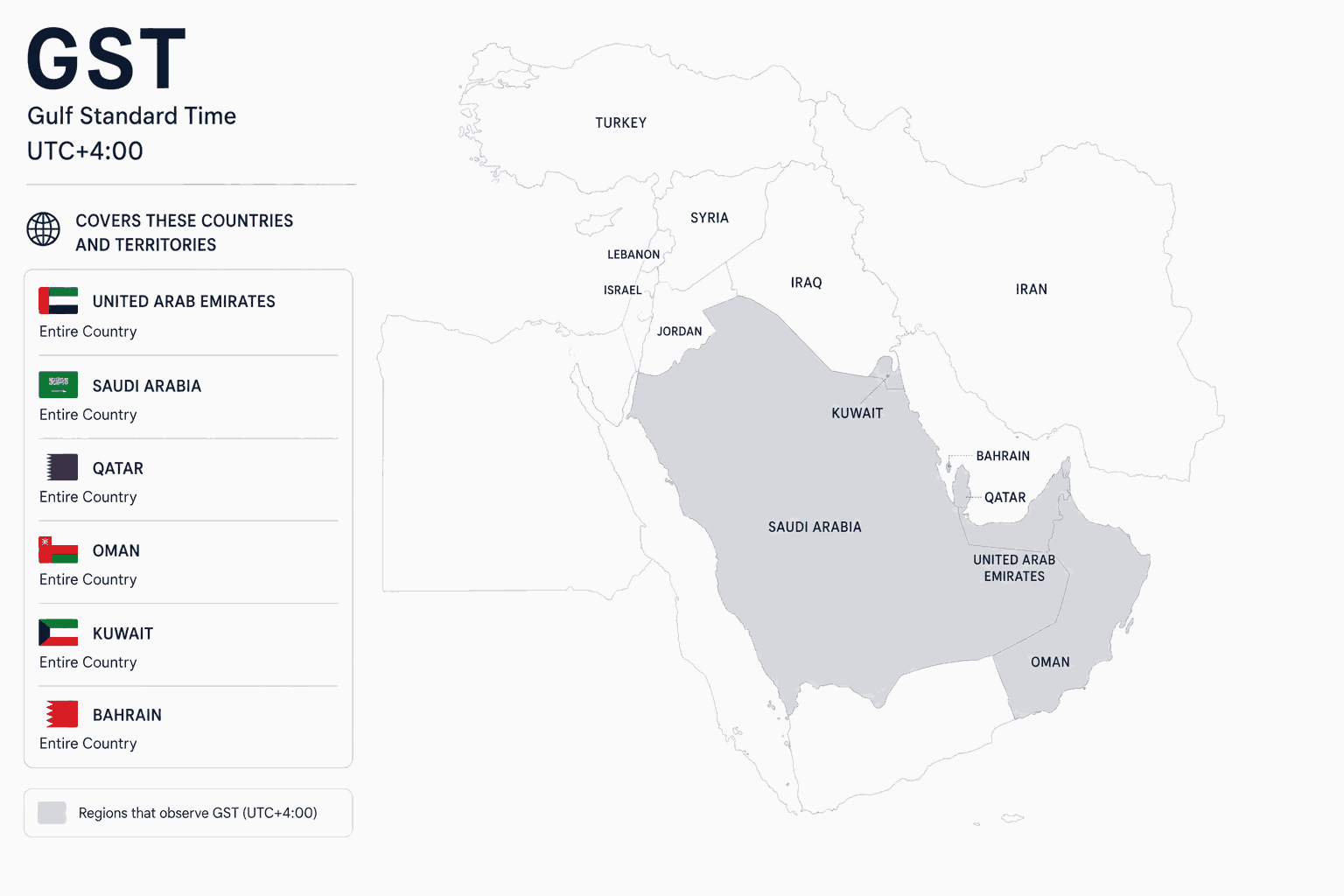
The map below highlights the specific regions, countries, and territories that observe the Gulf Standard Time time zone.
Understanding Gulf Standard Time (GST)
Gulf Standard Time (GST) operates at UTC+4:00, positioning Dubai and Abu Dhabi at the precise midpoint between the closing hours of Asian markets and the opening of European ones. When London begins its trading day at 09:00 GMT, it is already 13:00 in Dubai — giving GST-based professionals four hours of live European business overlap every afternoon. When Tokyo closes at 17:00 JST, it is 12:00 in Dubai — catching the Gulf workday at full pace. The Dubai International Financial Centre (DIFC) was built to exploit exactly this temporal geography, hosting over 4,000 registered companies that use Dubai's clock as the operational hinge between east and west. Emirates and Etihad collectively operate one of the world's two largest long-haul aviation networks from this same time anchor, routing passengers through a hub that never loses more than a few hours to either major hemisphere.
Countries and Territories Observing GST
Gulf Standard Time covers two countries on the Arabian Peninsula, both operating at UTC+4:00 year-round without any seasonal adjustment.
- ✦United Arab Emirates: All seven emirates — Dubai, Abu Dhabi, Sharjah, Ajman, Umm Al-Quwain, Ras Al Khaimah, and Fujairah — operate on a single unified time zone. There is no regional variation within the federation. The UAE's official workweek runs Monday through Friday following a 2022 federal shift from the previous Sunday–Thursday standard, aligning it more closely with European and American counterparts for international business scheduling.
- ✦Oman: The Sultanate of Oman shares the UTC+4:00 offset identically, with Muscat operating on the same clock as Dubai and Abu Dhabi. Oman has never observed DST. Its position directly adjacent to the UAE means that cross-border scheduling between Muscat and Dubai involves zero time conversion — a straightforward alignment for the significant trade volume between the two countries.
Daylight Saving Time (DST) Rules
GST does not observe Daylight Saving Time. The UAE and Oman have maintained a fixed UTC+4:00 offset without exception, and neither country has any legislative framework for seasonal clock changes. The clock in Dubai on March 29 reads the same offset as the clock on October 26 — no adjustment, no ambiguity.
For the large expatriate workforce in the UAE — which constitutes approximately 88% of the UAE's total population — this stability provides a consistent reference point for international calls home. The offset to the UK, however, does shift: during GMT (winter), London is 4 hours behind Dubai; during BST (summer), that gap narrows to 3 hours. Teams scheduling regular calls between Dubai and London must account for this one-hour seasonal shift, which originates entirely on the UK side.
| Major Cities | Country | DST Observed? |
|---|---|---|
| Dubai | United Arab Emirates | No |
| Abu Dhabi | United Arab Emirates | No |
| Sharjah | United Arab Emirates | No |
| Muscat | Oman | No |
Global Business Guide
GST's UTC+4:00 position creates two distinct and usable overlap corridors each business day.
Morning GST — Asian overlap: Between 09:00 and 12:00 GST, Singapore and Hong Kong (UTC+8) are at 13:00–16:00, and Tokyo (UTC+9) is at 14:00–17:00. This window captures Asian markets mid-afternoon and is the standard slot for Dubai–Asia trade, logistics, and financial calls before Asian cities close for the day.
Afternoon GST — European overlap: Between 13:00 and 18:00 GST, London (GMT, UTC+0) is at 09:00–14:00, and Frankfurt and Paris (CET, UTC+1) are at 10:00–15:00. This four-to-five hour afternoon window is where the bulk of Dubai's European financial and commercial activity is concentrated, with the DIFC explicitly structured around this afternoon-to-morning overlap.
India corridor: Mumbai and Bengaluru (IST, UTC+5:30) are just 1.5 hours ahead of GST — the tightest major international gap in the region. A 10:00 GST call reaches India at 11:30 IST, well within core business hours for both sides. This proximity makes the Dubai–India business corridor one of the most scheduling-friendly cross-border pairs in the world.
Americas: New York (EST, UTC-5) is 9 hours behind GST in winter. A 17:00–18:00 GST window — the final hour of the Dubai workday — corresponds to 08:00–09:00 EST, the earliest viable window for a US East Coast start. West Coast US teams (PST, UTC-8) face a 12-hour gap with no practical live overlap during standard business hours on either side.
Frequently Asked Questions
Does Dubai use Daylight Saving Time?
Dubai and the entire United Arab Emirates do not observe Daylight Saving Time, remaining fixed at UTC+4:00 throughout the year. This means the offset between Dubai and DST-observing countries such as the UK or the US shifts by one hour each spring and autumn when those countries change their clocks.
Is GST the same as UAE Standard Time?
Yes, UAE Standard Time is the national designation for the same UTC+4:00 offset that Gulf Standard Time describes regionally. Both terms refer to the same fixed clock used across the United Arab Emirates, and GST additionally covers Oman under its regional name.
Need to schedule a meeting?
Use our dedicated converter pages to find the perfect overlap time across different time zones.