
Current Time in Pakistan Standard Time (PKT)
Pakistan Standard Time (PKT) operates at 5 hours ahead of Coordinated Universal Time (UTC+05:00). It serves as the unified national time zone for Pakistan.
Current Pakistan Standard Time (PKT) Time
Date: ... · Your Local Time: ...
Pakistan Standard Time Geographical Coverage
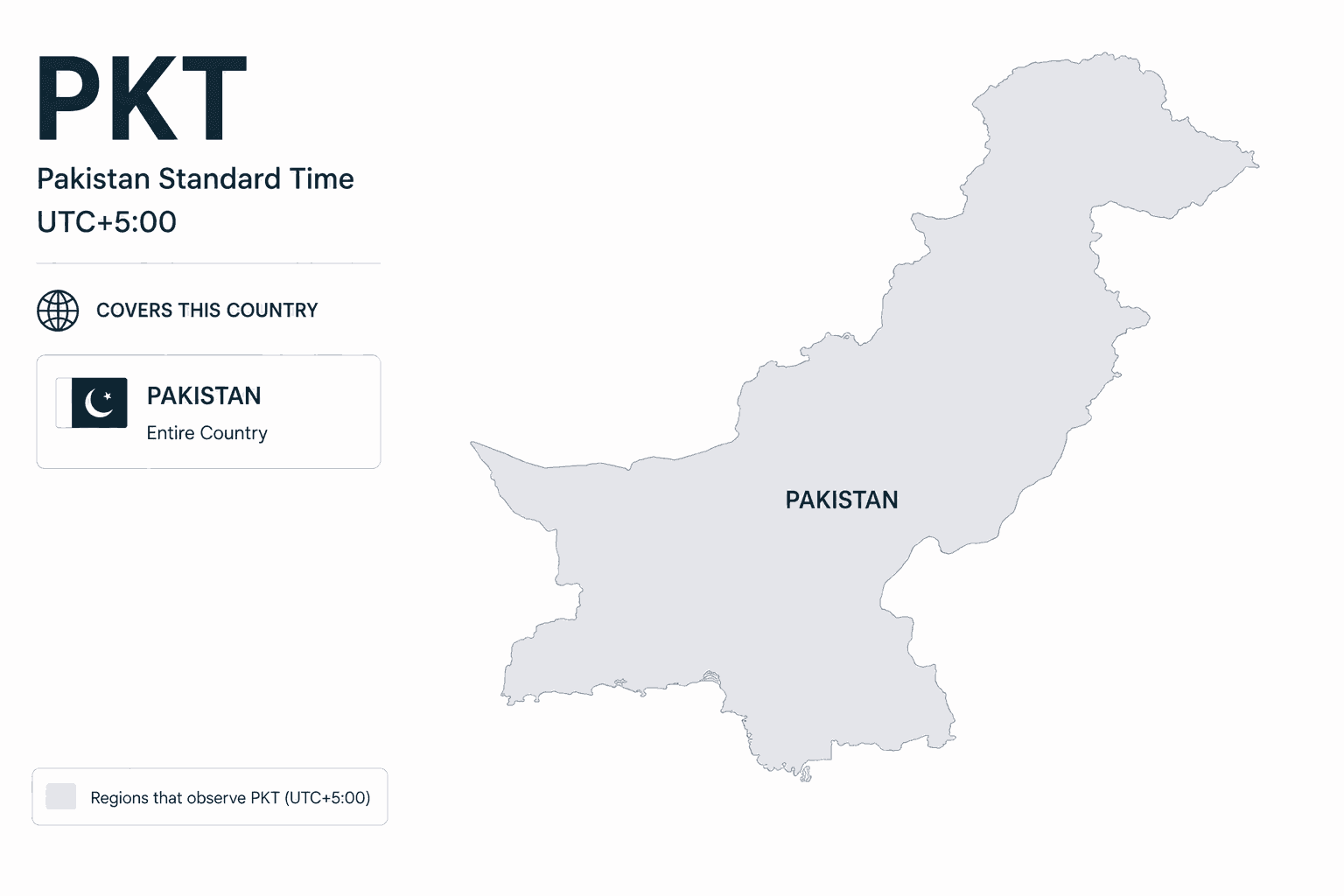
The map below highlights the specific regions, countries, and territories that observe the Pakistan Standard Time time zone.
Understanding Pakistan Standard Time (PKT)
Pakistan Standard Time (PKT) operates at UTC+5:00, positioning Karachi, Lahore, and Islamabad five hours ahead of Greenwich. Pakistan ranks among the top five countries globally by volume of registered freelancers on platforms like Upwork and Fiverr, with a technology and digital services workforce that is deeply integrated into US, European, and Gulf-based client workflows. The Pakistan Stock Exchange (PSX), headquartered in Karachi, opens at 09:15 PKT and serves a listed company base spanning textiles, cement, energy, and banking — sectors underpinning one of South Asia's largest industrial economies. The China-Pakistan Economic Corridor (CPEC), a $60+ billion infrastructure and energy investment program, has intensified Pakistan's commercial scheduling ties with China (UTC+8), making PKT a regular reference point in cross-border project coordination across three time zones. PKT's permanent, DST-free offset simplifies all of this: the clock never changes.
Countries and Territories Observing PKT
PKT covers Pakistan exclusively, with the entire country operating on a single unified time zone.
- ✦Pakistan: From the Arabian Sea port of Karachi in the south to the mountain valleys of Gilgit-Baltistan and Khyber Pakhtunkhwa in the north, every province, territory, and administrative unit in Pakistan runs on UTC+5:00. There are no regional subdivisions or internal time zone variations. The country spans roughly 1,600 kilometres from its southern coastline to its northernmost territory — a geographic range that in other large nations would typically prompt multiple time zones — but Pakistan has maintained a single national clock since independence in 1947.
Daylight Saving Time (DST) Rules
Pakistan does not observe Daylight Saving Time. The country has experimented with seasonal clock changes on three occasions — briefly in 2002, and more formally in 2008 and 2009 — each time as a government-directed energy conservation measure intended to reduce peak electricity demand during summer evenings. Public adoption was inconsistent, the energy savings contested, and the practice was formally abandoned after 2009. PKT has remained at a fixed UTC+5:00 without interruption since.
The operational benefit for global enterprise teams is direct: a Pakistani developer, support agent, or BPO team operating on a fixed UTC+5:00 schedule requires no calendar adjustment twice a year. When the US, UK, or EU shifts clocks in spring and autumn, the offset between those regions and Pakistan changes by one hour — but the PKT-side schedule remains untouched. Remote teams coordinating long-term projects across Pakistan and DST-observing countries need only update their partner-side meeting templates, not the Pakistani calendar.
| Major Cities | Country | DST Observed? |
|---|---|---|
| Karachi | Pakistan | No |
| Lahore | Pakistan | No |
| Islamabad | Pakistan | No |
| Faisalabad | Pakistan | No |
| Rawalpindi | Pakistan | No |
| Peshawar | Pakistan | No |
Global Business Guide
India — the nearest major economy: India Standard Time (IST, UTC+5:30) is exactly 30 minutes ahead of PKT, with neither country observing DST. This 30-minute gap is permanent and never changes. A 10:00 PKT Lahore call reaches Mumbai at 10:30 IST — a negligible offset that makes Pakistan–India cross-border scheduling (where politically applicable) among the most straightforward internationally. Operationally, this alignment is most relevant for Pakistani businesses engaged in international trade financing through Indian correspondent banking relationships or regional supply chain networks.
Gulf states: Dubai and Abu Dhabi (GST, UTC+4) are exactly 1 hour behind PKT year-round. A 10:00 PKT start in Karachi corresponds to 09:00 GST in Dubai — a near-perfect business hours overlap across the full working day. Given the scale of Pakistani expatriate employment in the UAE and the volume of remittances and commercial transactions flowing between the two countries, this 1-hour proximity is practically significant for daily financial and operational coordination.
Europe: London (GMT, UTC+0) is 5 hours behind PKT in winter and 4 hours behind during BST. A 14:00–17:00 PKT afternoon window maps to 09:00–12:00 GMT — a clean three-hour overlap covering London's morning. Frankfurt and Paris (CET, UTC+1) are 4 hours behind PKT in winter, making PKT's 13:00–17:00 afternoon align with Central European 09:00–13:00 morning. This makes the PKT early-to-mid afternoon the primary European engagement window — well-suited to Pakistan's IT services and BPO teams handling European client accounts during their own core hours.
United States: New York (EST, UTC-5) is 10 hours behind PKT in winter and 9 hours behind during EDT. A 19:00–20:00 PKT evening call reaches New York at 09:00–10:00 EST — the most commonly used Pakistan–US East Coast live sync window, falling outside standard PKT business hours but within reach for evening availability. US West Coast teams (PST, UTC-8) face a 13-hour winter gap: a 21:00–22:00 PKT call reaches San Francisco at 08:00–09:00 PST, placing the full burden of after-hours availability on the Pakistani side. For sustained PKT–US West Coast collaboration, asynchronous handoffs with a single weekly late-evening PKT video sync are the realistic operating model.
Frequently Asked Questions
Does Pakistan observe Daylight Saving Time?
Pakistan does not observe Daylight Saving Time and has maintained a permanent UTC+5:00 offset since abandoning its last seasonal DST trial in 2009. The fixed offset means that the time difference between Pakistan and any DST-observing partner country shifts by one hour twice annually when those countries change their clocks — but PKT itself never moves.
What is the time difference between PKT and India's IST?
Indian Standard Time (IST) is exactly 30 minutes ahead of Pakistan Standard Time (PKT) at all times, since neither country observes Daylight Saving Time. A meeting scheduled at 10:00 PKT in Karachi or Lahore falls at 10:30 IST in Mumbai or New Delhi — a fixed, permanent relationship that never shifts seasonally.
Need to schedule a meeting?
Use our dedicated converter pages to find the perfect overlap time across different time zones.