
Current Time in Central Africa Time (CAT)
Central Africa Time (CAT) is 2 hours ahead of Coordinated Universal Time (UTC+02:00). It serves as the standard time zone for South Africa, Zimbabwe, and neighboring nations.
Current Central Africa Time (CAT) Time
Date: ... · Your Local Time: ...
Central Africa Time Geographical Coverage
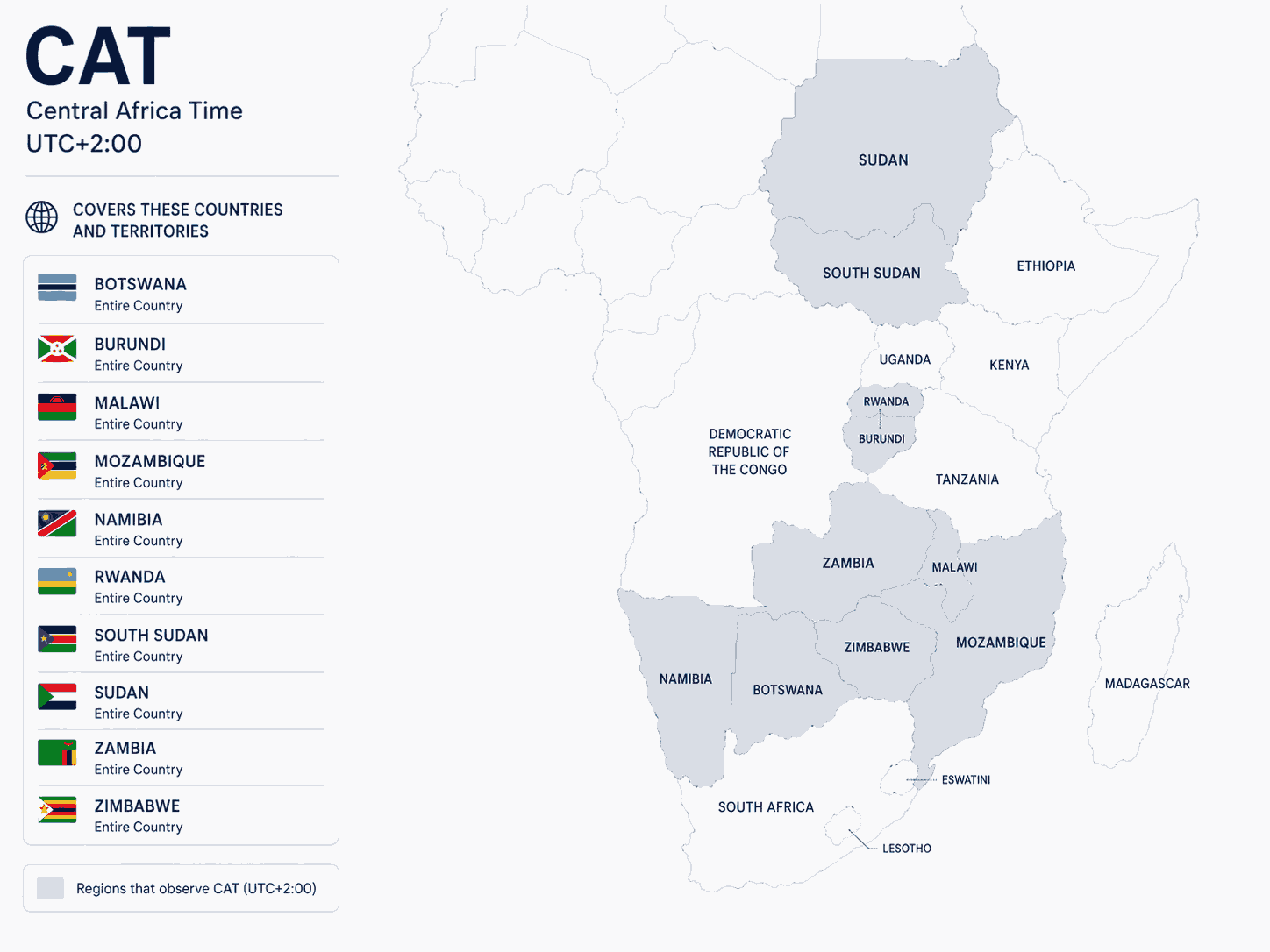
The map below highlights the specific regions, countries, and territories that observe the Central Africa Time time zone.
Understanding Central Africa Time (CAT)
Central Africa Time (CAT) runs at UTC+02:00, placing Johannesburg 2 hours ahead of Coordinated Universal Time and at the financial center of the African continent's most industrialized region. South Africa is the only African member of the G20, and Johannesburg is home to the Johannesburg Stock Exchange (JSE) — Africa's largest equity market by capitalization — along with the headquarters of major mining, financial services, and industrial conglomerates with operations across the continent. The broader CAT zone sits atop some of the world's most concentrated mineral wealth: South Africa produces the majority of the world's platinum, Zimbabwe holds significant chrome and lithium reserves, and Zambia is one of the world's top copper producers. Add a growing renewable energy infrastructure sector and a tourism industry anchored by South Africa's national parks and Cape Town's international profile, and CAT covers a regional economy that commodity investors, infrastructure developers, and pan-African financial institutions engage with daily.
Countries and Territories Observing CAT
CAT spans the southern third of the African continent, covering seven nations with distinct but complementary economic profiles — all operating on the same UTC+02:00 clock without regional exceptions.
- ✦South Africa, Zimbabwe & Zambia: South Africa anchors the zone commercially, providing financial market infrastructure, port access through Durban and Cape Town, and a developed services economy that supports regional operations. Zimbabwe's agricultural and mineral sectors and Zambia's copper mining industry feed directly into regional and global supply chains coordinated from Johannesburg's logistics and commodities trading infrastructure.
- ✦Botswana & Mozambique: Botswana's diamond sector — managed through the Debswana joint venture with De Beers — and Mozambique's growing liquefied natural gas (LNG) export industry both operate on CAT, integrating their commodity flows with Johannesburg's financial settlements and regional port logistics without any offset friction. Malawi and Eswatini round out the zone, contributing agricultural exports that flow through South African logistics corridors to international markets.
- ✦Regional Alignment (UTC+2): During European winter (late October through late March), CAT aligns exactly with Central European Time (CET, UTC+01:00 standard, UTC+02:00 after the clocks shift — clarification: CET itself is UTC+1, but Central European Summer Time is UTC+2, meaning CAT matches CEST during European summer and is one hour ahead of CET in European winter). In practical terms, CAT is permanently at UTC+2 while Europe oscillates around it — sitting 1 hour ahead of London in summer and 2 hours ahead in winter, and matching Frankfurt and Paris clocks exactly during European summer (CEST). This means the CAT–Europe scheduling relationship is tighter in European summer than in winter, contrary to what one might assume.
Daylight Saving Time (DST) Rules
None of the CAT-observing nations apply Daylight Saving Time. South Africa formally abolished DST in 1994, and no other country in the zone has introduced it since. CAT holds at UTC+02:00 every day of the year. For the industries that define the zone, this permanence has tangible operational value: JSE settlement windows are fixed against international counterparty schedules without seasonal adjustment, platinum and gold shipment documentation timelines remain consistent year-round, and logistics operators routing freight through Durban or Cape Town can build schedules against a clock that does not shift against their European and Asian partners' clocks twice a year.
| Major Regional Cities (UTC+2) | Country | DST Observed? |
|---|---|---|
| Johannesburg | South Africa | No |
| Harare | Zimbabwe | No |
| Lusaka | Zambia | No |
| Gaborone | Botswana | No |
Global Business Guide
CAT's UTC+02:00 position is one of the more balanced in this directory — not perfectly aligned with any single major trading bloc, but within workable range of Europe, the Middle East, and parts of Asia simultaneously.
Europe — the primary collaboration zone: CAT's relationship with Europe shifts seasonally because Europe observes DST and CAT does not. During European summer (late March to late October), CAT matches Central European Summer Time (CEST, UTC+02:00) exactly — Frankfurt, Paris, and Johannesburg run on the same clock, creating a complete shared business day with no offset. During European winter (late October to late March), Europe reverts to CET (UTC+01:00), placing CAT one hour ahead of Frankfurt and two hours ahead of London. Even at its widest, a two-hour gap still allows a full overlapping workday. The upshot: CAT enjoys its tightest European alignment precisely during the Northern Hemisphere summer, which is Southern Hemisphere winter — a counterintuitive but commercially useful arrangement for South African businesses managing European partnerships.
Middle East & Asia: CAT's morning aligns well with the Gulf states (AST, UTC+3), which are just one hour ahead — a consistently productive window for commodity and infrastructure investment discussions between Johannesburg and Dubai or Riyadh. India (IST, UTC+5:30) is 3.5 hours ahead of CAT, placing Mumbai's afternoon squarely within Johannesburg's business morning. Singapore and Hong Kong (UTC+8) are 6 hours ahead, meaning CAT's 09:00 open corresponds to 15:00 in Singapore — workable for end-of-day Asia calls in the early CAT morning.
Americas: The hardest corridor from CAT. New York (EST, UTC-5) is 7 hours behind CAT in winter, meaning Johannesburg's business day ends at 17:00 CAT / 10:00 EST — the US East Coast has barely started. During US summer (EDT, UTC-4), the gap narrows to 6 hours, but it remains structurally asymmetric. Practical coordination between CAT and the US East Coast concentrates in a narrow window around 15:00–17:00 CAT / 08:00–10:00 EST, requiring Johannesburg-side participants to take late-afternoon calls and New York-side participants to engage early in their morning. South African companies with significant US investor bases or American partners typically designate specific liaison staff for this corridor rather than expecting routine live overlap across teams.
Frequently Asked Questions
Does the Central Africa Time zone observe Daylight Saving Time?
None of the countries observing Central Africa Time use Daylight Saving Time. South Africa abolished DST in 1994, and no other CAT-observing nation currently applies seasonal clock changes — CAT remains permanently fixed at UTC+02:00 throughout the year.
Which major countries use Central Africa Time (CAT)?
Central Africa Time is observed by South Africa, Zimbabwe, Zambia, Botswana, Mozambique, Malawi, and Eswatini. South Africa is the zone's dominant economy, with Johannesburg functioning as the region's primary financial center and home to the Johannesburg Stock Exchange (JSE), Africa's largest equity market by capitalization.
Need to schedule a meeting?
Use our dedicated converter pages to find the perfect overlap time across different time zones.