
Current Time in Australian Eastern Standard Time (AEST)
Australian Eastern Standard Time (AEST) is 10 hours ahead of Coordinated Universal Time (UTC+10:00). It covers the eastern seaboard of Australia, including Sydney, Melbourne, and Brisbane.
Current Australian Eastern Standard Time (AEST) Time
Date: ... · Your Local Time: ...
Important Note: Australian Eastern Standard Time has a fixed standard offset of +10:00. However, because this location observes Daylight Saving Time, the live clock above may currently reflect a different daylight offset.
Australian Eastern Standard Time Geographical Coverage
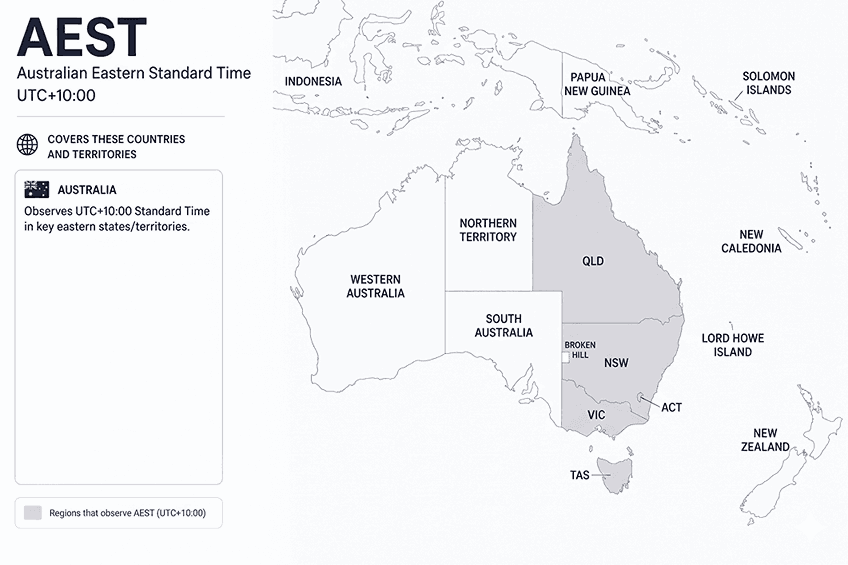
The map below highlights the specific regions, countries, and territories that observe the Australian Eastern Standard Time time zone.
Understanding Australian Eastern Standard Time (AEST)
Australian Eastern Standard Time (AEST) runs at UTC+10:00 and governs Australia's most densely populated and economically productive corridor — the eastern seaboard stretching from Cairns in tropical Queensland to Hobart in southern Tasmania. The Australian Securities Exchange (ASX) opens in Sydney at 10:00 AEST, making it one of the first major equity markets to begin trading each global day, ahead of Tokyo by one hour. The eastern states collectively account for the majority of Australia's GDP, housing its dominant financial services, technology, higher education, and mining export sectors. For global teams with APAC responsibilities, AEST is typically the final timezone activated in the Asia-Pacific trading day before the region's markets hand off to the Middle East and Europe.
Countries and Territories Observing AEST
AEST covers Australia's eastern states exclusively, with no international coverage outside the Australian continent and its offshore territories.
- ✦Australia (Eastern States): Five jurisdictions operate under the AEST/AEDT framework: New South Wales (Sydney), Victoria (Melbourne), Queensland (Brisbane), Tasmania (Hobart), and the Australian Capital Territory (Canberra). Together they encompass over 70% of Australia's population. The zone does not extend to South Australia (which uses UTC+9:30), the Northern Territory (also UTC+9:30), or Western Australia (UTC+8:00), reflecting the country's complex internal time zone geography.
Daylight Saving Time (DST) Rules
AEST observes DST only in part — and that internal split is the most important scheduling fact about this zone. New South Wales, Victoria, Tasmania, and the ACT advance their clocks to Australian Eastern Daylight Time (AEDT) at UTC+11:00 each October and return to AEST in April. Queensland does not participate. Brisbane remains on UTC+10:00 year-round, with no DST adjustment at any point.
The practical consequence: for several months each year, Sydney (AEDT, UTC+11) and Brisbane (AEST, UTC+10) run one hour apart despite being in the same nominal time zone. Any standing meeting between the two cities needs to account for this gap during the DST window. The Southern Hemisphere schedule runs opposite to the Northern Hemisphere — clocks in the DST-observing states spring forward in October and fall back in April, the reverse of European and North American patterns.
In 2026, AEDT begins on Sunday, October 4 (clocks advance at 02:00 local time) and ends on Sunday, April 5 (clocks fall back at 03:00 local time).
| Major Cities | State/Territory | DST Observed? |
|---|---|---|
| Sydney | New South Wales | Yes |
| Melbourne | Victoria | Yes |
| Brisbane | Queensland | No |
| Canberra | ACT | Yes |
| Hobart | Tasmania | Yes |
Global Business Guide
Asia — the natural overlap corridor: Singapore (SGT, UTC+8) is 2 hours behind AEST, and Tokyo (JST, UTC+9) is 1 hour behind. Sydney's 09:00 ASX opening corresponds to 08:00 JST and 07:00 SGT — both within reach of Asian teams willing to start slightly early. The AEST–Asia overlap is the tightest and most productive cross-regional scheduling corridor available to Australian businesses, and the ASX's afternoon session (post-lunch until 16:00 AEST) aligns perfectly with the full Singapore and Tokyo morning. During AEDT, the gap narrows further — Sydney advances to UTC+11, placing it just 2 hours ahead of Singapore and 1 hour ahead of Tokyo.
Europe — the hardest corridor from Australia: London (GMT) is 10 hours behind AEST in the Australian winter and 9–11 hours behind depending on DST overlap periods between the two hemispheres. A 17:00 AEST close corresponds to 07:00 GMT — workable only if the London team starts early. Frankfurt (CET) is 9 hours behind, making AEST's 17:00–18:00 the sole viable daily window for Australia–Europe live calls. For most Australia–Europe teams, end-of-day AEST to start-of-day CET async handoffs replace live meetings as the primary workflow.
Americas: New York (EST, UTC-5) is 15 hours behind AEST in winter. Sydney's 09:00 start corresponds to 18:00 EST the previous evening — no business-hours overlap exists in the standard direction. US West Coast teams (PST, UTC-8) are 18 hours behind: a 08:00 AEST early start reaches San Francisco at 14:00 PST the prior afternoon, creating a narrow late-US-afternoon to early-Australian-morning window that some Pacific-facing Australian technology teams use as their primary Americas sync slot.
Frequently Asked Questions
Does all of eastern Australia observe Daylight Saving Time?
No — eastern Australia is split on DST. New South Wales (Sydney), Victoria (Melbourne), Tasmania (Hobart), and the ACT (Canberra) advance their clocks to AEDT (UTC+11) each October, while Queensland (Brisbane) opts out entirely and remains on AEST (UTC+10) year-round. This means Sydney and Brisbane run on the same clock for only part of the year.
What is the difference between AEST and AEDT?
AEST (Australian Eastern Standard Time) is the UTC+10:00 offset observed during the Southern Hemisphere winter months, roughly April through October. AEDT (Australian Eastern Daylight Time) is the UTC+11:00 offset applied during the Southern Hemisphere summer when clocks spring forward in October, observed by New South Wales, Victoria, Tasmania, and the ACT.
Need to schedule a meeting?
Use our dedicated converter pages to find the perfect overlap time across different time zones.