
Current Time in Pacific Daylight Time (PDT)
Pacific Daylight Time (PDT) is the daylight saving offset for the North American West Coast, running at UTC-07:00 from the second Sunday in March through the first Sunday in November. It governs business hours for Silicon Valley, Hollywood, and Seattle — the combined global center of technology, entertainment, and cloud infrastructure.
Current Pacific Daylight Time (PDT) Time
Date: ... · Your Local Time: ...
Important Note: Pacific Daylight Time has a fixed standard offset of -07:00. However, because this location observes Daylight Saving Time, the live clock above may currently reflect a different daylight offset.
Pacific Daylight Time Geographical Coverage
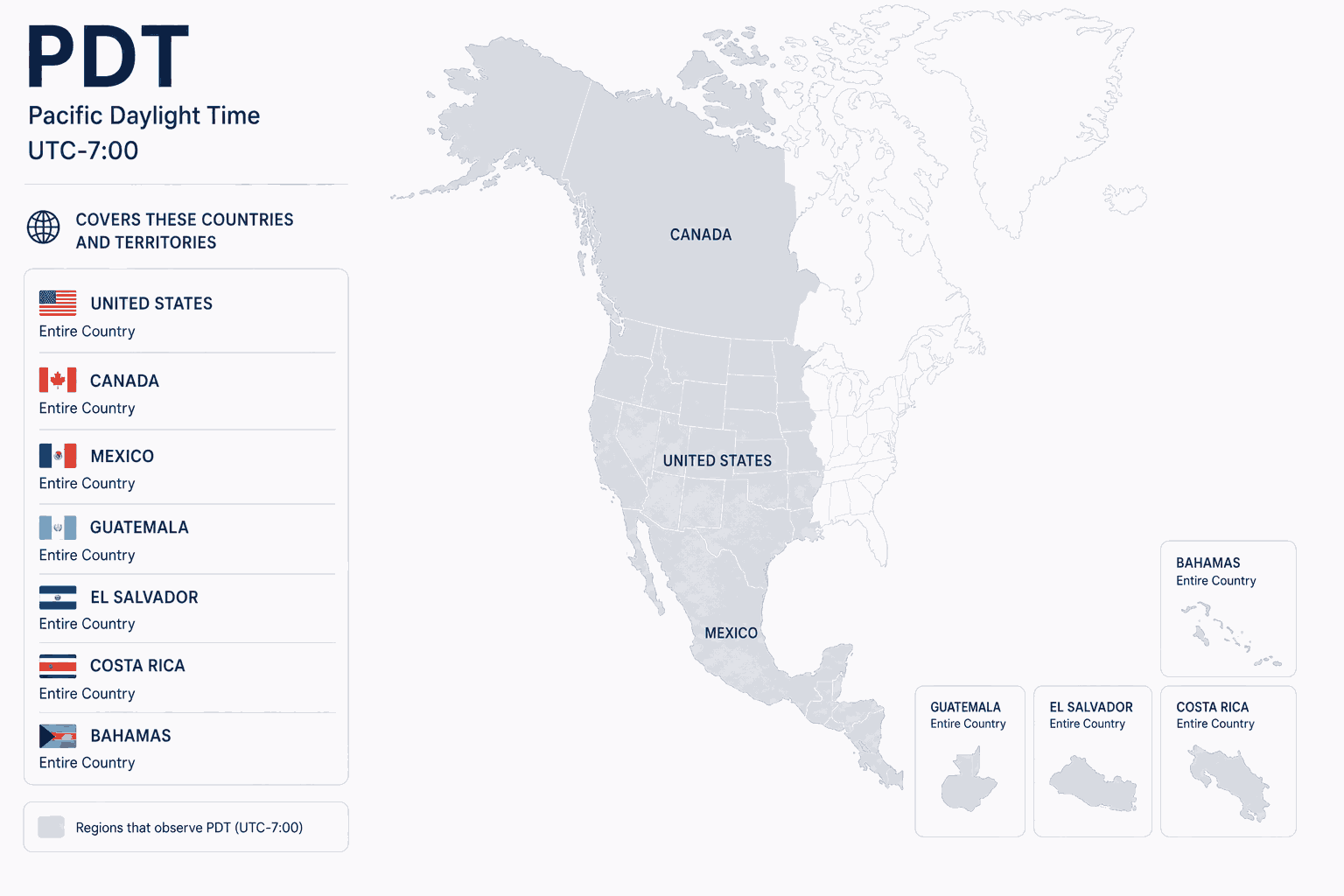
The map below highlights the specific regions, countries, and territories that observe the Pacific Daylight Time time zone.
Understanding Pacific Daylight Time (PDT)
Pacific Daylight Time (PDT) operates at UTC-7:00 and represents the active daylight saving phase for the North American West Coast — the eight-month window during which Silicon Valley, Seattle, and Los Angeles set their clocks one hour ahead of winter standard time. The economic weight concentrated in this timezone during PDT hours is extraordinary: Apple, Google, Meta, Netflix, Nvidia, and Amazon all anchor their Pacific operations to this offset. Venture capital firms managing the majority of US technology investment funding operate on Sand Hill Road in Menlo Park during PDT hours. Hollywood's production studios, streaming platforms, and talent agencies run their global deal-making calendars to Los Angeles time. Seattle hosts Microsoft, Amazon's headquarters, and Boeing's commercial aircraft division. For eight months of every year, PDT is the operational clock of the global technology industry.
Countries and Territories Observing PDT
PDT is observed across the North American Pacific coast from Alaska's southern border to Mexico's Baja California peninsula.
- ✦United States: California, Washington, Oregon, Nevada, and Idaho (northern portion) all advance to PDT on the standard federal DST schedule. California alone — home to Silicon Valley, Hollywood, and the Port of Los Angeles — represents the world's fifth-largest economy by GDP if measured as an independent nation, making PDT one of the most economically consequential daylight saving offsets on the planet.
- ✦Canada: British Columbia (Vancouver, Victoria) and Yukon observe PDT on the same schedule as the US states, maintaining full clock alignment with Seattle and San Francisco throughout the summer. The Vancouver–Seattle technology corridor and the Vancouver film and TV production industry both depend on this synchronization for day-to-day operational coordination.
- ✦Mexico: Baja California — including Tijuana and Mexicali — observes PDT on the US schedule, unlike the rest of Mexico which follows its own DST rules or none at all. This alignment reflects Baja California's deep economic integration with the Southern California market across the US–Mexico border, particularly in manufacturing, agriculture, and cross-border retail.
Daylight Saving Time (DST) Rules
PDT is the daylight saving phase of Pacific Time (PT), the umbrella designation covering both PST and PDT. Clocks advance from PST (UTC-8) to PDT (UTC-7) on the second Sunday in March at 02:00 local time, and revert from PDT back to PST on the first Sunday in November at 02:00 local time. In 2026, PDT runs from March 8 through November 1 — covering roughly 238 days, or about 65% of the calendar year.
The transition has direct consequences for distributed technology teams. Every standing meeting between a PDT-based engineering team and a European or Asian counterpart needs to be reviewed twice annually: when the US springs forward in March and when it falls back in November. The one-hour UTC shift at each transition can silently break calendar invites set with hard UTC offsets, and is the most common cause of missed standup calls and deadline misalignments in globally distributed software teams.
California's state legislature passed Proposition 7 in 2018 authorizing a permanent switch to PDT year-round, but the measure requires federal approval and has not been enacted as of mid-2026. Until it is, California — and the rest of the Pacific Time zone — continues the biannual PST/PDT transition.
| Major Cities | Country | Standard Time | Daylight Saving Time |
|---|---|---|---|
| Los Angeles | United States | PST (UTC-8) | PDT (UTC-7) |
| San Francisco | United States | PST (UTC-8) | PDT (UTC-7) |
| Seattle | United States | PST (UTC-8) | PDT (UTC-7) |
| Las Vegas | United States | PST (UTC-8) | PDT (UTC-7) |
| Vancouver | Canada | PST (UTC-8) | PDT (UTC-7) |
Global Business Guide
US East Coast: New York (EDT, UTC-4) is 3 hours ahead of PDT during the summer months when both zones are simultaneously on their daylight saving offsets. A 09:00 PDT San Francisco start corresponds to 12:00 EDT in New York — placing the entire West Coast morning within New York's afternoon. This 3-hour gap is the defining scheduling constraint of intra-US business: East Coast markets, federal government offices, and financial institutions are already mid-day by the time Pacific teams open. For product launches, earnings calls, and regulatory filings timed to NYSE hours, PDT teams routinely operate with effective early-morning deadlines.
Europe: London (BST, UTC+1) is 8 hours ahead of PDT during the Northern Hemisphere summer — the longest standard gap between Silicon Valley and a major European financial center. A 09:00 PDT San Francisco start corresponds to 17:00 BST in London, one hour before close. Frankfurt (CEST, UTC+2) is 9 hours ahead: PDT's 09:00 reaches Frankfurt at 18:00 CEST, after the Xetra trading session has ended. The only practical PDT–Europe live window is a PDT very-early-morning call (07:00 PDT = 15:00 BST / 16:00 CEST), and even this window requires European teams to remain available mid-afternoon. The net result is that the majority of PDT–Europe coordination runs asynchronously, with European teams handing off deliverables at their close that PDT teams pick up at their opening.
Asia — the follow-the-sun relay: Tokyo (JST, UTC+9) is 16 hours ahead of PDT. A 17:00 PDT Friday afternoon in San Francisco corresponds to 09:00 JST Saturday in Tokyo — across a calendar boundary but within reach of Asian Monday morning when accounting for the weekend. Singapore (SGT, UTC+8) is 15 hours ahead: a 17:00–18:00 PDT close maps to 08:00–09:00 SGT, the precise start of the Singapore business day. This makes the PDT end-of-day the most widely used follow-the-sun handoff point in global technology operations — a San Francisco engineering team completing a build at 17:00 PDT delivers to a Singapore or Tokyo team beginning their morning, with no overnight gap in the development cycle. India (IST, UTC+5:30) is 12.5 hours ahead: a 07:30 PDT early start reaches Mumbai at 20:00 IST, at the outer edge of extended Indian working hours. Most PDT–India tech coordination relies on this early-morning PDT window or on asynchronous task management.
Australia: Sydney (AEST, UTC+10) is 17 hours ahead of PDT. A 16:00 PDT Thursday afternoon corresponds to 09:00 AEST Friday in Sydney — a clean calendar-forward handoff for Australian teams starting their Friday morning with Thursday afternoon PDT deliverables. Melbourne follows the same pattern. During AEDT (UTC+11), Sydney moves one hour further ahead, tightening the handoff to a PDT 15:00 window for the same 09:00 AEDT result.
Frequently Asked Questions
When does PDT start and end?
PDT begins on the second Sunday in March at 02:00 local time, when clocks spring forward one hour from PST (UTC-8) to PDT (UTC-7). It ends on the first Sunday in November at 02:00 local time, when clocks fall back to PST. In 2026, PDT runs from March 8 through November 1 — covering the majority of the calendar year.
Is PDT the same as PST?
PDT and PST are two phases of the same Pacific Time zone, not two separate zones. PST (Pacific Standard Time) is the winter offset at UTC-8, observed from early November through mid-March. PDT (Pacific Daylight Time) is the summer offset at UTC-7, active during Daylight Saving Time — meaning Los Angeles, Seattle, and Vancouver run one hour ahead of their winter clock for approximately eight months of every year.
Need to schedule a meeting?
Use our dedicated converter pages to find the perfect overlap time across different time zones.