
Current Time in Alaska Standard Time (AKST)
Alaska Standard Time (AKST) is 9 hours behind Coordinated Universal Time (UTC-09:00). It serves as the primary time zone for almost the entire state of Alaska.
Current Alaska Standard Time (AKST) Time
Date: ... · Your Local Time: ...
Important Note: Alaska Standard Time has a fixed standard offset of -09:00. However, because this location observes Daylight Saving Time, the live clock above may currently reflect a different daylight offset.
Alaska Standard Time Geographical Coverage
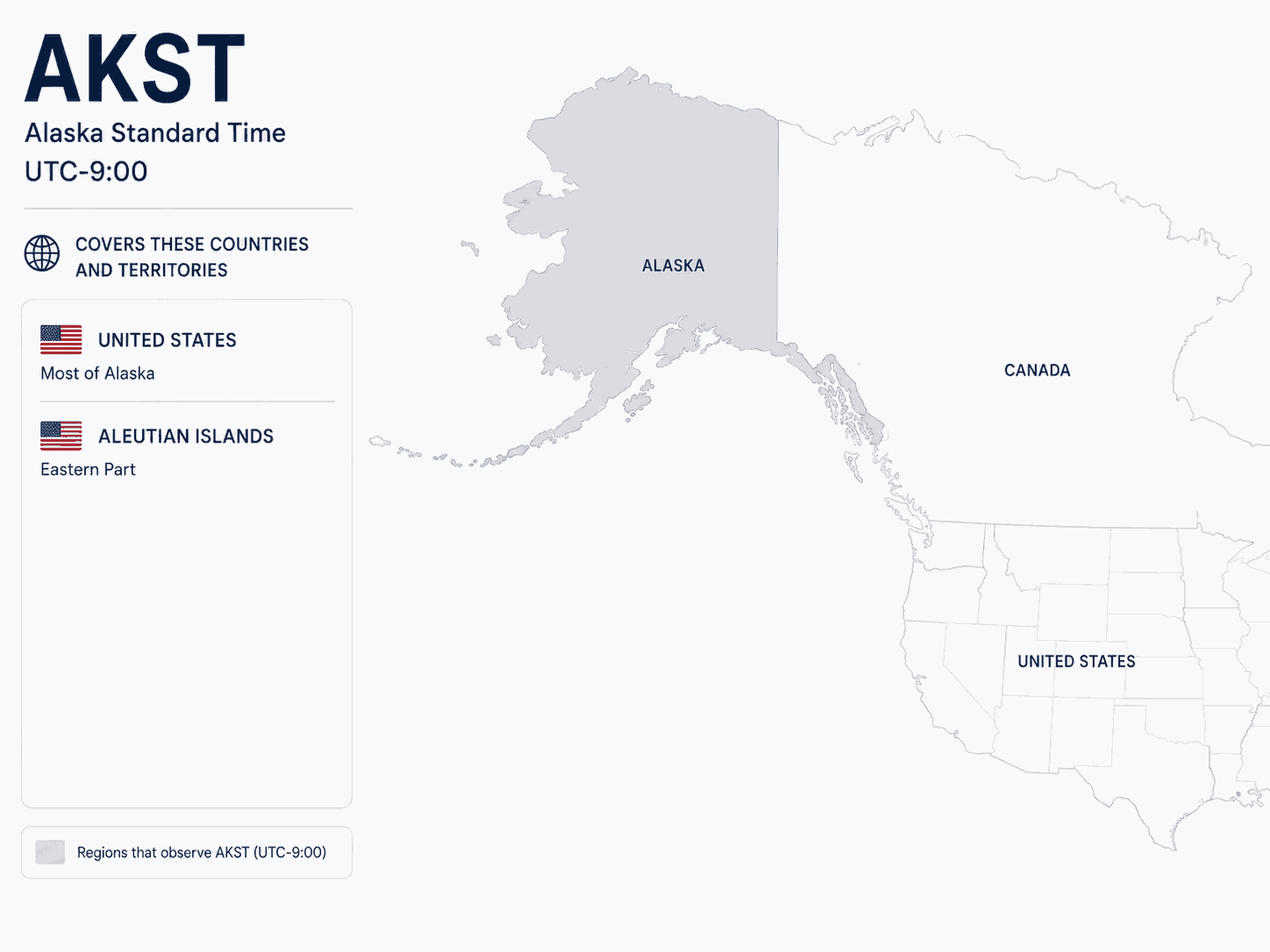
The map below highlights the specific regions, countries, and territories that observe the Alaska Standard Time time zone.
Understanding Alaska Standard Time (AKST)
Alaska Standard Time (AKST) runs at UTC-09:00, placing Anchorage 9 hours behind Coordinated Universal Time and in a geographic position that generates a paradox: Alaska is physically closer to Tokyo than to New York, yet it operates as an integral part of the US economy. That paradox is commercially productive. Ted Stevens Anchorage International Airport is consistently ranked among the world's busiest air cargo hubs — its location on the great circle route between Asia and North America makes it a natural refueling and transfer point for freighters that would otherwise need to fly longer routes across the Pacific. On the ground, the Alaska North Slope drives one of the United States' most significant oil and gas production regions, while the Bering Sea supports one of the world's most valuable commercial fishing industries, harvesting pollock, crab, and salmon at industrial scale.
Countries and Territories Observing AKST
AKST is a US-only time zone, applied exclusively within the state of Alaska. The state's vast geography — larger than Texas, California, and Montana combined — is unified under a single time zone, with one clearly defined exception.
- ✦The Alaskan Mainland: The overwhelming majority of Alaska, including Anchorage, Fairbanks, and the state capital Juneau, operates on AKST. This covers the oil-producing North Slope, the interior agricultural and mining regions around Fairbanks, the commercial fishing ports on the Kenai Peninsula, and the southeast panhandle where Juneau sits. A single statewide time zone simplifies coordination between these industries and their lower-48 counterparts without requiring the kind of interregional offset math that larger or more fragmented states impose.
- ✦The Aleutian Exception: Communities located west of 169° 30′ W longitude — the westernmost chain of the Aleutian Islands — do not observe AKST. These communities follow Hawaii-Aleutian Time (HST, UTC-10:00), one hour further behind. Their extreme western position places them beyond the solar time boundary where AKST is geographically reasonable, aligning them more naturally with Hawaii's solar schedule than with Anchorage's.
Daylight Saving Time (DST) Rules
Unlike the DST-free zones covered elsewhere in this directory, Alaska does observe Daylight Saving Time. On the second Sunday in March, most of Alaska transitions from AKST (UTC-09:00) to Alaska Daylight Time (AKDT, UTC-08:00). Clocks revert on the first Sunday in November, following the same schedule as the contiguous United States. During the AKDT period — which spans roughly 8 months of the year — Alaska's offset from the US East Coast narrows from 4 hours to 3 hours, easing early-morning scheduling friction for Alaskan businesses that need to align with New York trading hours or Washington D.C. government operations.
| Major Regional Cities (UTC-9) | Country | DST Observed? |
|---|---|---|
| Anchorage | USA | Yes |
| Fairbanks | USA | Yes |
| Juneau | USA | Yes |
Global Business Guide
AKST's position at UTC-09:00 creates a scheduling environment that is unlike any other US time zone — shaped as much by trans-Pacific geography as by domestic business alignment.
Contiguous US — the 4-hour gap: During AKST (winter), Alaska trails US Eastern Standard Time by 4 hours, Pacific Standard Time by 1 hour, and Mountain Standard Time by 2 hours. For Alaska-based businesses with lower-48 partners, this means NYSE and NASDAQ open at 05:30 AKST — early enough that Anchorage traders and logistics coordinators who need to catch the New York open must be at their desks before 6 AM. During AKDT (summer), the East Coast gap narrows to 3 hours, which is more workable but still requires early starts for live morning calls. The most practical scheduling window for East Coast collaboration is 13:00–17:00 AKST, which corresponds to 17:00–21:00 EST — catchable, but only by scheduling the Alaska side in its afternoon and the East Coast side in its early evening.
Asia-Pacific — physical proximity, temporal distance: Anchorage's great circle distance to Tokyo is roughly 5,600 miles — shorter than the New York-to-London route. But AKST sits 18 hours behind Japan Standard Time (JST, UTC+9) in winter, meaning Tokyo's 09:00 business open corresponds to 15:00 the previous day AKST. There is no usable live business-hour overlap between AKST and Northeast Asia. This disconnect is precisely why air cargo — an asynchronous logistics model that does not require real-time human coordination — rather than live business communication defines the Anchorage-Asia relationship. Cargo loaded at Asian factories in the evening arrives in Anchorage overnight and continues to US distribution centers by morning, without a single live cross-timezone call required.
Europe: The gap between AKST and European business hours is complete. At 09:00 GMT (London's business open), it is midnight in Anchorage. There is no functional live overlap between AKST and any major European time zone during standard business hours. European partners managing Alaskan operations — particularly in the oil and gas sector, where Norwegian and British firms have significant North Slope interests — coordinate through async reporting, designated liaison teams in lower-48 US offices, and structured weekly calls that require one party to work outside normal hours.
Frequently Asked Questions
Does Alaska observe Daylight Saving Time?
Most of Alaska observes Daylight Saving Time, transitioning from Alaska Standard Time (AKST, UTC-09:00) to Alaska Daylight Time (AKDT, UTC-08:00) on the second Sunday in March. Clocks revert to AKST on the first Sunday in November, following the same DST schedule as the contiguous United States.
Is all of Alaska on Alaska Standard Time?
Almost all of Alaska uses AKST, but the westernmost Aleutian Island communities — those located west of 169° 30′ W longitude — observe Hawaii-Aleutian Time (HST, UTC-10:00) instead. This exception reflects their extreme western geographic position, which places them closer in solar time to Hawaii than to Anchorage.
Need to schedule a meeting?
Use our dedicated converter pages to find the perfect overlap time across different time zones.