
Current Time in Australian Eastern Daylight Time (AEDT)
Australian Eastern Daylight Time (AEDT) is 11 hours ahead of Coordinated Universal Time (UTC+11:00). It is observed during the summer months in major Australian cities like Sydney and Melbourne.
Current Australian Eastern Daylight Time (AEDT) Time
Date: ... · Your Local Time: ...
Important Note: Australian Eastern Daylight Time has a fixed standard offset of +11:00. However, because this location observes Daylight Saving Time, the live clock above may currently reflect a different daylight offset.
Australian Eastern Daylight Time Geographical Coverage
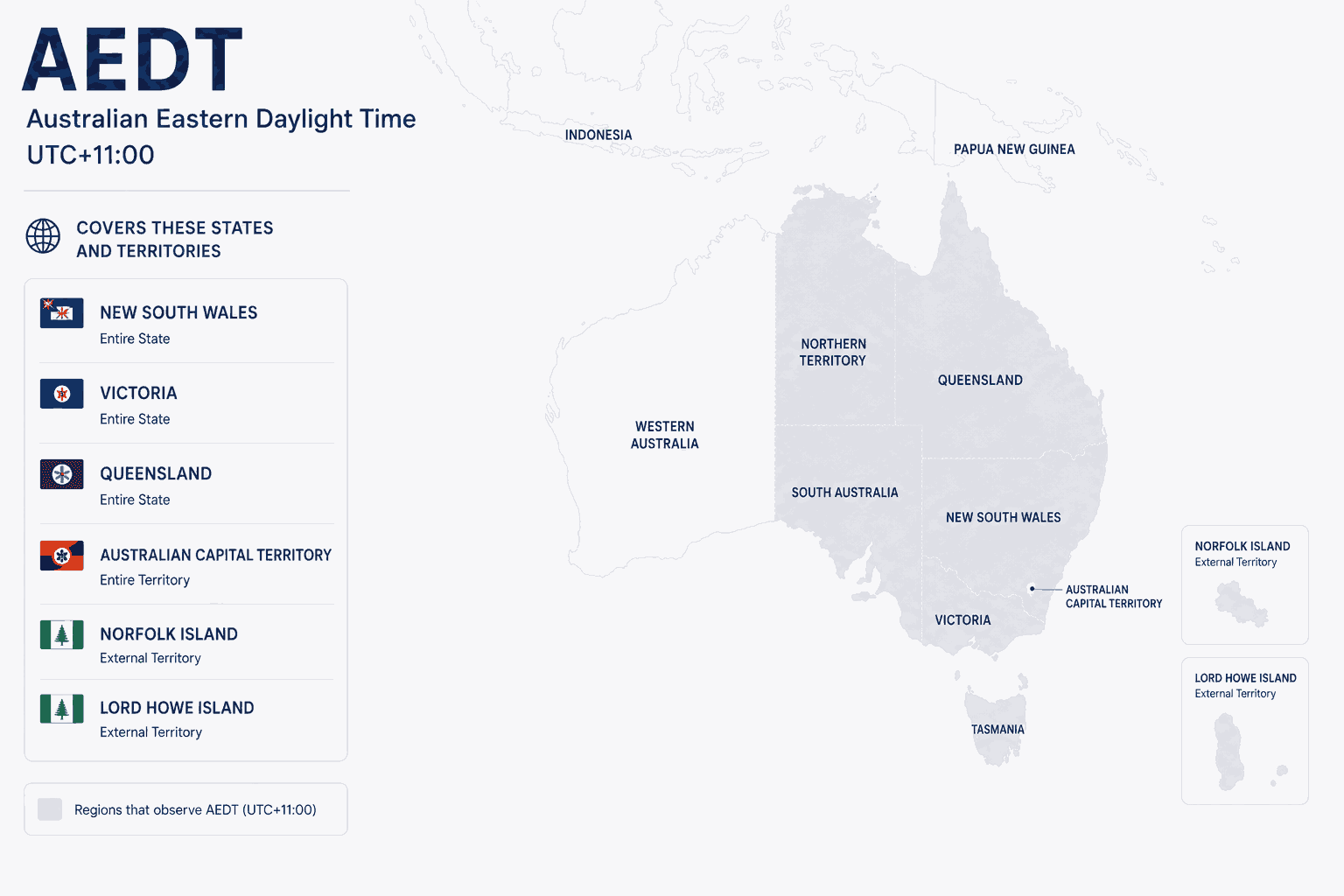
The map below highlights the specific regions, countries, and territories that observe the Australian Eastern Daylight Time time zone.
Understanding Australian Eastern Daylight Time (AEDT)
Australian Eastern Daylight Time (AEDT) operates at UTC+11:00 during the Southern Hemisphere summer — the offset active in Sydney and Melbourne from the first Sunday in October through the first Sunday in April. During AEDT, the Australian Securities Exchange (ASX) opens at 10:00 local time (23:00 UTC the previous day), making it the first major equity exchange in the world to begin each new trading day ahead of Tokyo, Hong Kong, and Singapore. Sydney's financial district and Melbourne's corporate headquarters collectively anchor the dominant share of Australian GDP, and the AEDT calendar governs ASX settlement cycles, Australian government bond auctions, and the earnings reporting schedules of Australia's largest listed companies. For global fund managers, commodity traders, and supply chain operators with Australian exposure, AEDT's position at UTC+11 means their Australian counterparts are already mid-morning by the time any other major financial center opens.
Regions Observing AEDT
AEDT applies to a specific subset of Australian states during the Southern Hemisphere summer, with one significant internal exception that affects domestic scheduling across the country's most populous eastern corridor.
- ✦Observing States: New South Wales (Sydney), Victoria (Melbourne), Tasmania (Hobart), and the Australian Capital Territory (Canberra) all advance from AEST (UTC+10) to AEDT (UTC+11) on the first Sunday in October and revert on the first Sunday in April. These four jurisdictions encompass Australia's two largest cities, its federal capital, and its southernmost state — together representing the majority of Australia's population and corporate economic activity.
- ✦The Queensland Exception: Queensland, including Brisbane, does not observe Daylight Saving Time and remains on AEST (UTC+10) year-round. This means that for the six months of the AEDT period, Brisbane runs one hour behind Sydney and Melbourne despite the two cities being separated by approximately 900 kilometres and sharing nearly the same line of longitude. A Sydney-based company calling its Brisbane office at 10:00 AEDT reaches Brisbane at 09:00 AEST — a one-hour gap that does not exist in winter. This internal split is the most common source of scheduling errors in Australian domestic business, particularly for teams that maintain standing meeting cadences year-round without seasonal calendar updates.
Daylight Saving Time (DST) Rules
AEDT is the daylight saving phase of Australian Eastern Time, active from the first Sunday in October through the first Sunday in April. In 2026, clocks spring forward to AEDT on October 4 at 02:00 local AEST time, and fall back to AEST on April 5 at 03:00 local AEDT time.
The Southern Hemisphere schedule runs directly opposite to Northern Hemisphere DST cycles, producing a compounding complexity for global teams. When Sydney advances to AEDT in October, London and New York are approaching the end of their own DST periods and are about to fall back. In late October, when Europe reverts from CEST to CET, Sydney is already on AEDT and moving further ahead. In early November, when the US reverts from EDT to EST, Sydney adds another hour of relative distance. The net result is that the AEDT–London gap and the AEDT–New York gap both widen by two hours between October and November as Northern Hemisphere cities fall back while Sydney holds at UTC+11. Teams managing regular Australia–Europe or Australia–US calls need to update their scheduling templates at each of these four transition points — October (AEDT starts), late October (EU falls back), early November (US falls back), and April (AEDT ends) — rather than treating it as a single annual event.
| Major Cities | State/Territory | DST Observed? | Summer Offset |
|---|---|---|---|
| Sydney | New South Wales | Yes | UTC+11 (AEDT) |
| Melbourne | Victoria | Yes | UTC+11 (AEDT) |
| Canberra | ACT | Yes | UTC+11 (AEDT) |
| Hobart | Tasmania | Yes | UTC+11 (AEDT) |
| Brisbane | Queensland | No | UTC+10 (AEST) |
Global Business Guide
Asia — the morning handoff window: Tokyo (JST, UTC+9) is 2 hours behind AEDT. Sydney's 10:00 ASX open corresponds to 08:00 JST — Tokyo is just opening its own market as Sydney's morning session begins. Singapore (SGT, UTC+8) and Hong Kong (HKT, UTC+8) are 3 hours behind AEDT: Sydney's 10:00 open reaches Singapore at 07:00 SGT, before standard Singapore business hours. The most productive AEDT–Asia live window is the Sydney morning (10:00–13:00 AEDT), catching Tokyo mid-morning and Singapore at the start of their day. Beijing (BJT, UTC+8) follows the same pattern as Singapore and Hong Kong. India (IST, UTC+5:30) is 5.5 hours behind AEDT: Sydney's 10:00 corresponds to Mumbai's 04:30 IST — no overlap during standard hours. AEDT's 14:00–17:00 afternoon maps to IST's 08:30–11:30, the only viable window for Australia–India live coordination.
Europe — the most constrained corridor: London (GMT, UTC+0) is 11 hours behind AEDT. Sydney's 10:00 ASX open corresponds to London's 23:00 the previous evening. The only viable AEDT–UK live window is Sydney's late afternoon: 16:00–17:00 AEDT maps to 05:00–06:00 GMT — before standard London business hours. Frankfurt (CET, UTC+1) is 10 hours behind AEDT: Sydney's 17:00 close corresponds to Frankfurt's 07:00 CET, one hour before the Xetra open. In practical terms, no standard business-hours overlap exists between AEDT and any European time zone. End-of-day AEDT to start-of-day Europe async handoffs — Sydney teams completing deliverables at 17:00 AEDT for European teams to review at their 08:00–09:00 open — are the default operating model for Australia–Europe distributed teams.
Americas: New York (EDT, UTC-4) is 15 hours behind AEDT during US summer. Sydney's 10:00 ASX open corresponds to New York's 19:00 EDT the previous evening. When the US falls back to EST (UTC-5) in early November — while Sydney remains on AEDT — the gap widens to 16 hours, the maximum practical separation between the two cities. The only live window is a Sydney very-early-morning call (07:00 AEDT = 16:00 EDT) or a US late-evening call, with one party absorbing the full out-of-hours burden. US West Coast teams (PDT, UTC-7) face an 18-hour AEDT gap: no business-hours overlap is structurally possible, and follow-the-sun async workflows are the universal operating model for Australia–California coordination. A Sydney team's end-of-Thursday deliverables reach a San Francisco team at the start of their Thursday morning — a clean calendar-backward relay that technology and media teams exploit for continuous development cycles.
Frequently Asked Questions
When does AEDT start and end?
AEDT begins on the first Sunday in October at 02:00 local time, when clocks spring forward one hour from AEST (UTC+10) to AEDT (UTC+11). It ends on the first Sunday in April at 03:00 local time, when clocks fall back to AEST. In 2026, AEDT starts on October 4 and ends on April 5 — following the Southern Hemisphere summer calendar, which runs opposite to DST schedules in Europe and North America.
Is Brisbane on AEDT?
No — Queensland, including Brisbane, does not observe Daylight Saving Time and remains on AEST (UTC+10) year-round. During the AEDT period from October through April, Sydney and Melbourne advance to UTC+11 while Brisbane stays at UTC+10, creating a one-hour gap between cities that share nearly the same longitude and are otherwise in the same time zone for the other six months of the year.
Need to schedule a meeting?
Use our dedicated converter pages to find the perfect overlap time across different time zones.