
Current Time in New Zealand Standard Time (NZST)
New Zealand Standard Time (NZST) is 12 hours ahead of Coordinated Universal Time (UTC+12:00). It is the first major global time zone to start a new calendar day.
Current New Zealand Standard Time (NZST) Time
Date: ... · Your Local Time: ...
Important Note: New Zealand Standard Time has a fixed standard offset of +12:00. However, because this location observes Daylight Saving Time, the live clock above may currently reflect a different daylight offset.
New Zealand Standard Time Geographical Coverage
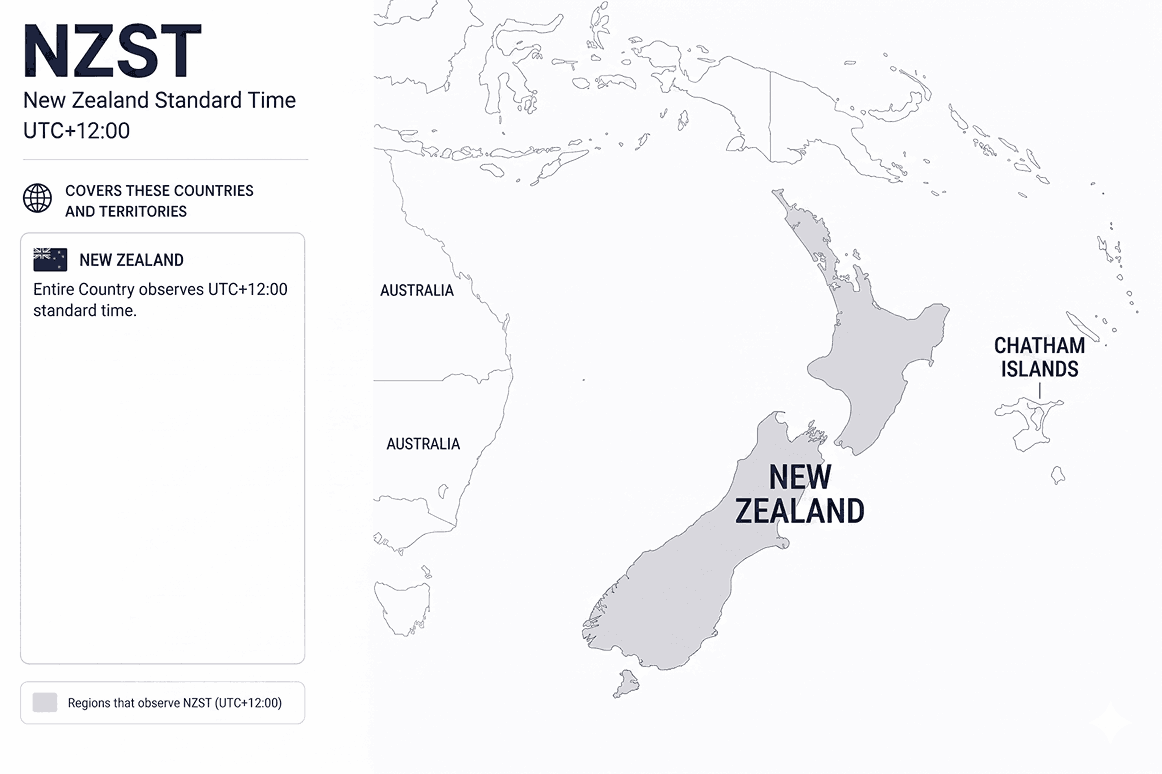
The map below highlights the specific regions, countries, and territories that observe the New Zealand Standard Time time zone.
Understanding New Zealand Standard Time (NZST)
New Zealand Standard Time (NZST) operates at UTC+12:00, placing Auckland and Wellington at the leading edge of the global calendar — the first major financial markets to open each new trading day. The New Zealand Exchange (NZX) begins trading at 10:00 NZST, with no other significant equity market ahead of it on the clock. New Zealand's export economy is anchored in primary industries: dairy products (Fonterra is the world's largest dairy exporter by volume), meat, wool, and horticultural products including kiwifruit ship to markets across Asia, Europe, and the Americas from this timezone. Tourism draws over three million international visitors annually to landscapes that have served as the primary filming location for the Lord of the Rings and Hobbit franchises, produced entirely by Wellington's Weta FX — the visual effects studio that has accumulated more Academy Awards for visual effects than any other facility on Earth. During the Southern Hemisphere summer, the zone advances to New Zealand Daylight Time (NZDT) at UTC+13:00, briefly making New Zealand the furthest-ahead major timezone on the planet.
Countries and Territories Observing NZST
NZST covers New Zealand's main islands and extends, by operational necessity, to the most remote human outposts on Earth.
- ✦New Zealand (Mainland): The North Island (Auckland, Wellington, Hamilton), the South Island (Christchurch, Dunedin, Queenstown), and Stewart Island all operate uniformly on NZST/NZDT. There are no regional time zone subdivisions within mainland New Zealand. The Chatham Islands, located approximately 800 kilometres east of Christchurch, are the notable exception — they observe their own UTC+12:45 standard offset (advancing to UTC+13:45 during DST), a quirk that makes them one of the few inhabited territories in the world running on a 45-minute offset increment.
- ✦Antarctica (McMurdo Station): McMurdo Station — the largest Antarctic research station by population, operated by the United States Antarctic Program — observes NZST and NZDT. So does Amundsen-Scott South Pole Station, located at 90° South latitude where every meridian converges and the concept of a "local" time zone is geometrically meaningless. Both bases align their operations with New Zealand time because Christchurch International Airport serves as the primary gateway for all US Antarctic Program flights, cargo, and personnel rotations. Operating on New Zealand time eliminates a time conversion step across the entire Christchurch–McMurdo supply chain.
Daylight Saving Time (DST) Rules
New Zealand observes Daylight Saving Time on a Southern Hemisphere schedule that runs in the opposite direction from European and North American DST cycles. Clocks advance to NZDT (UTC+13:00) on the last Sunday in September and return to NZST (UTC+12:00) on the first Sunday in April. In 2026, NZDT begins on September 27 and ends on April 5.
The inverse relationship with Northern Hemisphere DST produces significant seasonal offset swings for global teams. When London advances to BST in late March, the gap between London and Auckland narrows by one hour. When New Zealand falls back to NZST in April — just days before London reverts to GMT — the two changes partially overlap, creating a brief window where the Auckland–London gap shifts twice within a few weeks. Teams managing regular NZ–UK scheduling need to track both transitions independently rather than treating them as a mirrored system.
During NZDT, New Zealand briefly operates at UTC+13:00 — ahead of UTC+12:00 Fiji, UTC+12:00 Tonga (outside DST), and the majority of the Pacific island nations, making Auckland the furthest-ahead major city on the planet for the duration of the daylight saving period.
| Major Cities/Bases | Country/Region | DST Observed? |
|---|---|---|
| Auckland | New Zealand | Yes |
| Wellington | New Zealand | Yes |
| Christchurch | New Zealand | Yes |
| Hamilton | New Zealand | Yes |
| McMurdo Station | Antarctica | Yes |
Global Business Guide
Australia — the natural overlap partner: Sydney (AEST, UTC+10) is 2 hours behind NZST in winter, narrowing to 1 hour when Sydney advances to AEDT (UTC+11). Brisbane (permanently UTC+10) stays 2 hours behind NZST year-round. Auckland's 09:00 NZX open corresponds to 07:00 AEST in Sydney — reachable for early Australian starts. The NZ–Australia business corridor operates with the most functional same-day overlap of any of New Zealand's international relationships, and the ASX–NZX trading day runs in near-parallel sequence.
Asia: Tokyo (JST, UTC+9) is 3 hours behind NZST. Singapore and Hong Kong (UTC+8) are 4 hours behind. Auckland's 09:00–13:00 morning corresponds to Tokyo's 06:00–10:00 and Singapore's 05:00–09:00 — workable only for early Asian starts. The most practical NZ–Asia live window is the NZST early afternoon (13:00–15:00 NZST = 09:00–11:00 JST and 10:00–12:00 SGT), catching both Asian markets mid-morning. During NZDT, New Zealand's UTC+13 position pushes it even further ahead, tightening the overlap to NZ early morning.
Europe — the near-opposite schedule: London (GMT, UTC+0) is exactly 12 hours behind NZST in winter — the most symmetrically opposed scheduling relationship of any major bilateral business pairing. Auckland's 09:00 corresponds to London's 21:00 the previous evening; London's 09:00 GMT reaches Auckland at 21:00 NZST. During NZDT (UTC+13) and BST (UTC+1), the gap narrows to 12 hours — identical in absolute terms. No standard business-hours overlap exists. The only live window is a NZ very-early-morning call (07:00 NZST = 19:00 GMT) or a NZ late-evening call (20:00–21:00 NZST = 08:00–09:00 GMT), with one party absorbing the full out-of-hours burden.
Americas — the trans-Pacific calendar handoff: Los Angeles (PST, UTC-8) is 20 hours behind NZST in winter. Auckland's 09:00 Tuesday corresponds to Los Angeles' 13:00 Monday — a full calendar day earlier. New York (EST, UTC-5) is 17 hours behind NZST. This calendar offset, while logistically challenging for live calls, enables a highly efficient follow-the-sun handoff: a Wellington team completing deliverables at 17:00 NZST on Tuesday hands off to a New York team beginning their Monday afternoon at 00:00 EST — a near-seamless sequential relay for software development and content production workflows running between New Zealand and the US East Coast.
Frequently Asked Questions
Does New Zealand observe Daylight Saving Time?
New Zealand observes Daylight Saving Time annually, advancing clocks to New Zealand Daylight Time (NZDT) at UTC+13:00 on the last Sunday of September and returning to NZST (UTC+12:00) on the first Sunday of April. In 2026, clocks spring forward on September 27 and fall back on April 5 — following the Southern Hemisphere calendar, which runs opposite to DST schedules in Europe and North America.
Why does Antarctica use New Zealand Time?
McMurdo Station and Amundsen-Scott South Pole Station — the two largest US Antarctic research bases — operate on NZST and NZDT because their primary supply and personnel flights operate out of Christchurch International Airport in New Zealand. Aligning base operations with New Zealand time eliminates scheduling complexity across the Christchurch–McMurdo logistics chain, which handles all cargo, fuel, and personnel rotations for the US Antarctic Program.
Need to schedule a meeting?
Use our dedicated converter pages to find the perfect overlap time across different time zones.