
Current Time in Hawaii-Aleutian Standard Time (HST)
Hawaii-Aleutian Standard Time (HST) is 10 hours behind Coordinated Universal Time (UTC-10:00). It covers the Hawaiian Islands and the westernmost Aleutian Islands of Alaska.
Current Hawaii-Aleutian Standard Time (HST) Time
Date: ... · Your Local Time: ...
Important Note: Hawaii-Aleutian Standard Time has a fixed standard offset of -10:00. However, because this location observes Daylight Saving Time, the live clock above may currently reflect a different daylight offset.
Hawaii-Aleutian Standard Time Geographical Coverage
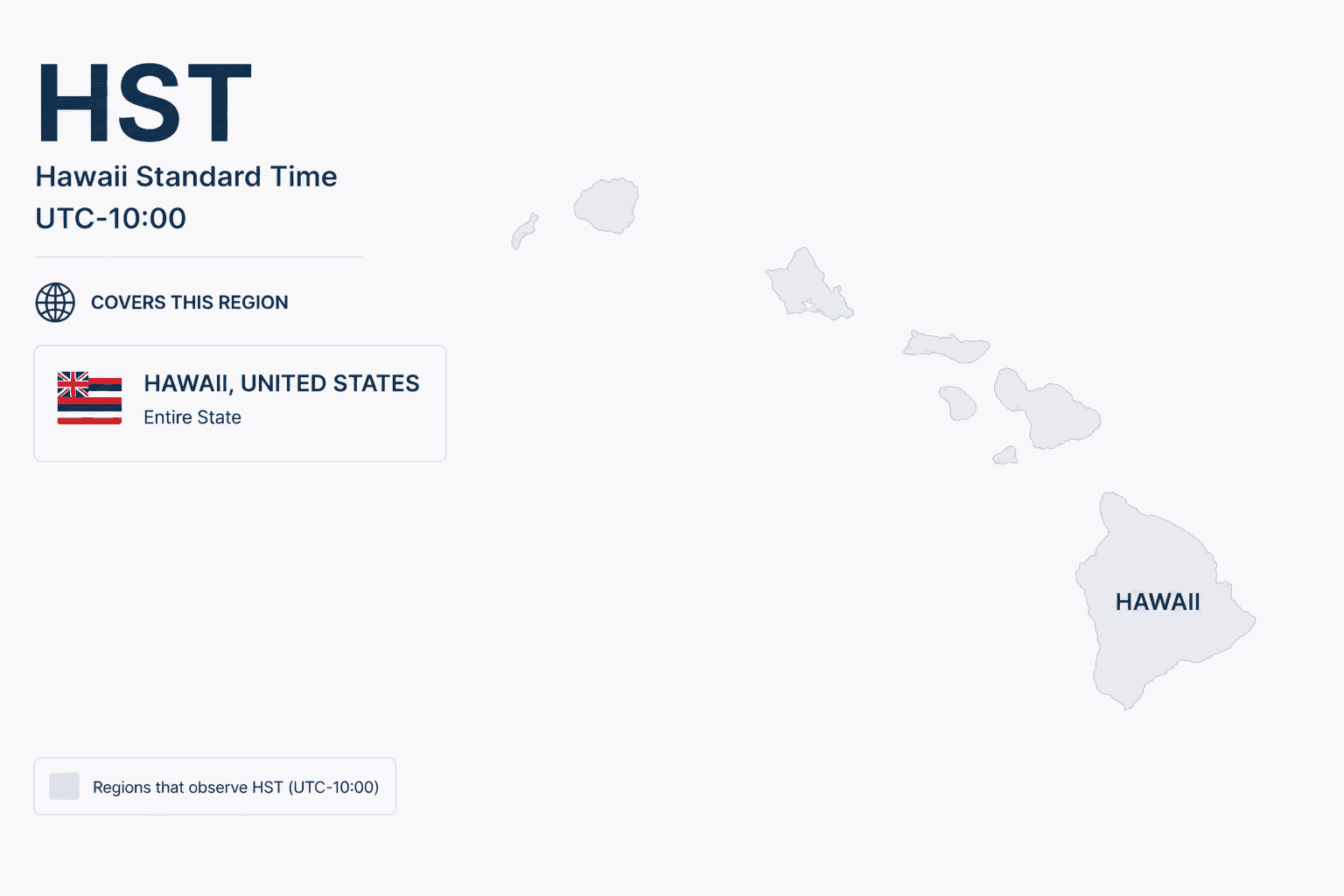
The map below highlights the specific regions, countries, and territories that observe the Hawaii-Aleutian Standard Time time zone.
Understanding Hawaii-Aleutian Standard Time (HST)
Hawaii-Aleutian Standard Time (HST) sits at UTC-10:00 — one of the westernmost offsets in the United States time zone system, and one of the most strategically consequential. Honolulu hosts the headquarters of the US Indo-Pacific Command (INDOPACOM), the largest unified combatant command in the US military by geographic area of responsibility, covering more than half the Earth's surface. The Hawaiian archipelago serves simultaneously as a global tourism destination receiving over 10 million visitors annually and as a critical mid-Pacific logistics waypoint between the US West Coast and East Asia. Mauna Kea on the Big Island hosts some of the world's most advanced astronomical observatories, operated by institutions from the US, Japan, Canada, and the UK, making HST the reference clock for a significant portion of global astronomical research. During summer, the westernmost Aleutian Island communities advance to Hawaii-Aleutian Daylight Time (HDT) at UTC-9:00, while the rest of Hawaii holds fixed at UTC-10:00.
Countries and Territories Observing HST
HST covers two geographically separated US territories that share a common longitude band despite being separated by roughly 3,000 kilometres of open ocean.
- ✦Hawaii: All eight main Hawaiian Islands — Oahu (Honolulu), Hawaii Island (Hilo, Kailua-Kona), Maui, Kauai, Molokai, Lanai, Niihau, and Kahoolawe — operate on HST year-round. Hawaii is one of only two US states that never observes Daylight Saving Time, the other being most of Arizona. The Hawaii state government, courts, financial institutions, and all commercial operations run on a single fixed offset with no seasonal adjustment at any point in the year.
- ✦Aleutian Islands (Alaska): The Aleutian Island chain extends westward from the Alaskan Peninsula past the 180° meridian, placing communities like Adak geographically in the Eastern Hemisphere while remaining under US jurisdiction. Those Aleutian communities west of 169° 30′ W longitude share HST's UTC-10:00 standard offset but, unlike Hawaii, do observe DST — advancing to HDT (UTC-9:00) each March and returning to HST each November on the standard federal schedule.
Daylight Saving Time (DST) Rules
Hawaii and the Aleutian Islands take opposite positions on DST despite sharing the same base offset, creating one of the more unusual within-zone splits in the US time zone system.
Hawaii has not observed DST since 1947 and operates on a permanent UTC-10:00 basis. The geographic rationale is straightforward: at approximately 20° North latitude, the difference between Hawaii's longest and shortest day is roughly 1.5 hours — far smaller than the 3–4 hour variation that makes DST meaningful at mid-latitudes. The Hawaii state legislature has consistently rejected proposals to introduce DST, citing the disruption it would cause to tourism scheduling and inter-island commerce.
The Aleutian Islands, at latitudes between 51° and 55° North, experience significant seasonal daylight variation comparable to the continental US Pacific Northwest. Adak and other qualifying Aleutian communities therefore observe DST on the standard federal schedule: clocks advance to HDT (UTC-9:00) on the second Sunday in March and return to HST (UTC-10:00) on the first Sunday in November. In 2026, HDT begins on March 8 and ends on November 1.
The net result: from March through November, Honolulu and Adak run one hour apart despite nominally sharing the same time zone designation in winter.
| Major Cities/Regions | State | DST Observed? |
|---|---|---|
| Honolulu | Hawaii | No |
| Hilo | Hawaii | No |
| Kailua | Hawaii | No |
| Kailua-Kona | Hawaii | No |
| Adak | Alaska (Aleutian Islands) | Yes |
Global Business Guide
US West Coast: Los Angeles (PST, UTC-8) is 2 hours ahead of HST in winter. When California advances to PDT (UTC-7) in spring, the gap widens to 3 hours — and it stays at 3 hours through the summer since Hawaii never adjusts. A 09:00 HST Honolulu start corresponds to 11:00 PST in winter and 12:00 PDT in summer. For US-mainland teams calling Hawaii, the seasonal shift means a standing 10:00 PST meeting that reaches Honolulu at 08:00 HST in winter slides to 07:00 HST in summer — a meaningful early-morning shift that often goes unnoticed until it causes scheduling failures.
Asia — the natural forward handoff: HST's position at UTC-10:00 places it on the opposite side of the International Date Line from Asia, creating a calendar-day offset that is operationally useful for sequential workflows. Tokyo (JST, UTC+9) is 19 hours ahead of HST — which means 17:00 HST on a Monday corresponds to 12:00 JST on Tuesday. A Honolulu team completing work at end-of-day can hand off to a Tokyo team at the start of their next morning with a near-perfect 12-hour relay. Singapore (SGT, UTC+8) is 18 hours ahead, producing a similar handoff dynamic. This makes HST a genuinely functional node in follow-the-sun engineering workflows between the US West Coast and East Asia, with Honolulu sitting between San Francisco (PST) and Tokyo (JST) in the relay chain.
Europe: London (GMT, UTC+0) is 10 hours ahead of HST in winter — the maximum gap between Hawaii and any major European financial center. A 17:00 GMT London close corresponds to 07:00 HST, meaning Europe shuts down just as Hawaii's business day is opening. Frankfurt (CET, UTC+1) is 11 hours ahead. No practical same-day business-hours overlap exists between Hawaii and Europe under standard working schedules, making full asynchronous workflows the default for any Hawaii–Europe team coordination.
Frequently Asked Questions
Does Hawaii observe Daylight Saving Time?
Hawaii does not observe Daylight Saving Time and has not done so since 1947, remaining fixed at UTC-10:00 year-round. At roughly 20° North latitude, Hawaii's daylight hours vary by only about 1.5 hours between the summer and winter solstices — far too little to justify the disruption of a seasonal clock change.
Why is it called Hawaii-Aleutian time?
The name combines two geographically distant US territories that share the same UTC-10:00 standard offset: the Hawaiian Islands in the central Pacific and the westernmost Aleutian Islands of Alaska, which extend past the 180° meridian into the Eastern Hemisphere. Despite sharing a base offset, they behave differently — Hawaii observes no DST, while the Aleutian communities such as Adak do advance to HDT (UTC-9) each summer.
Need to schedule a meeting?
Use our dedicated converter pages to find the perfect overlap time across different time zones.