
Current Time in Eastern Africa Time (EAT)
Eastern Africa Time (EAT) is 3 hours ahead of Coordinated Universal Time (UTC+03:00). It serves as the standard time zone for Kenya, Ethiopia, Tanzania, and surrounding nations.
Current Eastern Africa Time (EAT) Time
Date: ... · Your Local Time: ...
Eastern Africa Time Geographical Coverage
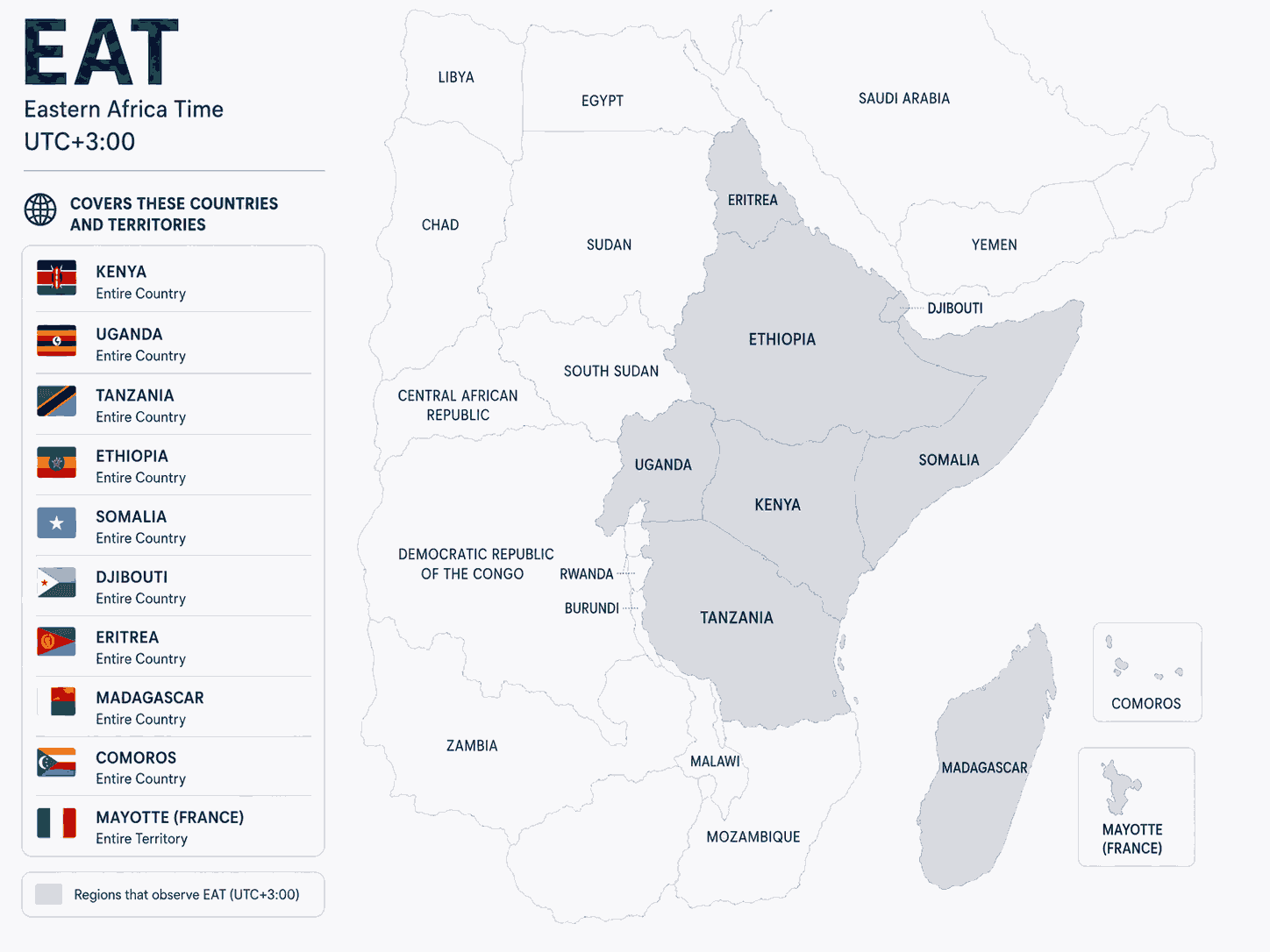
The map below highlights the specific regions, countries, and territories that observe the Eastern Africa Time time zone.
Understanding Eastern Africa Time (EAT)
Eastern Africa Time (EAT) operates at UTC+03:00, placing Nairobi 3 hours ahead of Coordinated Universal Time and at the center of one of the world's fastest-growing regional economic blocs. Kenya anchors the zone's technology ambitions: Nairobi's "Silicon Savannah" earned its name through M-Pesa, the mobile money platform launched by Safaricom that became the global template for fintech in emerging markets, and has since attracted a dense ecosystem of startups, venture capital, and multinational tech offices. Ethiopia contributes as the world's second-largest coffee producer and a major supplier to European specialty markets. Tanzania's port of Dar es Salaam and Kenya's port of Mombasa are critical nodes in the Indian Ocean shipping network connecting African commodity exporters to buyers across Asia and the Middle East. Together, these industries make EAT a time zone that commodity traders, logistics operators, fintech investors, and agricultural supply chain managers cannot afford to miscalculate.
Countries and Territories Observing EAT
EAT spans a broad swath of eastern Africa and the western Indian Ocean, covering seven nations across diverse geographies — from the Ethiopian highlands to the Tanzanian coast to the island of Madagascar.
- ✦Kenya, Ethiopia & Tanzania: These three economies carry the largest share of EAT's commercial weight. Kenya is East Africa's financial and technology capital. Ethiopia is the continent's second most populous nation and a major logistics hub anchored by Addis Ababa Bole International Airport, one of Africa's busiest. Tanzania contributes through Dar es Salaam's port, gold and mineral exports, and a fast-growing manufacturing base targeting regional markets.
- ✦Uganda & Madagascar: Uganda's capital Kampala has developed a growing fintech and startup ecosystem that complements Nairobi's regional leadership, while Madagascar's agricultural and textile exports contribute meaningfully to the EAT zone's trade profile. Both countries integrate seamlessly into EAT-based regional supply chain scheduling without offset friction.
- ✦Regional Alignment (UTC+3): EAT shares its exact UTC+03:00 offset with Arabia Standard Time (AST), which governs Saudi Arabia, the UAE, Qatar, and Kuwait. This alignment is commercially significant: the Gulf states are among East Africa's largest trading partners and foreign direct investment sources, and the zero-offset relationship means Nairobi and Dubai operate on the same clock — no conversion required for commodity pricing calls, investment discussions, or logistics coordination between the two regions.
Daylight Saving Time (DST) Rules
None of the countries observing EAT use Daylight Saving Time. All seven nations sit close to the equator, where the difference between the longest and shortest day of the year is measured in minutes rather than hours — seasonal clock changes would produce no meaningful alignment benefit. EAT remains permanently fixed at UTC+03:00 every day of the year. For the industries that run on EAT, this permanence removes a recurring scheduling variable: tea auction schedules at the Mombasa Tea Auction (the world's largest), shipping container dispatch windows at East African ports, and M-Pesa transaction processing windows that interface with global banking systems all operate against a clock that never shifts.
| Major Regional Cities (UTC+3) | Country | DST Observed? |
|---|---|---|
| Nairobi | Kenya | No |
| Addis Ababa | Ethiopia | No |
| Dar es Salaam | Tanzania | No |
| Kampala | Uganda | No |
Global Business Guide
EAT's UTC+03:00 position creates strong natural overlap with Europe and the Middle East, a workable but compressed window with Asia, and a structurally difficult relationship with the Americas.
Europe & Middle East — the core collaboration zone: EAT's best scheduling conditions run westward. London (GMT, UTC+0) is 3 hours behind EAT, placing Nairobi's full business day (08:00–17:00 EAT) in near-perfect alignment with the London afternoon and early morning. Central European Time (CET, UTC+1) is 2 hours behind — even tighter. Dubai and Riyadh (AST, UTC+3) are on the exact same clock as Nairobi. This creates a seamless, frictionless business corridor across the Middle East and into Europe that covers the agricultural export trade, private equity deal flow, and development finance coordination that defines much of East Africa's external economic relationships.
Asia: EAT mornings align with Asian afternoons. At 09:00–12:00 EAT, Mumbai (IST, UTC+5:30) is at 11:30–14:30 and Singapore (SGT, UTC+8) is at 17:00–20:00. The India window is productive for IT services and outsourcing coordination. The Singapore and Hong Kong windows are tight — catchable at EAT's midday, but requiring Asia-Pacific counterparts to extend into evening. Chinese working hours (CST, UTC+8) follow the same pattern as Singapore, with the overlap concentrated around EAT's midday.
Americas: The most structurally difficult corridor. At New York's business open (09:00 EST, UTC-5), it is already 17:00 EAT — end of the Nairobi business day. During US Eastern Daylight Time (EDT, UTC-4) in summer, the EAT–EST gap narrows to 7 hours, but the overlap remains extremely narrow. Businesses managing EAT–Americas relationships typically schedule fixed early-evening calls in Nairobi (17:00–19:00 EAT) that correspond to mid-morning in New York (09:00–11:00 EST), or rely on structured asynchronous workflows with next-day turnaround commitments.
Frequently Asked Questions
Do East African countries observe Daylight Saving Time?
None of the countries observing Eastern Africa Time use Daylight Saving Time. Situated close to the equator, these nations experience minimal seasonal variation in daylight hours, making clock changes unnecessary — EAT remains permanently fixed at UTC+03:00 throughout the year.
Which major countries use Eastern Africa Time (EAT)?
Eastern Africa Time is observed by Kenya, Ethiopia, Tanzania, Uganda, Madagascar, Somalia, and Djibouti. Among these, Kenya and Ethiopia are the zone's two largest economies, with Nairobi and Addis Ababa serving as the primary financial and administrative centers.
Need to schedule a meeting?
Use our dedicated converter pages to find the perfect overlap time across different time zones.