
Current Time in Fiji Time (FJT)
Fiji Time (FJT) is 12 hours ahead of Coordinated Universal Time (UTC+12:00). It serves as the standard time zone for the entire island nation of Fiji.
Current Fiji Time (FJT) Time
Date: ... · Your Local Time: ...
Fiji Time Geographical Coverage
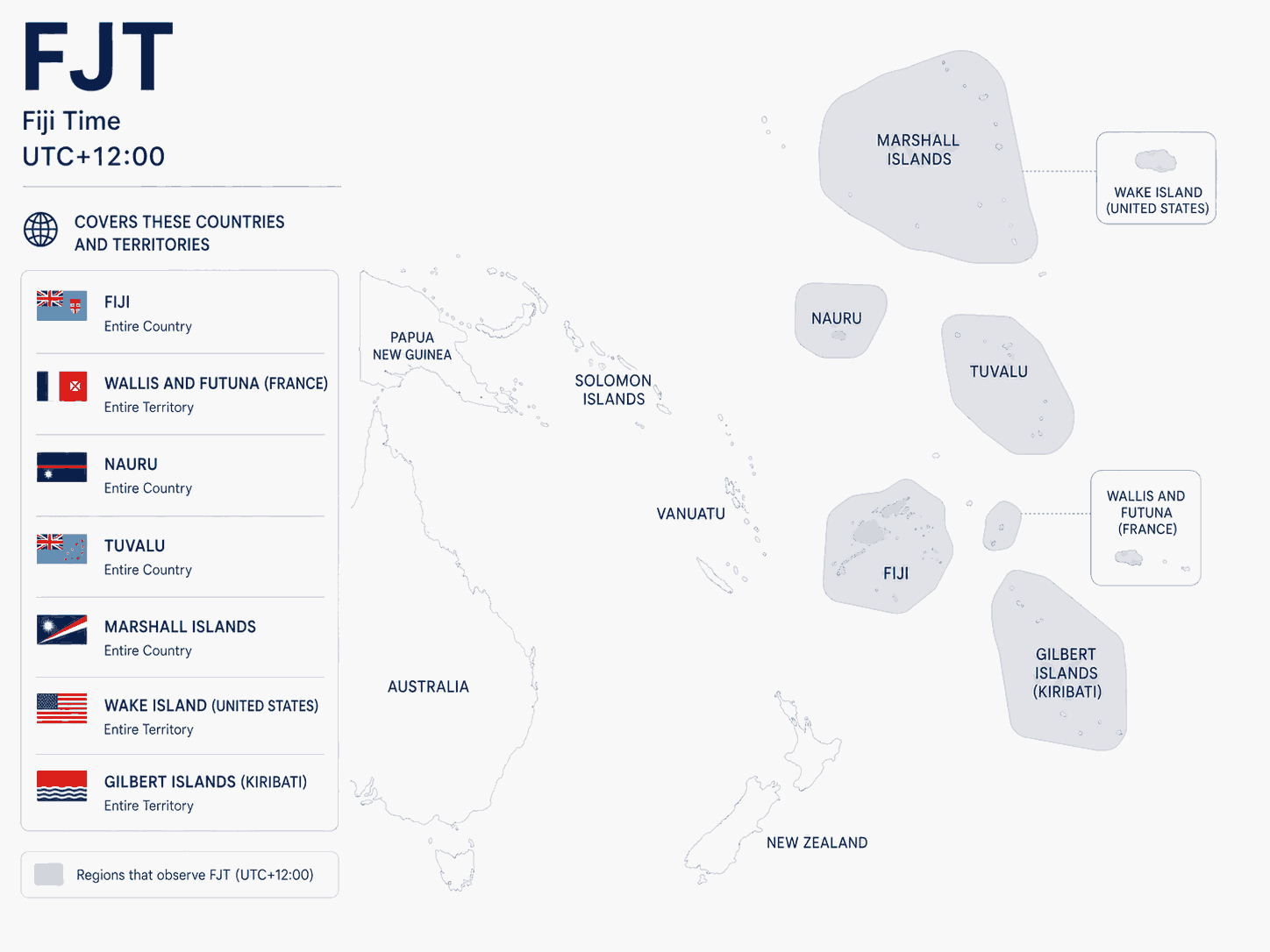
The map below highlights the specific regions, countries, and territories that observe the Fiji Time time zone.
Understanding Fiji Time (FJT)
Fiji Time (FJT) operates at UTC+12:00, placing Suva among the first major inhabited locations on Earth to begin each calendar day — a geographic and temporal position that is more commercially significant than it might initially appear. Tourism is Fiji's largest industry by GDP contribution, drawing visitors primarily from Australia, New Zealand, and North America to a resort and hospitality infrastructure that operates around the clock across Nadi's international gateway and hundreds of island properties. Agricultural exports — particularly sugar and the premium bottled water brands that have turned Fiji's aquifer into a globally recognized commodity — contribute meaningfully to foreign exchange earnings. And increasingly, Suva and the broader urban economy are developing a Business Process Outsourcing (BPO) and IT support sector that exploits FJT's extreme offset deliberately: Fijian BPO teams working standard daytime hours are processing overnight workloads for North American and European clients whose business day has already ended. That follow-the-sun dynamic is what makes UTC+12:00 not just a geographic curiosity but a structural outsourcing advantage.
Countries and Territories Observing FJT
FJT applies exclusively to the Republic of Fiji — an archipelago of more than 330 islands spread across roughly 1.3 million square kilometers of the South Pacific, with the two largest islands, Viti Levu and Vanua Levu, accounting for the vast majority of population and economic activity.
- ✦The Republic of Fiji: Every island in the Fijian archipelago operates on the same UTC+12:00 clock, from Nadi International Airport on Viti Levu's western coast to the administrative capital Suva on its southeastern shore and across to Vanua Levu in the north. This single-zone uniformity simplifies inter-island ferry and aviation scheduling, synchronizes resort check-in and hospitality operations across properties in different island groups, and gives the BPO sector a consistent, predictable work schedule that international clients can plan against without accounting for domestic offset variations.
- ✦Regional Alignment (UTC+12): FJT shares its UTC+12:00 standard offset with New Zealand Standard Time (NZST), the Marshall Islands (MHT), and Tuvalu (TVT). The New Zealand alignment is commercially the most significant: Auckland is Fiji's primary regional financial center and source of foreign direct investment, and when both countries are on UTC+12:00 during New Zealand's winter months, the two economies operate on an identical clock. Note that New Zealand shifts to UTC+13:00 during its summer under NZDT, placing Auckland one hour ahead of Suva for roughly half of each year — a seasonal divergence that Fiji-based businesses with Auckland partners need to track.
Daylight Saving Time (DST) Rules
Fiji permanently abolished Daylight Saving Time in 2021, ending an on-again, off-again relationship with seasonal clock changes that dated back to 1998. FJT now holds at UTC+12:00 every day of the year without exception. For the industries that depend on it, this permanence resolves a recurring operational headache: international airlines scheduling connections through Nadi no longer need to update slot times twice a year, resort groups managing global reservation systems no longer face biannual clock-change reconciliation, and BPO operators selling "follow-the-sun" overnight coverage to North American clients can guarantee a fixed, unchanging handoff time rather than one that shifts seasonally.
| Major Regional Cities (UTC+12) | Country | DST Observed? |
|---|---|---|
| Suva | Fiji | No |
| Nadi | Fiji | No |
| Auckland (Winter) | New Zealand | Yes |
| Majuro | Marshall Islands | No |
Global Business Guide
FJT's UTC+12:00 position is one of the most extreme in this directory — exceptionally well-placed for Australasian trade and follow-the-sun outsourcing, and structurally isolated from real-time collaboration with Europe and much of Asia.
Australasia — the natural trading zone: Sydney (AEDT, UTC+11) is one hour behind FJT in Australian summer and two hours behind (AEST, UTC+10) in Australian winter, keeping Fiji and Australia within a narrow, workable band year-round. Auckland (NZST, UTC+12) aligns exactly with FJT during New Zealand's winter months, creating a zero-offset window that covers the most active period of trans-Tasman financial and trade activity. These relationships define Fiji's primary commercial corridor: Australian and New Zealand tourists, investors, and importers interact with Fijian counterparts across time gaps that rarely exceed two hours in either direction.
Follow-the-sun outsourcing — the structural advantage: FJT's most distinctive commercial application is the one least obvious to a casual observer. When a North American business ends its workday at 17:00 EST (UTC-5), it is 10:00 the following morning FJT — Fijian BPO teams are already two hours into their business day. Overnight customer support tickets, data processing batches, and IT monitoring tasks submitted at New York close of business are available for action in Fiji's morning without either party working outside standard hours. This follow-the-sun model works cleanest for US East Coast clients: the handoff from New York to Suva is clean, predictable, and requires no overlap window at all — the work is simply waiting at Fiji's 08:00 open.
Europe — no practical live overlap: At London's business open (09:00 GMT, UTC+0), it is 21:00 FJT in Suva — late evening. Frankfurt (CET, UTC+1) opens to find Fiji at 22:00. There is no workable live business-hour window between FJT and any major European time zone during standard hours. European companies with Fijian operations — primarily in the hospitality investment and tourism sectors — coordinate through structured async workflows, designated liaison staff in Australian offices that bridge the gap, or infrequent live calls that require one side to work significantly outside core hours.
Frequently Asked Questions
Does Fiji observe Daylight Saving Time?
Fiji officially abolished Daylight Saving Time in 2021, ending a practice it had observed intermittently since 1998. FJT now remains permanently fixed at UTC+12:00 throughout the entire year, with no seasonal clock changes.
Are Fiji Time (FJT) and New Zealand Time (NZST) the same?
FJT and New Zealand Standard Time (NZST) share the exact same UTC+12:00 offset during the Southern Hemisphere winter months, meaning Suva and Auckland run on identical clocks during that period. However, New Zealand shifts to UTC+13:00 during its summer under New Zealand Daylight Time (NZDT), while Fiji stays fixed at UTC+12:00 year-round — placing the two zones one hour apart for roughly half of each year.
Need to schedule a meeting?
Use our dedicated converter pages to find the perfect overlap time across different time zones.